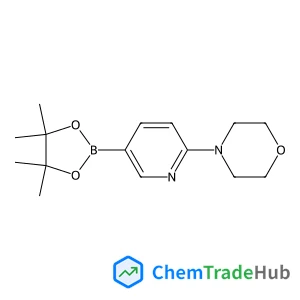
4-(5-(4,4,5,5-tetramethyl-1,3,2-dioxaborolan-2-yl)pyridin-2-yl)morpholine
CAS Number:
485799-04-0
Molecular Formula:
C15H23BN2O3
Courtney N. Talicska, Eamon C. O'Connell, Howard W. Ward, Angel R. Diaz, Mark A. Hardink, Douglas Connolly, Kevin P. Girard, Tomislav Ljubicic
As flow processes are being increasingly utilized for development of active pharmaceutical ingredients (APIs), the importance of process analytical technology (PAT) in the pharmaceutical industry is growing. Here, we describe a variety of PAT tools (FTIR, on-line UPLC-MS, flow NMR) used in support of flow chemistry platforms at Pfizer as part of the Flexible API Supply Technology (FAST) initiative. A blend of qualitative and quantitative PAT approaches are described, with each method tailored to the specific aims of each individual platform. PAT is demonstrated to be beneficial for real-time process understanding and for rapid optimization of chemical reactions in the flow-chemistry space, reducing the need for off-line analytics and helping to accelerate development timelines.
Weiwei Ju, Shuai Zhang, Caijuan Xia
DOI: 10.1039/C9CP05185F
Hassan Ghermezcheshme, Hesam Makki, Mohsen Mohseni, Morteza Ebrahimi
DOI: 10.1039/D0CP04244G
A. I. Lozano, L. S. Maioli, B. Pamplona, M. Mendes, F. Ferreira da Silva, F. Kossoski, D. Süβ, M. H. F. Bettega, G. García, P. Limão-Vieira
DOI: 10.1039/D0CP02570D
Karol Rytel, Kamil Kędzierski, Bolesław Barszcz, Małgorzata Widelicka, Alicja Stachowiak, Andrzej Biadasz, Łukasz Majchrzycki, Emerson Coy, Danuta Wróbel
DOI: 10.1039/D0CP90227F
DOI: 10.1039/D0CP02470H
Fuping Wang, Lang Chen, Deshen Geng, Jianying Lu, Junying Wu
DOI: 10.1039/D0CP02796K
Liu-Cheng Chen, Hui Yang, Ming-An Fu, Jia Cheng, Xiao-Lin Wu, Yun Gao, Zhong-Bing Huang, Xiao-Jia Chen
DOI: 10.1039/C9CP04227J
Aniket A. Hande, Clovis Darrigan, Paulina Bartos, Patrick Baylère, Anna Chrostowska
DOI: 10.1039/D0CP03896B
A. Bellili, M. C. Gazeau, Y. Bénilan, N. Fray, J. C. Guillemin, M. Hochlaf, M. Schwell
DOI: 10.1039/C9CP04310A
Domenico Alberga, Ilaria Ciofini
DOI: 10.1039/D0CP03038D
Waste containing 2-Ethyl-4-Methyl-1H-Imidazole-5-Carbaldehyde (CAS: 88634-80-4) ...
Triethoxy(octyl)silane (CAS: 1385031-14-0) is widely used in the pharmaceuticals...
Several alternatives to 3-iodo-7-nitro-1H-indazole (CAS: 864724-64-1) exist in t...
Yes, there are alternatives to Benzene, bis[(trimethoxysilyl)ethyl] (CAS: 266317...
Isothiazole-3-carbonitrile (CAS: 1452-17-1) is generally considered safe when us...
(3-Chlorophenyl)methanol (CAS: 873-63-2) is considered low to moderately toxic. ...
(2S,3S)-2-Hydroxy-3-({[(2-methyl-2-propanyl)oxy]carbonyl}amino)-3-(2-naphthyl)pr...
Proper handling of methyl 2-(bromomethyl)-5-methoxybenzoate requires the use of ...
6,8-Dibromoimidazo[1,2-a]pyridine-2-carboxylic acid (CAS: 904805-36-3) is an aro...
3-Amino-5-bromo-2-pyridinecarbonitrile is considered safe when handled under pro...

Reaction Chemistry & Engineering is an interdisciplinary journal reporting cutting-edge research focused on enhancing the understanding and efficiency of reactions. Reaction engineering leverages the interface where fundamental molecular chemistry meets chemical engineering and technology. Challenges in chemistry can be overcome by the application of new technologies, while engineers may find improved solutions for process development from the latest developments in reaction chemistry. Reaction Chemistry & Engineering is a unique forum for researchers whose interests span the broad areas of chemical engineering and chemical sciences to come together in solving problems of importance to wider society. All papers should be written to be approachable by readers across the engineering and chemical sciences. Papers that consider multiple scales, from the laboratory up to and including plant scale, are particularly encouraged.