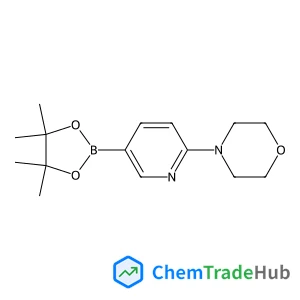
4-(5-(4,4,5,5-tetramethyl-1,3,2-dioxaborolan-2-yl)pyridin-2-yl)morpholine
CAS Number:
485799-04-0
Molecular Formula:
C15H23BN2O3
Domenico Alberga, Ilaria Ciofini
The field of organic photovoltaics has witnessed a steady growth in the last few decades and a recent renewal with the blossoming of single-material organic solar cells (SMOSCs). However, due to the intrinsic complexity of these devices (both in terms of their size and of the condensed phases involved), computational approaches to accurately predict their geometrical and electronic structure and to link their microscopic properties to the observed macroscopic behaviour are still lacking. In this work, we have focused on the rationalization of transport dynamics and we have set up a computational approach that makes a combined use of classical simulations and Density Functional Theory with the aim of disclosing the most relevant electronic and structural features of dyads used for SMOSC applications. As a prototype dyad, we have considered a molecule that consists in a dithiafulvalene-functionalized diketopyrrolopyrrole (DPP), acting as an electron donor, covalently linked to a fulleropyrrolidine (Ful), the electron acceptor. Our results, beside a quantitative agreement with experiments, show that the overall observed mobilities result from the competing packing mechanisms of the constituting units within the dyad both in the case of crystalline and amorphous phases. As a consequence, not all stable polymorphs have the same efficiency in transporting holes or electrons which often results in a highly directional carrier transport that is not, in general, a desirable feature for polycrystalline thin-films. The present work, linking microscopic packing to observed transport, thus opens the route for the in silico design of new dyads with enhanced and controlled structural and electronic features.
Martin Kabeláč
DOI: 10.1039/B819350A
Juanjuan Gao, Shuangyang Li, Xianren Zhang, Wenchuan Wang
DOI: 10.1039/B918449J
R.-P. Baumann, M. Schranz
DOI: 10.1039/B919729J
Rajib Pramanik, Souravi Sarkar, Chiranjib Ghatak, Palash Setua, Nilmoni Sarkar
DOI: 10.1039/B922867E
Patrick Bultinck, David L. Cooper, Dimitri Van Neck
DOI: 10.1039/B821734C
Zhi-Hong Wang, Daniel Käfer, Asif Bashir, Jan Götzen, Alexander Birkner, Gregor Witte, Christof Wöll
DOI: 10.1039/B924230A
Ilko Bald, Sigrid Weigelt, Xiaojing Ma, Pengyang Xie, Ramesh Subramani, Mingdong Dong, Chen Wang, Wael Mamdouh, Jianguo Wang, Flemming Besenbacher
DOI: 10.1039/B924098E
Ryo Akiyama, Yasuhito Karino, Hokuto Obama, Ayako Yoshifuku
DOI: 10.1039/B921314G
Patricio F. Provasi, Stephan P. A. Sauer
DOI: 10.1039/B819376B
Waste containing 2-Ethyl-4-Methyl-1H-Imidazole-5-Carbaldehyde (CAS: 88634-80-4) ...
Triethoxy(octyl)silane (CAS: 1385031-14-0) is widely used in the pharmaceuticals...
Several alternatives to 3-iodo-7-nitro-1H-indazole (CAS: 864724-64-1) exist in t...
Yes, there are alternatives to Benzene, bis[(trimethoxysilyl)ethyl] (CAS: 266317...
Isothiazole-3-carbonitrile (CAS: 1452-17-1) is generally considered safe when us...
(3-Chlorophenyl)methanol (CAS: 873-63-2) is considered low to moderately toxic. ...
(2S,3S)-2-Hydroxy-3-({[(2-methyl-2-propanyl)oxy]carbonyl}amino)-3-(2-naphthyl)pr...
Proper handling of methyl 2-(bromomethyl)-5-methoxybenzoate requires the use of ...
6,8-Dibromoimidazo[1,2-a]pyridine-2-carboxylic acid (CAS: 904805-36-3) is an aro...
3-Amino-5-bromo-2-pyridinecarbonitrile is considered safe when handled under pro...

Physical Chemistry Chemical Physics (PCCP) is an international journal co-owned by 19 physical chemistry and physics societies from around the world. This journal publishes original, cutting-edge research in physical chemistry, chemical physics and biophysical chemistry. To be suitable for publication in PCCP, articles must include significant innovation and/or insight into physical chemistry; this is the most important criterion that reviewers and Editors will judge against when evaluating submissions. The journal has a broad scope and welcomes contributions spanning experiment, theory, computation and data science. Topical coverage includes spectroscopy, dynamics, kinetics, statistical mechanics, thermodynamics, electrochemistry, catalysis, surface science, quantum mechanics, quantum computing and machine learning. Interdisciplinary research areas such as polymers and soft matter, materials, nanoscience, energy, surfaces/interfaces, and biophysical chemistry are welcomed if they demonstrate significant innovation and/or insight into physical chemistry. Joined experimental/theoretical studies are particularly appreciated when complementary and based on up-to-date approaches.