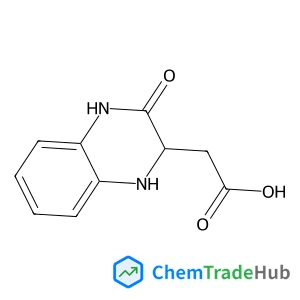
(3-Oxo-1,2,3,4-tetrahydro-2-quinoxalinyl)acetic acid
CAS Number:
136584-14-0
Molecular Formula:
C10H10N2O3
Zihnil A. I. Mazrad, May Lai, Thomas P. Davis, Joseph A. Nicolazzo, Meike N. Leiske
Polymers bearing amine moieties are highly valuable for their ability to conjugate and/or complex a variety of molecules. However, their incorporation into synthetic macromolecules remains challenging. Poly(2-oxazolines) (POx) are a highly functional class of polymers, which through the choice of polymerization components or post-polymerization modifications, can be furnished with a large range of functional groups. Here, we explored their potential for the preparation of α-amine telechelic macromolecules through a comprehensive comparison of different amine-containing cationic ring-opening polymerization (CROP) initiators comprised of the amine protecting groups tert-butyloxycarbonyl (BOC) and phthalimide and the counterions tosylate (Tos) and bromide (Br). Polymerization kinetics of 2-ethyl-2-oxazoline (EtOx) and stability tests revealed the commercially available phthalimide-NH2-C3-Br as the most suitable initiator for achieving the highest degree of control over the polymerization. The polymerization initiated by this new initiator at 140 °C under microwave irradiation was characterized by a stable protected amine group, and fast initiation, and delivered well-defined poly(2-ethyl-2-oxazoline)s (PEtOx). α-Amine telechelic PEtOx were subsequently synthesized using different terminating agents, enabling the future preparation of tailored aminated POx-based architectures.
Kelei Zhuo, Yujuan Chen, Jing Chen, Guangyue Bai, Jianji Wang
DOI: 10.1039/C1CP20948E
I. Panas
DOI: 10.1039/C0CP02132F
Abu Md Asaduzzaman, Georg Schreckenbach
DOI: 10.1039/C1CP21168D
Yoshihiko Kanemitsu
DOI: 10.1039/C1CP21235D
Athi N. Naganathan
DOI: 10.1039/C1CP20964G
Srinivasan Anandan, Masahiro Miyauchi
DOI: 10.1039/C1CP21514K
Shinobu Gonsui, Tetsuya Tsuda, Ken-ichi Fukui
DOI: 10.1039/C1CP20643E
Cunku Dong, Jingyao Qi
DOI: 10.1039/C1CP21030K
Christine Cézard, Frédéric Aubry, Florence Djedaïni-Pilard, François-Yves Dupradeau
DOI: 10.1039/C1CP20854C
Natalya Schmerl, Gunther Andersson
DOI: 10.1039/C1CP20734B
This compound is mainly used as an intermediate in the synthesis of antipsychoti...
Waste containing 1-(D-Ribofuranosyl)-1,4-dihydro-3-pyridinecarboxamide (CAS: 191...
2-Methyl-2-propanyl 3-bromo-3-(hydroxymethyl)-1-azetidinecarboxylate (CAS: 20079...
N-(4-Chloro-2-pyridinyl)acetamide (CAS: 245056-66-0) is a chemical compound with...
5-Chloro-2-hydroxybenzoic acid, also known as 5-chlorosalicylic acid, is an arom...
When handling 1,1-Dichloro-1-fluoroethane (CAS: 1717-00-6), it is important to u...
Fmoc-(2S,3R)-3-phenylpyrrolidine-2-carboxylic acid is a white crystalline solid ...
4-Amino-5-bromo-2-pyridinecarboxylic acid is primarily used as a precursor in th...
Handling this compound should be done with personal protective equipment (PPE) i...
When handling 8-bromo-2,2-dimethyl-3,4-dihydro-2H-1,4-benzoxazin-3-one, use prop...

Polymer Chemistry welcomes submissions in all areas of polymer science that have a strong focus on macromolecular chemistry. Manuscripts may cover a broad range of fields, yet no direct application focus is required.
![4-Chloro-3-(trifluoromethyl)-1H-pyrrolo[2,3-b]pyridine structure](https://static.chemtradehub.com/structs/869/869335-75-1-a9d0.webp "4-Chloro-3-(trifluoromethyl)-1H-pyrrolo[2,3-b]pyridine structure")