












Molecularly engineered dual-crosslinked elastomer vitrimers with superior strength, improved creep resistance, and retained malleability
Literature Information
Publication Date
2022-06-22
DOI
10.1039/D2PY00489E
Impact Factor
5.582
Authors
Lin Wang, Yunhe Qiao, Yuli Wang, Ziwen Cui, Shaoyi Zhu, Fuwei Dong, Sikun Fang, Aihua Du
View Original
Abstract
It is very challenging to prepare elastomer vitrimers that are both robust and dimensionally stable in service. To address this issue, we have initiated a multi-phase design of elastomer vitrimers by incorporating quadruple hydrogen bonds (H-bonds) into vitrimer networks. Specifically, commercialized styrene–butadiene rubber (SBR) was functionalized with the synthesized 5-benzyl-3,6-dioxo-2-piperazineacetic acid (DKP) to introduce amide functionalities, which was then crosslinked by dimercapto-borate via thiol–ene “click” chemistry. The H-bonds between amide moieties functioned as sacrificial units, which could undergo reversible breakage and recombination events, and therefore improve the modulus, ultimate strength, and toughness simultaneously. Moreover, with an aromatic ring and a symmetrical amide group in the structure, the grafted DKP could self-assemble via hydrogen bonds, leading to the formation of a microphase-separated structure in the elastomer matrix. Besides, the creep resistance was improved as the H-bonds were physical crosslinks that imposed additional constraints on chain segment diffusion. Nevertheless, the reprocessability of the network was not affected as the H-bonds and boronic ester crosslinks could dissociate and exchange at elevated temperatures, respectively.
Related Literature
Structural characterization and DFT study of VIVO(acac)2 in imidazolium ionic liquids
Andreia Mota, Jason P. Hallett, Maxim L. Kuznetsov, Isabel Correia
2011-07-25
Paper
DOI: 10.1039/C1CP20800D
Intramolecular charge transfer and dual fluorescence of 4-(dimethylamino)benzonitrile: ultrafast branching followed by a two-fold decay mechanism‡
Pedro B. Coto, Luis Serrano-Andrés, Thomas Gustavsson, Takashige Fujiwara, Edward C. Lim
2011-07-18
Paper
DOI: 10.1039/C1CP21089K
Experimental and theoretical study of the metastable decay of negatively charged nucleosides in the gas phase
Helga Dögg Flosadóttir, Hannes Jónsson, Snorri Th. Sigurdsson, Oddur Ingólfsson
2011-07-18
Paper
DOI: 10.1039/C1CP21298B
Synthesis of Ge-imogolite: influence of the hydrolysis ratio on the structure of the nanotubes
L. Olivi, C. Dominici, F. Ziarelli
2011-07-12
Paper
DOI: 10.1039/C1CP20346K
Molecular dynamics studies of native and substituted cyclodextrins in different media: 1. Charge derivation and force field performances
Christine Cézard, Frédéric Aubry, Florence Djedaïni-Pilard, François-Yves Dupradeau
2011-07-26
Paper
DOI: 10.1039/C1CP20854C
X-ray photoelectron spectroscopy of pyrrolidinium-based ionic liquids: cation–anion interactions and a comparison to imidazolium-based analogues
Shuang Men, Kevin R. J. Lovelock, Peter Licence
2011-07-22
Paper
DOI: 10.1039/C1CP21053J
Depolarization of water in protic ionic liquids
Stefan Zahn, Katharina Wendler, Luigi Delle Site, Barbara Kirchner
2011-07-18
Paper
DOI: 10.1039/C1CP20288J
Diffusional effects on the reversible excited-state proton transfer. From experiments to Brownian dynamics simulations‡
Alexander V. Popov, Elizabeth-Ann Gould, Michael A. Salvitti, Rigoberto Hernandez, Kyril M. Solntsev
2011-07-14
Paper
DOI: 10.1039/C1CP20952C
You might also like
Compound Q&A
What are the main uses of 1-(3-Aminophenyl)-3-[(3R)-1-(3,3-dimethyl-2-oxobutyl)-2-oxo-5-(2-pyridinyl)-2,3-dihydro-1H-1,4-benzodiazepin-3-yl]urea (CAS: 155412-88-7)?
This compound is mainly used as an intermediate in the synthesis of antipsychoti...
155412-88-71-(3-Aminophenyl)-3-...
Compound Q&A
How should waste containing 1-(D-Ribofuranosyl)-1,4-dihydro-3-pyridinecarboxamide (CAS: 19132-12-8) be handled?
Waste containing 1-(D-Ribofuranosyl)-1,4-dihydro-3-pyridinecarboxamide (CAS: 191...
19132-12-81-(D-Ribofuranosyl)-...
Compound Q&A
What regulatory guidelines apply to 2-Methyl-2-propanyl 3-bromo-3-(hydroxymethyl)-1-azetidinecarboxylate (CAS: 2007919-81-3)?
2-Methyl-2-propanyl 3-bromo-3-(hydroxymethyl)-1-azetidinecarboxylate (CAS: 20079...
2007919-81-32-Methyl-2-propanyl ...
Compound Q&A
What is N-(4-Chloro-2-pyridinyl)acetamide (CAS: 245056-66-0)?
N-(4-Chloro-2-pyridinyl)acetamide (CAS: 245056-66-0) is a chemical compound with...
245056-66-0N-(4-Chloro-2-pyridi...
Compound Q&A
What is 5-Chloro-2-hydroxybenzoic acid (CAS: 321-14-2)?
5-Chloro-2-hydroxybenzoic acid, also known as 5-chlorosalicylic acid, is an arom...
321-14-25-Chloro-2-hydroxybe...
Compound Q&A
What precautions should be taken when handling 1,1-Dichloro-1-fluoroethane (CAS: 1717-00-6)?
When handling 1,1-Dichloro-1-fluoroethane (CAS: 1717-00-6), it is important to u...
1717-00-61,1-Dichloro-1-fluor...
Compound Q&A
What are the physical and chemical properties of Fmoc-(2S,3R)-3-phenylpyrrolidine-2-carboxylic acid (CAS: 281655-32-1)?
Fmoc-(2S,3R)-3-phenylpyrrolidine-2-carboxylic acid is a white crystalline solid ...
281655-32-1Fmoc-(2S,3R)-3-pheny...
Compound Q&A
What are the main uses of 4-Amino-5-bromo-2-pyridinecarboxylic acid (CAS: 1363381-01-4)?
4-Amino-5-bromo-2-pyridinecarboxylic acid is primarily used as a precursor in th...
1363381-01-44-Amino-5-bromo-2-py...
Compound Q&A
What precautions should be taken when handling (S)-tert-butyl 2-((2-(4-bromophenyl)-2-oxoethyl)carbamoyl)pyrrolidine-1-carboxylate (CAS: 1007881-98-2)?
Handling this compound should be done with personal protective equipment (PPE) i...
1007881-98-2(S)-tert-butyl 2-((2...
Compound Q&A
What precautions should be taken when handling 8-bromo-2,2-dimethyl-3,4-dihydro-2H-1,4-benzoxazin-3-one (CAS: 688363-73-7)?
When handling 8-bromo-2,2-dimethyl-3,4-dihydro-2H-1,4-benzoxazin-3-one, use prop...
688363-73-78-bromo-2,2-dimethyl...
Source Journal
Polymer Chemistry

CiteScore:
8.6
Self-citation Rate:
7.3%
Articles per Year:
457
Polymer Chemistry welcomes submissions in all areas of polymer science that have a strong focus on macromolecular chemistry. Manuscripts may cover a broad range of fields, yet no direct application focus is required.
Recommended Compounds

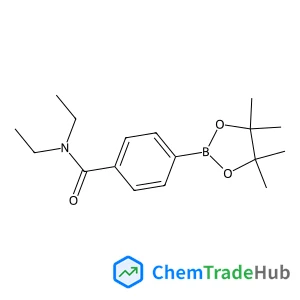
N,N-Diethyl-4-(4,4,5,5-tetramethyl-1,3,2-dioxaborolan-2-yl)benzamide
CAS Number:
325142-99-2
Molecular Formula:
C17H26BNO3
Recommended Suppliers





Disclaimer
This page provides academic journal information for reference and research purposes only. We are not affiliated with any journal publishers and do not handle publication submissions. For publication-related inquiries, please contact the respective journal publishers directly.
If you notice any inaccuracies in the information displayed, please contact us at support@chemtradehub.com. We will promptly review and address your concerns.