












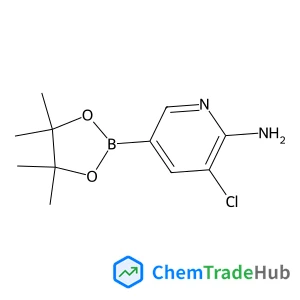
3-Chloro-5-(4,4,5,5-tetramethyl-1,3,2-dioxaborolan-2-yl)-2-pyridinamine
CAS Number:
1032758-99-8
Molecular Formula:
C11H16BClN2O2
Stefan Zahn, Katharina Wendler, Luigi Delle Site, Barbara Kirchner
A mixture of the protic ionic liquid mono-methylammonium nitrate with 1.6 wt% water was investigated from Car–Parrinello molecular dynamics simulations. In contrast to imidazolium-based ionic liquids, the cation possesses strong directional hydrogen bonds to water and all hydrogen bonds in the mixture have a comparable strength. This results in a good incorporation of water into the hydrogen bond network of mono-methylammonium nitrate and a tetrahedral hydrogen bond coordination of water. Hence, one might expect a larger dipole moment of water in the investigated mixture compared to neat water due to the good hydrogen bond network incorporation and the charged vicinity of water in the protic ionic liquid. However, the opposite is observed pointing to strong electrostatic screening in protic ionic liquids. Additionally, the influence of water on the properties of the protic ionic liquid is discussed.
Paul J. Koovits, Marco A. Dessoy, An Matheeussen, Louis Maes, Guy Caljon, Leonardo L. G. Ferreira, Rafael C. Chelucci, Simone Michelan-Duarte, Adriano D. Andricopulo, Simon Campbell, Jadel M. Kratz, Charles E. Mowbray, Luiz C. Dias
DOI: 10.1039/D0MD00165A
Shams Ul Mahmood, Huimin Cheng, Sreedhar R. Tummalapalli, Ramappa Chakrasali, Rammohan R. Yadav Bheemanaboina, Tamara Kreiss, Agnieska Chojnowski, Tyler Eck, John J. Siekierka, David P. Rotella
DOI: 10.1039/C9MD00511K
Virender Kumar Sharma, Ankur Biswas, Mayurika Lahiri, Sudipta Basu
DOI: 10.1039/D1MD00095K
XiXi Xu, Ariane Roseblade, Tristan Rawling, Alison T. Ung
DOI: 10.1039/C9MD00237E
Julia Fernández de Luco, Alejandro I. Recio-Balsells, Diego G. Ghiano, Ana Bortolotti, Juán Manuel Belardinelli, Nina Liu, Pascal Hoffmann, Christian Lherbet, Peter J. Tonge, Babu Tekwani
DOI: 10.1039/D0MD00291G
Larissa G. Maciel, Andrey da S. Barbosa, Edilson B. de Alencar-Filho, Thereza A. Soares, Janaína V. dos Anjos
DOI: 10.1039/D0MD00305K
Yuichiro Akao, Stacie Canan, Yafeng Cao, Kevin Condroski, Ola Engkvist, Sachiko Itono, Rina Kaki, Chiaki Kimura, Thierry Kogej, Kazuya Nagaoka, Akira Naito, Hiromi Nakai, Garry Pairaudeau, Constantin Radu, Ieuan Roberts, Mitsuyuki Shimada, David Shum, Nao-aki Watanabe, Huanxu Xie, Shuji Yonezawa, Osamu Yoshida, Ryu Yoshida, Charles Mowbray, Benjamin Perry
DOI: 10.1039/D0MD00353K
Hidetoshi Kajino, Tomomi Nagatani, Miku Oi, Atsuya Nishiyama, Makoto Nakanishi, Kenzo Yamatsugu, Shigehiro A. Kawashima, Motomu Kanai
DOI: 10.1039/D0CB00029A
This compound is mainly used as an intermediate in the synthesis of antipsychoti...
Waste containing 1-(D-Ribofuranosyl)-1,4-dihydro-3-pyridinecarboxamide (CAS: 191...
2-Methyl-2-propanyl 3-bromo-3-(hydroxymethyl)-1-azetidinecarboxylate (CAS: 20079...
N-(4-Chloro-2-pyridinyl)acetamide (CAS: 245056-66-0) is a chemical compound with...
5-Chloro-2-hydroxybenzoic acid, also known as 5-chlorosalicylic acid, is an arom...
When handling 1,1-Dichloro-1-fluoroethane (CAS: 1717-00-6), it is important to u...
Fmoc-(2S,3R)-3-phenylpyrrolidine-2-carboxylic acid is a white crystalline solid ...
4-Amino-5-bromo-2-pyridinecarboxylic acid is primarily used as a precursor in th...
Handling this compound should be done with personal protective equipment (PPE) i...
When handling 8-bromo-2,2-dimethyl-3,4-dihydro-2H-1,4-benzoxazin-3-one, use prop...

Physical Chemistry Chemical Physics (PCCP) is an international journal co-owned by 19 physical chemistry and physics societies from around the world. This journal publishes original, cutting-edge research in physical chemistry, chemical physics and biophysical chemistry. To be suitable for publication in PCCP, articles must include significant innovation and/or insight into physical chemistry; this is the most important criterion that reviewers and Editors will judge against when evaluating submissions. The journal has a broad scope and welcomes contributions spanning experiment, theory, computation and data science. Topical coverage includes spectroscopy, dynamics, kinetics, statistical mechanics, thermodynamics, electrochemistry, catalysis, surface science, quantum mechanics, quantum computing and machine learning. Interdisciplinary research areas such as polymers and soft matter, materials, nanoscience, energy, surfaces/interfaces, and biophysical chemistry are welcomed if they demonstrate significant innovation and/or insight into physical chemistry. Joined experimental/theoretical studies are particularly appreciated when complementary and based on up-to-date approaches.
![tert-Butyl N-[(2-chloropyridin-4-yl)methyl]carbamate structure](https://static.chemtradehub.com/structs/916/916210-27-0-9f95.webp "tert-Butyl N-[(2-chloropyridin-4-yl)methyl]carbamate structure")
![1-[3-(4-Morpholinylsulfonyl)phenyl]methanamine structure](https://static.chemtradehub.com/structs/933/933989-32-3-51af.webp "1-[3-(4-Morpholinylsulfonyl)phenyl]methanamine structure")



