












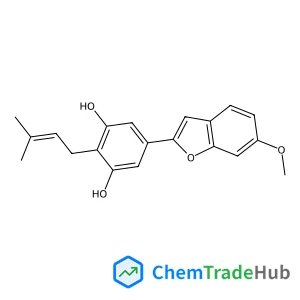
5-(6-Methoxy-1-benzofuran-2-yl)-2-(3-methyl-2-buten-1-yl)-1,3-benzenediol
CAS Number:
1017277-40-5
Molecular Formula:
C20H20O4
Tao Chen, Yujin Ji
Nitrogen doping is identified as an intriguing way to regulate graphene-supported single-atom catalysts (SACs) for heterogeneous catalysis. However, little theoretical effort has been directed towards exploring the activity trend in terms of N-doping level. In this study, we systematically investigated the N-doping effect on CO oxidation activities for graphene-supported three-coordinated Ni SACs (Ni–NxC3−x) in virtue of density functional theory (DFT) calculations and microkinetic modeling. We found that N-doping will shift the d-band center of single-atom Ni upwards, enhance the adsorption of intermediates, and tune the activation barrier to the overall reaction activities. Ni–N1C2 exhibits excellent catalytic performance with the highest total reaction rate comparable to that of noble metal SACs. These findings are helpful for understanding the N-doping influence and rationalizing the art of designing novel SACs for CO oxidation at low temperatures.
Jiahang Yan, Yanxia Zhen, Pengyan Wang, Yimeng Han, Huanhuan Zou, Junhan Chen, Weigang He
DOI: 10.1039/D3QO01898A
Jingli Zhang, Weipeng Xu, Du Wang, Ye Yuan, Yongqi Bai, Minyan Wang, Taolei Sun
DOI: 10.1039/D3QO01776A
José Francisco Rizo, Jesús F. Arteaga, Ludovic Favereau, Abel Ros, Uwe Pischel
DOI: 10.1039/D3QO01762A
Yuanrui Jiang, Wenjing Zhu, Jiawen Huang, Fan Luo, Xiaobei Chen, Chunhui Fang, Xin Chen, Shihui Liu, Yanwei Hu, Shilei Zhang
DOI: 10.1039/D3QO01109G
Xiaoxiang Zhang, Chenrui Liu, Wenwei Pang, Xiaoting Gu, Wanxing Wei, Zhuan Zhang, Haiyan Chen, Taoyuan Liang
DOI: 10.1039/D3QO01492D
Liangxin Fan, Mengyang He, Xinyuan Liu, Fangyu He, Lulu Wu, Guoyu Yang, Zhenliang Pan, Lijun Shi, Caixia Wang, Cuilian Xu
DOI: 10.1039/D3OB01437A
Feihu Cong, Wenjing Zhang, Gan Zhang, Jie Liu, Yicheng Zhang, Chao Zhou
DOI: 10.1039/D3OB01154B
Pavel Yu. Ushakov, Ivan S. Golovanov, Sema L. Ioffe, Andrey A. Tabolin
DOI: 10.1039/D3QO01664A
Yongjuan Jiao, Tao Wu, Xinyu Zhang
DOI: 10.1039/D3QO01537H
Meng Liu, Xinke Ouyang, Chenglong Xuan
DOI: 10.1039/D3QO01929B
When handling 2-Methyl-2-propanyl 5-amino-2-thiophenecarboxylate (CAS: 1498311-5...
5-Bromo-1,2-dichloro-3-fluorobenzene (CAS: 1000572-93-9) is a crystalline solid ...
(2R)-2-Amino-2-(4-bromophenyl)ethanol (CAS: 354153-64-3) should be stored in a c...
Methyl 4-(aminomethyl)tetrahydro-2H-pyran-4-carboxylate hydrochloride (CAS: 3627...
1,4-Dimethyl-1H-pyrazole-5-sulfonyl chloride is primarily used as an intermediat...
Dinaphtho[1,2-b:2',1'-d]furan is generally safe when handled with appropriate pe...
The market for 7-Methyl-7,9-dihydro-1H-purine-2,6,8(3H)-trione (CAS: 612-37-3) i...
2-(4-Chlorophenyl)malonaldehyde (CAS: 205676-17-1) is a colorless or light yello...
2-Methylchrysene (CAS: 3351-32-4) is typically synthesized via the reaction of c...
N-(6-aminopyrimidin-4-yl)acetamide (CAS: 89533-23-3) is generally considered saf...

Physical Chemistry Chemical Physics (PCCP) is an international journal co-owned by 19 physical chemistry and physics societies from around the world. This journal publishes original, cutting-edge research in physical chemistry, chemical physics and biophysical chemistry. To be suitable for publication in PCCP, articles must include significant innovation and/or insight into physical chemistry; this is the most important criterion that reviewers and Editors will judge against when evaluating submissions. The journal has a broad scope and welcomes contributions spanning experiment, theory, computation and data science. Topical coverage includes spectroscopy, dynamics, kinetics, statistical mechanics, thermodynamics, electrochemistry, catalysis, surface science, quantum mechanics, quantum computing and machine learning. Interdisciplinary research areas such as polymers and soft matter, materials, nanoscience, energy, surfaces/interfaces, and biophysical chemistry are welcomed if they demonstrate significant innovation and/or insight into physical chemistry. Joined experimental/theoretical studies are particularly appreciated when complementary and based on up-to-date approaches.
![3-[7-Amino-3-(3-pyridinyl)pyrazolo[1,5-a]pyrimidin-6-yl]phenol structure](https://static.chemtradehub.com/structs/861/861249-77-6-025b.webp "3-[7-Amino-3-(3-pyridinyl)pyrazolo[1,5-a]pyrimidin-6-yl]phenol structure")
![methyl 6-amino-1H-pyrrolo[2,3-b]pyridine-4-carboxylate structure](https://static.chemtradehub.com/structs/119/1190315-60-6-9d9a.webp "methyl 6-amino-1H-pyrrolo[2,3-b]pyridine-4-carboxylate structure")
![1-Oxa-8-azaspiro[4.5]decan-3-ol structure](https://static.chemtradehub.com/structs/757/757239-76-2-a0ec.webp "1-Oxa-8-azaspiro[4.5]decan-3-ol structure")




