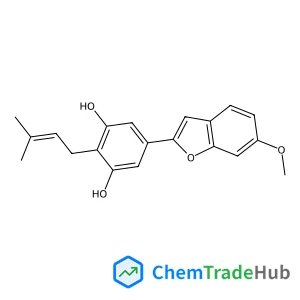
5-(6-Methoxy-1-benzofuran-2-yl)-2-(3-methyl-2-buten-1-yl)-1,3-benzenediol
CAS Number:
1017277-40-5
Molecular Formula:
C20H20O4
Jessica Wulfes, Ann-Katrin Baumann, Tobias Melchert, Carsten Schröder, Swetlana Schauermann
Microscopic-level understanding of the interaction of hydrocarbons with transition metal surfaces is an important prerequisite for rational design of new materials with improved catalytic properties. In this report, we present a mechanistic study on the keto–enol tautomerisation of butanal on Pd(111), which was theoretically predicted to play a crucial role in low-barrier hydrogenation of carbonyl compounds. These processes were addressed by a combination of reflection-absorption infrared spectroscopy, molecular beam techniques and theoretical calculations at the density functional theory level. Spectroscopic information obtained on Pd(111) suggests that butanal forms three different aldehyde species, which we indicate as A1–A3 as well as their enol counterpart E1. The electronically strongest perturbed and strongest binding species A1 is most likely related to the η2(C,O) adsorption configuration, in which both C and O atoms are involved in the bonding with the underlying metal. The species A2 weakly binds and is less electronically perturbed and can be associated with the η1(O) adsorption configuration. The third type of aldehyde species A3, which is nearly unperturbed and is found only at low temperatures, results from the formation of the butanal multilayer. Importantly, the enol form of butanal was observed on the surface, which gives rise to a new characteristic band at 1104 cm−1 related to the stretching vibration of the C–O single bond (ν(C–O)). With increasing temperature, the multi-layer related species A3 disappears from the surface above 136 K. The population of aldehyde species A1 and the enol species E1 noticeably increases with increasing temperature, while the band related to the aldehyde species A2 becomes strongly attenuated and finally completely disappears above 120 K. These observations suggest that species E1 and A1 are formed in an activated process and – in view of the strongly anti-correlated population of the species E1 and A2 – it can be concluded that enol species E1 is most likely formed from the weakly bound aldehyde species A2 (η1(O)). Finally, we discuss the possible routes to enol stabilization via intermolecular bonding and provide the possible structure of the enol-containing stabilized complex, which is compatible with all spectroscopic observations. The obtained results provide important insights into the process of keto–enol tautomerisation of simple carbonyl compounds.
DOI: 10.1039/C003389H
DOI: 10.1039/B821452B
Qiuju Zhang, Liang Chen, Ping Cui, Xiaoqing Pan
DOI: 10.1039/B925764K
Zhen Yang, Xiaoning Yang, Zhijun Xu, Shuyan Liu
DOI: 10.1039/B821328C
Josh J. Newby, Christian W. Müller, Ching-Ping Liu, Timothy S. Zwier
DOI: 10.1039/B903830B
William M. Ames, Sarah C. Larsen
DOI: 10.1039/B905750A
Sergey P. Laptenok, Katharine M. Mullen, Ivo H. M. van Stokkum
DOI: 10.1039/B919700A
When handling 2-Methyl-2-propanyl 5-amino-2-thiophenecarboxylate (CAS: 1498311-5...
5-Bromo-1,2-dichloro-3-fluorobenzene (CAS: 1000572-93-9) is a crystalline solid ...
(2R)-2-Amino-2-(4-bromophenyl)ethanol (CAS: 354153-64-3) should be stored in a c...
Methyl 4-(aminomethyl)tetrahydro-2H-pyran-4-carboxylate hydrochloride (CAS: 3627...
1,4-Dimethyl-1H-pyrazole-5-sulfonyl chloride is primarily used as an intermediat...
Dinaphtho[1,2-b:2',1'-d]furan is generally safe when handled with appropriate pe...
The market for 7-Methyl-7,9-dihydro-1H-purine-2,6,8(3H)-trione (CAS: 612-37-3) i...
2-(4-Chlorophenyl)malonaldehyde (CAS: 205676-17-1) is a colorless or light yello...
2-Methylchrysene (CAS: 3351-32-4) is typically synthesized via the reaction of c...
N-(6-aminopyrimidin-4-yl)acetamide (CAS: 89533-23-3) is generally considered saf...

Physical Chemistry Chemical Physics (PCCP) is an international journal co-owned by 19 physical chemistry and physics societies from around the world. This journal publishes original, cutting-edge research in physical chemistry, chemical physics and biophysical chemistry. To be suitable for publication in PCCP, articles must include significant innovation and/or insight into physical chemistry; this is the most important criterion that reviewers and Editors will judge against when evaluating submissions. The journal has a broad scope and welcomes contributions spanning experiment, theory, computation and data science. Topical coverage includes spectroscopy, dynamics, kinetics, statistical mechanics, thermodynamics, electrochemistry, catalysis, surface science, quantum mechanics, quantum computing and machine learning. Interdisciplinary research areas such as polymers and soft matter, materials, nanoscience, energy, surfaces/interfaces, and biophysical chemistry are welcomed if they demonstrate significant innovation and/or insight into physical chemistry. Joined experimental/theoretical studies are particularly appreciated when complementary and based on up-to-date approaches.
![N-[(1-Ethyl-2-pyrrolidinyl)methyl]-2-hydroxy-5-sulfamoylbenzamide structure](https://static.chemtradehub.com/structs/673/67381-52-6-877f.webp "N-[(1-Ethyl-2-pyrrolidinyl)methyl]-2-hydroxy-5-sulfamoylbenzamide structure")