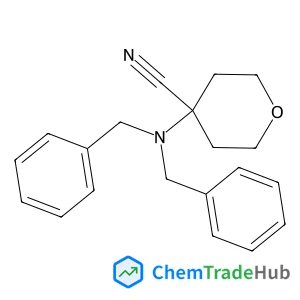
4-(Dibenzylamino)tetrahydro-2H-pyran-4-carbonitrile
CAS Number:
1630906-81-8
Molecular Formula:
C20H22N2O
Sergey P. Laptenok, Katharine M. Mullen, Ivo H. M. van Stokkum
A methodology is described for the quantitative determination of Förster resonance energy transfer (FRET) in live cells using the rise time of acceptor fluorescence as determined with fluorescence lifetime imaging microscopy (FLIM). An advantage of this method is that only those molecules that are involved in the energy-transfer process are monitored. This contrasts with current methods that measure either steady-state fluorescence of donor and acceptor molecules or time-resolved fluorescence of donor molecules, and thereby probe a mixture of donor molecules that are involved in FRET and those that are fluorescent but not involved in FRET. The absence of FRET can, for instance, be due to unwanted acceptor bleaching or incomplete maturing of visible proteins that should act as acceptor molecules. In addition, parameters describing the rise of acceptor fluorescence and the decay of donor fluorescence can be determined via simultaneous global analysis of multiple FLIM images, thereby increasing the reliability of the analysis. In the present study, plant protoplasts transfected with fusions of visible fluorescent proteins are used to illustrate the new data analysis method. It is demonstrated that the distances estimated with the present method are substantially smaller than those estimated from the average donor lifetimes, due to a fraction of non-transferring donor molecules. Software to reproduce the presented results is provided in an open-source and freely available package called “TIMP” for “The R project for Statistical Computing”.
Naveen Sihag, Hemaang Bhartiya, M. Ramu Yadav
DOI: 10.1039/D3QO01603J
Pavel Yu. Ushakov, Ivan S. Golovanov, Sema L. Ioffe, Andrey A. Tabolin
DOI: 10.1039/D3QO01664A
Jiahao Liu, Zhuofeng Ke
DOI: 10.1039/D3QO01777J
Shuyuan Liang, Liangjian Tang, Ying Chen, Xueqiu Huang, Xueqin Wei
DOI: 10.1039/D3QO01525D
Huaipu Yan, Dandan Zhang, Yonghong Liu, Xin Wang, Zhixian Wu, Yunhe Jin, Xiaobo Ding, Jing-Ran Shan, Erjun Hao
DOI: 10.1039/D3QO01403G
Krzysztof Bartkowski, Abhishek Kumar Gupta, Tomas Matulaitis, Maja Morawiak, Eli Zysman-Colman, Marcin Lindner
DOI: 10.1039/D3QO01914D
Jiao Kang
DOI: 10.1039/D3QO01455J
Meng Wang, Ze-Hong Zheng, Mu-Qiu Chen, Gu Zhan, Jie Wang, Qian-Qian Yang, Wei Huang
DOI: 10.1039/D3QO01184D
Alexander P. Atkins, Atul K. Chaturvedi, Joseph A. Tate, Alastair J. J. Lennox
DOI: 10.1039/D3QO01865B
When handling 2-Methyl-2-propanyl 5-amino-2-thiophenecarboxylate (CAS: 1498311-5...
5-Bromo-1,2-dichloro-3-fluorobenzene (CAS: 1000572-93-9) is a crystalline solid ...
(2R)-2-Amino-2-(4-bromophenyl)ethanol (CAS: 354153-64-3) should be stored in a c...
Methyl 4-(aminomethyl)tetrahydro-2H-pyran-4-carboxylate hydrochloride (CAS: 3627...
1,4-Dimethyl-1H-pyrazole-5-sulfonyl chloride is primarily used as an intermediat...
Dinaphtho[1,2-b:2',1'-d]furan is generally safe when handled with appropriate pe...
The market for 7-Methyl-7,9-dihydro-1H-purine-2,6,8(3H)-trione (CAS: 612-37-3) i...
2-(4-Chlorophenyl)malonaldehyde (CAS: 205676-17-1) is a colorless or light yello...
2-Methylchrysene (CAS: 3351-32-4) is typically synthesized via the reaction of c...
N-(6-aminopyrimidin-4-yl)acetamide (CAS: 89533-23-3) is generally considered saf...

Physical Chemistry Chemical Physics (PCCP) is an international journal co-owned by 19 physical chemistry and physics societies from around the world. This journal publishes original, cutting-edge research in physical chemistry, chemical physics and biophysical chemistry. To be suitable for publication in PCCP, articles must include significant innovation and/or insight into physical chemistry; this is the most important criterion that reviewers and Editors will judge against when evaluating submissions. The journal has a broad scope and welcomes contributions spanning experiment, theory, computation and data science. Topical coverage includes spectroscopy, dynamics, kinetics, statistical mechanics, thermodynamics, electrochemistry, catalysis, surface science, quantum mechanics, quantum computing and machine learning. Interdisciplinary research areas such as polymers and soft matter, materials, nanoscience, energy, surfaces/interfaces, and biophysical chemistry are welcomed if they demonstrate significant innovation and/or insight into physical chemistry. Joined experimental/theoretical studies are particularly appreciated when complementary and based on up-to-date approaches.
![2-[2-(2-Methoxyethoxy)ethoxy]-2-methylpropane structure](https://static.chemtradehub.com/structs/527/52788-79-1-71c1.webp "2-[2-(2-Methoxyethoxy)ethoxy]-2-methylpropane structure")