


DFT calculations of the EPR parameters for Cu(ii) DETA imidazole complexes
Literature Information
Publication Date
2009-07-01
DOI
10.1039/B905750A
Impact Factor
3.676
Authors
William M. Ames, Sarah C. Larsen
View Original
Abstract
The electron paramagnetic resonance (EPR) parameters for Cu(II) diethylenetriamine imidazole complexes, which serve as empirical models for copper-containing proteins, were calculated using density functional theory (DFT). The orientations of three different types of imidazole ligands, imidazole, 1-methylimidazole and 4-methylimidazole, were investigated by rotating the ligand about the Cu(II) imidazole bond. The calculated EPR values indicate that the imidazole ligands studied are oriented approximately ±45° with respect to the ligand plane. EPR parameters calculated using the B3LYP density functional in conjunction with the conductor-like solvent model (COSMO) show the best agreement with the experimentally determined EPR values. Good agreement with electron spin echo envelope modulation (ESEEM) data is achieved when an explicit water molecule is located near the remote nitrogen atom of the imidazole ligand. The implications of these DFT calculations for interpreting experimental pulsed EPR data for copper proteins containing imidazole ligands are discussed.
Recommended Journals

Faraday Discussions

Photochemical & Photobiological Sciences

European Journal of Organic Chemistry

Mini-Reviews in Medicinal Chemistry

Physical Chemistry Chemical Physics

Foundations of Chemistry

Angewandte Chemie International Edition

Advanced Engineering Materials

Environmental Toxicology and Pharmacology

Molecular Diversity
Related Literature
Controlling the reactivity of phthalonitriles for the efficient synthesis of chiral phthalocyanines with self-assembly abilities
Irene Paramio
2023-11-09
Research Article
DOI: 10.1039/D3QO01630G
Halogen bonding and mechanochemistry combined: synthesis, characterization, and application of N-iodosaccharin pyridine complexes
Khai-Nghi Truong, Jas S. Ward, Rakesh Puttreddy, Anssi Rajala, Elias Lassila, Carsten Bolm, Kari Rissanen
2023-12-05
Research Article
DOI: 10.1039/D3QO01512B
Gold catalysed regio- and chemoselective azo coupling of 1,2- and 1,4-diazoquinones with 1H-indoles
Jianwen Jin, Andrés Felipe León Rojas, Yichao Zhao, Bingwei Zhong
2023-11-17
Research Article
DOI: 10.1039/D3QO01676E
Correction: An efficient metal free synthesis of 2-aminobenzothiozoles – a greener approach
Ganesh Sambasivam, Govindarajulu Gavara, Ramraj S, Gaikwad Rajendra, Karthikeyan Sivashanmugam
2023-11-02
Correction
DOI: 10.1039/D3OB90143B
Porphyrin- and Bodipy-helicene conjugates: syntheses, separation of enantiomers and chiroptical properties
Vincent Silber, Marion Jean, Nicolas Vanthuyne, Natalia Del Rio, Paola Matozzo, Jeanne Crassous, Romain Ruppert
2023-10-25
Paper
DOI: 10.1039/D3OB01459B
Ni-catalyzed regioselective C–C bond formation of 1,1-disubstituted allenes with aldehydes
Seoyeon Kim, Jinyoung Kim, Shrikant D. Tambe, Eun Jin Cho
2023-12-11
Research Article
DOI: 10.1039/D3QO01800H
You might also like
Compound Q&A
What precautions should be taken when handling 2-Methyl-2-propanyl 5-amino-2-thiophenecarboxylate (CAS: 1498311-57-1)?
When handling 2-Methyl-2-propanyl 5-amino-2-thiophenecarboxylate (CAS: 1498311-5...
1498311-57-12-Methyl-2-propanyl ...
Compound Q&A
What are the physical and chemical properties of 5-Bromo-1,2-dichloro-3-fluorobenzene (CAS: 1000572-93-9)?
5-Bromo-1,2-dichloro-3-fluorobenzene (CAS: 1000572-93-9) is a crystalline solid ...
1000572-93-95-Bromo-1,2-dichloro...
Compound Q&A
How should (2R)-2-Amino-2-(4-bromophenyl)ethanol (CAS: 354153-64-3) be stored?
(2R)-2-Amino-2-(4-bromophenyl)ethanol (CAS: 354153-64-3) should be stored in a c...
354153-64-3(2R)-2-Amino-2-(4-br...
Compound Q&A
What regulatory guidelines apply to Methyl 4-(aminomethyl)tetrahydro-2H-pyran-4-carboxylate hydrochloride (CAS: 362707-24-2)?
Methyl 4-(aminomethyl)tetrahydro-2H-pyran-4-carboxylate hydrochloride (CAS: 3627...
362707-24-2Methyl 4-(aminomethy...
Compound Q&A
What are the main uses of 1,4-dimethyl-1H-pyrazole-5-sulfonyl chloride (CAS: 1174834-52-6)?
1,4-Dimethyl-1H-pyrazole-5-sulfonyl chloride is primarily used as an intermediat...
1174834-52-61,4-dimethyl-1H-pyra...
Compound Q&A
Is Dinaphtho[1,2-b:2',1'-d]furan (CAS: 239-69-0) safe?
Dinaphtho[1,2-b:2',1'-d]furan is generally safe when handled with appropriate pe...
239-69-0Dinaphtho[1,2-b:2',1...
Compound Q&A
What is the market or research trend for 7-Methyl-7,9-dihydro-1H-purine-2,6,8(3H)-trione (CAS: 612-37-3)?
The market for 7-Methyl-7,9-dihydro-1H-purine-2,6,8(3H)-trione (CAS: 612-37-3) i...
612-37-37-Methyl-7,9-dihydro...
Compound Q&A
What are the physical and chemical properties of 2-(4-Chlorophenyl)malonaldehyde (CAS: 205676-17-1)?
2-(4-Chlorophenyl)malonaldehyde (CAS: 205676-17-1) is a colorless or light yello...
205676-17-12-(4-Chlorophenyl)ma...
Compound Q&A
How is 2-Methylchrysene (CAS: 3351-32-4) typically synthesized?
2-Methylchrysene (CAS: 3351-32-4) is typically synthesized via the reaction of c...
3351-32-42-Methylchrysene
Compound Q&A
Is N-(6-aminopyrimidin-4-yl)acetamide (CAS: 89533-23-3) safe?
N-(6-aminopyrimidin-4-yl)acetamide (CAS: 89533-23-3) is generally considered saf...
89533-23-3N-(6-aminopyrimidin-...
Source Journal
Physical Chemistry Chemical Physics
CiteScore:
5.5
Self-citation Rate:
10.3%
Articles per Year:
3036
Physical Chemistry Chemical Physics (PCCP) is an international journal co-owned by 19 physical chemistry and physics societies from around the world. This journal publishes original, cutting-edge research in physical chemistry, chemical physics and biophysical chemistry. To be suitable for publication in PCCP, articles must include significant innovation and/or insight into physical chemistry; this is the most important criterion that reviewers and Editors will judge against when evaluating submissions. The journal has a broad scope and welcomes contributions spanning experiment, theory, computation and data science. Topical coverage includes spectroscopy, dynamics, kinetics, statistical mechanics, thermodynamics, electrochemistry, catalysis, surface science, quantum mechanics, quantum computing and machine learning. Interdisciplinary research areas such as polymers and soft matter, materials, nanoscience, energy, surfaces/interfaces, and biophysical chemistry are welcomed if they demonstrate significant innovation and/or insight into physical chemistry. Joined experimental/theoretical studies are particularly appreciated when complementary and based on up-to-date approaches.
Recommended Compounds
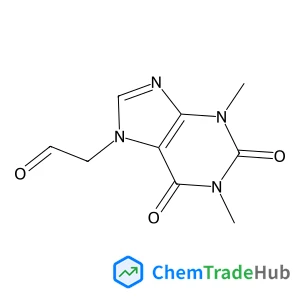
(1,3-Dimethyl-2,6-dioxo-1,2,3,6-tetrahydro-7H-purin-7-yl)acetaldehyde
CAS Number:
5614-53-9
Molecular Formula:
C9H10N4O3
![L-Lysine,N6-[2-[[(1,1-dimethylethoxy)carbonyl]amino]benzoyl]-N2-[(9H-fluoren-9-ylmethoxy)carbonyl]- structure](https://static.chemtradehub.com/structs/159/159322-59-5-c046.webp "L-Lysine,N6-[2-[[(1,1-dimethylethoxy)carbonyl]amino]benzoyl]-N2-[(9H-fluoren-9-ylmethoxy)carbonyl]- structure")
L-Lysine,N6-[2-[[(1,1-dimethylethoxy)carbonyl]amino]benzoyl]-N2-[(9H-fluoren-9-ylmethoxy)carbonyl]-
CAS Number:
159322-59-5
Molecular Formula:
C33H37N3O7
![2-[2-(2-Methoxyethoxy)ethoxy]-2-methylpropane structure](https://static.chemtradehub.com/structs/527/52788-79-1-71c1.webp "2-[2-(2-Methoxyethoxy)ethoxy]-2-methylpropane structure")
![4-Chloro-N-{[4-(dimethylamino)phenyl]carbamoyl}benzenesulfonamide structure](https://static.chemtradehub.com/structs/558/5581-42-0-7dcb.webp "4-Chloro-N-{[4-(dimethylamino)phenyl]carbamoyl}benzenesulfonamide structure")
4-Chloro-N-{[4-(dimethylamino)phenyl]carbamoyl}benzenesulfonamide
CAS Number:
5581-42-0
Molecular Formula:
C15H16ClN3O3S
Recommended Suppliers






Disclaimer
This page provides academic journal information for reference and research purposes only. We are not affiliated with any journal publishers and do not handle publication submissions. For publication-related inquiries, please contact the respective journal publishers directly.
If you notice any inaccuracies in the information displayed, please contact us at support@chemtradehub.com. We will promptly review and address your concerns.