












An inward replacement/etching route to synthesize double-walled Cu7S4 nanoboxes and their enhanced performances in ammonia gas sensing
Literature Information
Publication Date
2009-05-13
DOI
10.1039/B821452B
Impact Factor
3.676
Authors
View Original
Abstract
Well-defined and uniform double-walled Cu7S4 nanoboxes with an average edge length of about 400 nm have been successfully synthesized by using Cu2O nanocubes as sacrificial template based on an inward replacement/etching method. The key step of the process involves repeated formation of Cu7S4 layer in Na2S solution and dissolution of the Cu2O core in ammonia solution for two consecutive cycles. Experiments show that the time of dissolving Cu2O core with ammonia solution plays a key role in the preparation of double-walled Cu7S4. The as-prepared samples have been characterized by X-ray diffraction, field-emission scanning electron microscopy, transmission electron microscopy and photoluminescence analysis. NH3 sensing properties of Cu7S4 nanoboxes with single and double walls have been investigated at room temperature with a simply adapted photoluminescence-type gas sensor. The results revealed that the double-walled Cu7S4 nanobox sensor exhibited enhanced performances such as higher sensitivity and shorter response time in ammonia gas sensing compared with the single-walled one.
Recommended Journals
Related Literature
N-Sulfenyl phthalimide enabled Markovnikov hydrothiolation of unactivated alkenes via ligand promoted cobalt catalysis
Xiang-Rui Li, Rong-Jin Zhang, Yonghong Xiao, Qing-Xiao Tong
2023-11-07
Research Article
DOI: 10.1039/D3QO01632C
Advances in photoinduced radical–polar crossover cyclization (RPCC) of bifunctional alkenes
Meng Liu, Xinke Ouyang, Chenglong Xuan
2023-12-20
Review Article
DOI: 10.1039/D3QO01929B
Synthesis of 2-acyl benzofurans and indoles based on nucleophile-intercepted Meyer–Schuster rearrangement of o-hydroxyphenyl and o-aminophenyl propargylic alcohols
Zhao-Zhao Li, Si-Jing Jiang, Shu-Yun He, Yu-Ning Gao, Ming Bian, Hui-Yu Chen
2023-12-11
Research Article
DOI: 10.1039/D3QO01671D
Access to disulfides through ligand-controlled nickel-catalyzed dithiosulfonate and alkyl halides
Wang Chen, Xin-yu Liu, Yi-Fan Jiang, Weidong Rao, Shu-Su Shen, Zhao-Ying Yang, Shun-Yi Wang
2023-12-19
Research Article
DOI: 10.1039/D3QO01868G
Photoredox-catalyzed intramolecular oxy- and aminoacylation of alkenes with acyl oxime esters: facile synthesis of acylated saturated heterocycles
Min Wang, Liang-Chen Ren, Yu-Rui Jian, Xin-Yu Fu, Hong-Yu Zheng, Xiao Zha
2023-11-17
Research Article
DOI: 10.1039/D3QO01659E
N-Aminophthalimide-mediated aerobic deborohydroxylation of boronic acid in air
Wenzheng Zhang, Zhenxing Yan, Chuan-Ying Li
2023-11-21
Research Article
DOI: 10.1039/D3QO01651J
Sequential annulation of bidentate diamines for modular access to N-fused/helical/spiro-carbazole scaffolds
Yi Xiao, Xiya Zhang, Yuqin Wang, Kaida Li, Guixia Wang, Xiangfei Kong, Jinhua Wang, Shiqing Li
2023-11-23
Research Article
DOI: 10.1039/D3QO01788E
A three-component reaction of cyclobutanone oxime esters, sulfur dioxide and N-alkyl-N-methacryloyl benzamides
Chen Zhuang, Jiajing Lv, Chao Zhang, Qi Chen, Zhiyuan Wu, Jie Wu
2023-11-06
Paper
DOI: 10.1039/D3OB01439H
Olefination of aldehydes with alpha-halo redox-active esters
Zhengqiang Liu, Wenbo H. Liu
2023-12-14
Research Article
DOI: 10.1039/D3QO01805A
Asymmetric permanganate dihydroxylation of enoates: substrate scope, mechanistic insights and application in bicalutamide synthesis
Peilong Gu, Shuangshuang Wang, Xiangxiang Wen, Jinxin Tian, Chao Wang, Lili Zong, Choon-Hong Tan
2023-12-11
Research Article
DOI: 10.1039/D3QO01729J
You might also like
Compound Q&A
What precautions should be taken when handling 2-Methyl-2-propanyl 5-amino-2-thiophenecarboxylate (CAS: 1498311-57-1)?
When handling 2-Methyl-2-propanyl 5-amino-2-thiophenecarboxylate (CAS: 1498311-5...
1498311-57-12-Methyl-2-propanyl ...
Compound Q&A
What are the physical and chemical properties of 5-Bromo-1,2-dichloro-3-fluorobenzene (CAS: 1000572-93-9)?
5-Bromo-1,2-dichloro-3-fluorobenzene (CAS: 1000572-93-9) is a crystalline solid ...
1000572-93-95-Bromo-1,2-dichloro...
Compound Q&A
How should (2R)-2-Amino-2-(4-bromophenyl)ethanol (CAS: 354153-64-3) be stored?
(2R)-2-Amino-2-(4-bromophenyl)ethanol (CAS: 354153-64-3) should be stored in a c...
354153-64-3(2R)-2-Amino-2-(4-br...
Compound Q&A
What regulatory guidelines apply to Methyl 4-(aminomethyl)tetrahydro-2H-pyran-4-carboxylate hydrochloride (CAS: 362707-24-2)?
Methyl 4-(aminomethyl)tetrahydro-2H-pyran-4-carboxylate hydrochloride (CAS: 3627...
362707-24-2Methyl 4-(aminomethy...
Compound Q&A
What are the main uses of 1,4-dimethyl-1H-pyrazole-5-sulfonyl chloride (CAS: 1174834-52-6)?
1,4-Dimethyl-1H-pyrazole-5-sulfonyl chloride is primarily used as an intermediat...
1174834-52-61,4-dimethyl-1H-pyra...
Compound Q&A
Is Dinaphtho[1,2-b:2',1'-d]furan (CAS: 239-69-0) safe?
Dinaphtho[1,2-b:2',1'-d]furan is generally safe when handled with appropriate pe...
239-69-0Dinaphtho[1,2-b:2',1...
Compound Q&A
What is the market or research trend for 7-Methyl-7,9-dihydro-1H-purine-2,6,8(3H)-trione (CAS: 612-37-3)?
The market for 7-Methyl-7,9-dihydro-1H-purine-2,6,8(3H)-trione (CAS: 612-37-3) i...
612-37-37-Methyl-7,9-dihydro...
Compound Q&A
What are the physical and chemical properties of 2-(4-Chlorophenyl)malonaldehyde (CAS: 205676-17-1)?
2-(4-Chlorophenyl)malonaldehyde (CAS: 205676-17-1) is a colorless or light yello...
205676-17-12-(4-Chlorophenyl)ma...
Compound Q&A
How is 2-Methylchrysene (CAS: 3351-32-4) typically synthesized?
2-Methylchrysene (CAS: 3351-32-4) is typically synthesized via the reaction of c...
3351-32-42-Methylchrysene
Compound Q&A
Is N-(6-aminopyrimidin-4-yl)acetamide (CAS: 89533-23-3) safe?
N-(6-aminopyrimidin-4-yl)acetamide (CAS: 89533-23-3) is generally considered saf...
89533-23-3N-(6-aminopyrimidin-...
Source Journal
Physical Chemistry Chemical Physics

CiteScore:
5.5
Self-citation Rate:
10.3%
Articles per Year:
3036
Physical Chemistry Chemical Physics (PCCP) is an international journal co-owned by 19 physical chemistry and physics societies from around the world. This journal publishes original, cutting-edge research in physical chemistry, chemical physics and biophysical chemistry. To be suitable for publication in PCCP, articles must include significant innovation and/or insight into physical chemistry; this is the most important criterion that reviewers and Editors will judge against when evaluating submissions. The journal has a broad scope and welcomes contributions spanning experiment, theory, computation and data science. Topical coverage includes spectroscopy, dynamics, kinetics, statistical mechanics, thermodynamics, electrochemistry, catalysis, surface science, quantum mechanics, quantum computing and machine learning. Interdisciplinary research areas such as polymers and soft matter, materials, nanoscience, energy, surfaces/interfaces, and biophysical chemistry are welcomed if they demonstrate significant innovation and/or insight into physical chemistry. Joined experimental/theoretical studies are particularly appreciated when complementary and based on up-to-date approaches.
Recommended Compounds
![1-{[5-(4,4,5,5-Tetramethyl-1,3,2-dioxaborolan-2-yl)-2-thienyl]methyl}piperidine structure](https://static.chemtradehub.com/structs/121/1218790-44-3-baef.webp "1-{[5-(4,4,5,5-Tetramethyl-1,3,2-dioxaborolan-2-yl)-2-thienyl]methyl}piperidine structure")
1-{[5-(4,4,5,5-Tetramethyl-1,3,2-dioxaborolan-2-yl)-2-thienyl]methyl}piperidine
CAS Number:
1218790-44-3
Molecular Formula:
C16H26BNO2S
![1-Oxa-8-azaspiro[4.5]decan-3-ol structure](https://static.chemtradehub.com/structs/757/757239-76-2-a0ec.webp "1-Oxa-8-azaspiro[4.5]decan-3-ol structure")
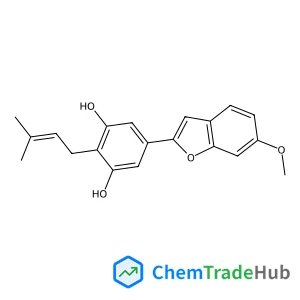
5-(6-Methoxy-1-benzofuran-2-yl)-2-(3-methyl-2-buten-1-yl)-1,3-benzenediol
CAS Number:
1017277-40-5
Molecular Formula:
C20H20O4
Recommended Suppliers




Disclaimer
This page provides academic journal information for reference and research purposes only. We are not affiliated with any journal publishers and do not handle publication submissions. For publication-related inquiries, please contact the respective journal publishers directly.
If you notice any inaccuracies in the information displayed, please contact us at support@chemtradehub.com. We will promptly review and address your concerns.