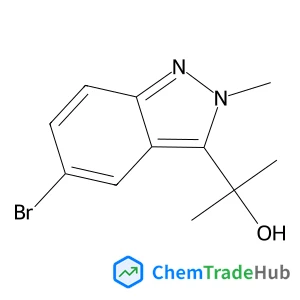
2-(5-Bromo-2-methyl-2H-indazol-3-yl)-2-propanol
CAS Number:
1823787-20-7
Molecular Formula:
C11H13BrN2O
Priyanka Dutta
Advanced gas sensing devices are urgently demanded in the modern scientific world to control air pollution and protect human life. For this purpose, semiconducting electroactive materials can revolutionize the idea of conventional gas sensors. Chemi-resistive gas sensors based on electroactive hybrid organic–inorganic nanocomposites are incredibly promising gas sensing materials because they possess the advantages of excellent selectivity, high sensitivity, low response time, repeatability, high stability, cost-effectiveness, and simple fabrication techniques, and they can be operated at room temperature. This review emphasizes the recent developments of organic–inorganic hybrid nanocomposite-based electroactive gas sensors, including metal oxide nanocomposites, which are potential gas sensing materials due to the presence of numerous charge carriers. The review also focuses on nanostructured materials of different dimensions, such as semiconducting quantum dots, carbon dots, nanotubes, nanowires, and nanosheets, used for developing these gas sensing compounds and their significance and challenges. Some possible fabrication techniques for developing efficient gas sensors with different morphologies are discussed, with their probable sensing mechanism behind the detection of toxic vapours. Subsequently, a summary and possible outcome of this study, along with the various achievements and prospects in this field, are also discussed.
Tatsuo Shibata, Hiroshi Irie, Donald A. Tryk
DOI: 10.1039/B927332H
Francisco García-Blanco, José V. García-Ramos, Santiago Sánchez-Cortés
DOI: 10.1039/B903935J
R. Wugt Larsen, M. A. Suhm
DOI: 10.1039/B925578H
William M. Ames, Sarah C. Larsen
DOI: 10.1039/B905750A
DOI: 10.1039/C003389H
DOI: 10.1039/B821452B
Takuji Ikeda, David A. Pacheco Tanaka, Margot A. Llosa Tanco, Yoshito Wakui, Koich Sato, Fujio Mizukami, Toshishige M. Suzuki
DOI: 10.1039/B909401F
Deborah J. Last, Juan J. Nájera, Carl J. Percival, Andrew B. Horn
DOI: 10.1039/B901815H
When handling 2-Methyl-2-propanyl 5-amino-2-thiophenecarboxylate (CAS: 1498311-5...
5-Bromo-1,2-dichloro-3-fluorobenzene (CAS: 1000572-93-9) is a crystalline solid ...
(2R)-2-Amino-2-(4-bromophenyl)ethanol (CAS: 354153-64-3) should be stored in a c...
Methyl 4-(aminomethyl)tetrahydro-2H-pyran-4-carboxylate hydrochloride (CAS: 3627...
1,4-Dimethyl-1H-pyrazole-5-sulfonyl chloride is primarily used as an intermediat...
Dinaphtho[1,2-b:2',1'-d]furan is generally safe when handled with appropriate pe...
The market for 7-Methyl-7,9-dihydro-1H-purine-2,6,8(3H)-trione (CAS: 612-37-3) i...
2-(4-Chlorophenyl)malonaldehyde (CAS: 205676-17-1) is a colorless or light yello...
2-Methylchrysene (CAS: 3351-32-4) is typically synthesized via the reaction of c...
N-(6-aminopyrimidin-4-yl)acetamide (CAS: 89533-23-3) is generally considered saf...

Physical Chemistry Chemical Physics (PCCP) is an international journal co-owned by 19 physical chemistry and physics societies from around the world. This journal publishes original, cutting-edge research in physical chemistry, chemical physics and biophysical chemistry. To be suitable for publication in PCCP, articles must include significant innovation and/or insight into physical chemistry; this is the most important criterion that reviewers and Editors will judge against when evaluating submissions. The journal has a broad scope and welcomes contributions spanning experiment, theory, computation and data science. Topical coverage includes spectroscopy, dynamics, kinetics, statistical mechanics, thermodynamics, electrochemistry, catalysis, surface science, quantum mechanics, quantum computing and machine learning. Interdisciplinary research areas such as polymers and soft matter, materials, nanoscience, energy, surfaces/interfaces, and biophysical chemistry are welcomed if they demonstrate significant innovation and/or insight into physical chemistry. Joined experimental/theoretical studies are particularly appreciated when complementary and based on up-to-date approaches.
![2,5-Dichloro-1H-pyrrolo[3,2-b]pyridine structure](https://static.chemtradehub.com/structs/100/1000342-87-9-f632.webp "2,5-Dichloro-1H-pyrrolo[3,2-b]pyridine structure")
![L-Lysine,N6-[2-[[(1,1-dimethylethoxy)carbonyl]amino]benzoyl]-N2-[(9H-fluoren-9-ylmethoxy)carbonyl]- structure](https://static.chemtradehub.com/structs/159/159322-59-5-c046.webp "L-Lysine,N6-[2-[[(1,1-dimethylethoxy)carbonyl]amino]benzoyl]-N2-[(9H-fluoren-9-ylmethoxy)carbonyl]- structure")