


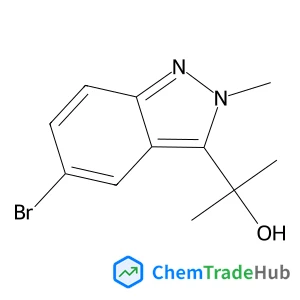
2-(5-Bromo-2-methyl-2H-indazol-3-yl)-2-propanol
CAS Number:
1823787-20-7
Molecular Formula:
C11H13BrN2O
Tatsuo Shibata, Hiroshi Irie, Donald A. Tryk
The wettability changes of TiO2 surface, photo-induced hydrophilic conversion and back-reaction in the dark, were evaluated using rutile (100) and (001) single crystals with diamond polishing (DP) and chemical mechanical polishing (CMP) treatments. Dynamic hardness measurements indicated that the DP surface had a residual compressive stress; however, the CMP surface did not. The rate of hydrophilic conversion was greatly suppressed (approximately one fourteenth) on the DP surface compared to the CMP surface, showing that the photoinduced hydrophilicity was greatly suppressed on the surface with compressive stress although the number of photogenerated carriers at the DP surface was estimated to decrease to only ca. half that at the CMP surface. In addition, when a heat treatment relaxed the compressive stress, the hydrophilicity was greatly increased. The back-reaction in the dark, i.e., the degradation of the photo-produced hydrophilic state, was ca. two times faster on the DP surface with compressive stress. The results strongly suggest that the pressure effect caused by the compressive stress could be the main reason for the degradation of the hydrophilicity and acceleration of the back reaction.

Physical Chemistry Chemical Physics

Foundations of Chemistry

Journal of Enzyme inhibition and Medicinal Chemistry

Nature Reviews Drug Discovery

Faraday Discussions

Photochemical & Photobiological Sciences

Environmental Toxicology and Pharmacology

Green Chemistry

Lab on a Chip

Mini-Reviews in Medicinal Chemistry
Shuyuan Liang, Liangjian Tang, Ying Chen, Xueqiu Huang, Xueqin Wei
DOI: 10.1039/D3QO01525D
Yangang Wu, Wenbo Cai, Lulu Yu, Junbiao Chang, Chuanjun Song
DOI: 10.1039/D3QO01454A
Zi-Jun Lei, Yue-Yue Zhang, Hui-Ling Lu, Fu-Gang Zhao, Jian-Hai Zhou, Xiaogang Peng
DOI: 10.1039/D3QO01560B
Krzysztof Bartkowski, Abhishek Kumar Gupta, Tomas Matulaitis, Maja Morawiak, Eli Zysman-Colman, Marcin Lindner
DOI: 10.1039/D3QO01914D
Weinan Chen, Yujie Xie, Jianping Xu, Jia-Wei Cai, Gang Zhou
DOI: 10.1039/D3QO01708G
Xiang-Rui Li, Rong-Jin Zhang, Yonghong Xiao, Qing-Xiao Tong
DOI: 10.1039/D3QO01632C
Jeong Min Bak, Moonyeong Song, Inji Shin, Hee Nam Lim
DOI: 10.1039/D3OB01603J
When handling 2-Methyl-2-propanyl 5-amino-2-thiophenecarboxylate (CAS: 1498311-5...
5-Bromo-1,2-dichloro-3-fluorobenzene (CAS: 1000572-93-9) is a crystalline solid ...
(2R)-2-Amino-2-(4-bromophenyl)ethanol (CAS: 354153-64-3) should be stored in a c...
Methyl 4-(aminomethyl)tetrahydro-2H-pyran-4-carboxylate hydrochloride (CAS: 3627...
1,4-Dimethyl-1H-pyrazole-5-sulfonyl chloride is primarily used as an intermediat...
Dinaphtho[1,2-b:2',1'-d]furan is generally safe when handled with appropriate pe...
The market for 7-Methyl-7,9-dihydro-1H-purine-2,6,8(3H)-trione (CAS: 612-37-3) i...
2-(4-Chlorophenyl)malonaldehyde (CAS: 205676-17-1) is a colorless or light yello...
2-Methylchrysene (CAS: 3351-32-4) is typically synthesized via the reaction of c...
N-(6-aminopyrimidin-4-yl)acetamide (CAS: 89533-23-3) is generally considered saf...
Physical Chemistry Chemical Physics (PCCP) is an international journal co-owned by 19 physical chemistry and physics societies from around the world. This journal publishes original, cutting-edge research in physical chemistry, chemical physics and biophysical chemistry. To be suitable for publication in PCCP, articles must include significant innovation and/or insight into physical chemistry; this is the most important criterion that reviewers and Editors will judge against when evaluating submissions. The journal has a broad scope and welcomes contributions spanning experiment, theory, computation and data science. Topical coverage includes spectroscopy, dynamics, kinetics, statistical mechanics, thermodynamics, electrochemistry, catalysis, surface science, quantum mechanics, quantum computing and machine learning. Interdisciplinary research areas such as polymers and soft matter, materials, nanoscience, energy, surfaces/interfaces, and biophysical chemistry are welcomed if they demonstrate significant innovation and/or insight into physical chemistry. Joined experimental/theoretical studies are particularly appreciated when complementary and based on up-to-date approaches.
![L-Lysine,N6-[2-[[(1,1-dimethylethoxy)carbonyl]amino]benzoyl]-N2-[(9H-fluoren-9-ylmethoxy)carbonyl]- structure](https://static.chemtradehub.com/structs/159/159322-59-5-c046.webp "L-Lysine,N6-[2-[[(1,1-dimethylethoxy)carbonyl]amino]benzoyl]-N2-[(9H-fluoren-9-ylmethoxy)carbonyl]- structure")
![methyl 6-amino-1H-pyrrolo[2,3-b]pyridine-4-carboxylate structure](https://static.chemtradehub.com/structs/119/1190315-60-6-9d9a.webp "methyl 6-amino-1H-pyrrolo[2,3-b]pyridine-4-carboxylate structure")
![2-[2-(2-Methoxyethoxy)ethoxy]-2-methylpropane structure](https://static.chemtradehub.com/structs/527/52788-79-1-71c1.webp "2-[2-(2-Methoxyethoxy)ethoxy]-2-methylpropane structure")




