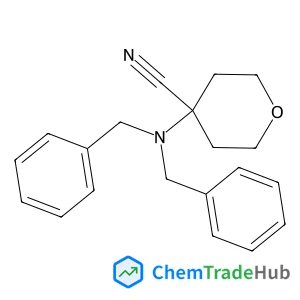
4-(Dibenzylamino)tetrahydro-2H-pyran-4-carbonitrile
CAS Number:
1630906-81-8
Molecular Formula:
C20H22N2O
Jone M. Elorrieta, Abel Milena-Pérez, Jean-François Vigier, Laura J. Bonales, Nieves Rodríguez-Villagra
The study of uranium oxides at different conditions is of paramount importance in the nuclear field, especially regarding characterization of the spent nuclear fuel behavior in dry storage scenarios. This paper reports results of XRD and Raman analysis on four powdered samples prepared in order to cover a specific stoichiometry range in UO2+x, i.e. x = 0.24, 0.26, 0.28 and 0.30. XRD results reveal a clear increase of the average tetragonal distortion with the increase in oxidation degree, with the main phase detected for all the samples being a weakly tetragonal phase identified as U3O7−z (c/a ≪ 1.032). U4O9 has not been detected in any sample. The Raman study carried out consists of both qualitative and quantitative analysis. The former, where a profile analysis has been performed on the acquired spectra, shows that the most intense bands (centered at ∼455 and ∼635 cm−1) are actually a doublet each, in agreement with a previous experimental study. Moreover, this work shows, for the first time, that the band at ∼160 cm−1 is also a doublet, which makes its classical assignment no longer obvious. The most important and original results from this study are obtained by applying Quantitative Raman Spectroscopy (QRS). This analysis shows that the second contribution at ∼475 cm−1 to the known T2g mode increases its relative intensity with the oxidation degree. This contribution may be related to the tetragonal distortion occurring in the cubic UO2 lattice due to the addition of interstitial oxygen, based on its comparison with the obtained XRD outcomes. In addition, the so-called “defects band” (centered at around 600 cm−1) presents a remarkable kink, of around 20 cm−1, in its Raman shift between UO2.26 and UO2.28. Such behavior might be directly associated with the observed appearance of the stoichiometric U3O7 phase (c/a = 1.032) for UO2.28 and UO2.30.
Hèctor Prats, Pablo Gamallo, Ramón Sayós, Francesc Illas
DOI: 10.1039/C5CP06863K
N. Scott Bobbitt, Grady Schofield, Charles Lena, James R. Chelikowsky
DOI: 10.1039/C5CP02561C
Ana P. Gamiz-Hernandez, Ville R. I. Kaila
DOI: 10.1039/C5CP05244K
P. Anees, M. C. Valsakumar, B. K. Panigrahi
DOI: 10.1039/C5CP06111C
Heng-Liang Wu, Yujin Tong, Qiling Peng, Na Li, Shen Ye
DOI: 10.1039/C5CP04960A
Monica Bugeanu, Roberto Di Remigio, Krzysztof Mozgawa, Simen Sommerfelt Reine, Helmut Harbrecht, Luca Frediani
DOI: 10.1039/C5CP03410H
Vijay Beniwal, Shashi K. Shukla, Anil Kumar
DOI: 10.1039/C5CP05921F
Franziska Buchner, Berit Heggen, Hans-Hermann Ritze, Walter Thiel, Andrea Lübcke
DOI: 10.1039/C5CP04394H
Manoj A. Lazar, Danah Al-Masri, Douglas R. MacFarlane, Jennifer M. Pringle
DOI: 10.1039/C5CP04305K
Ludmila B. Boinovich, Alexandre M. Emelyanenko, Kirill A. Emelyanenko, Konstantin I. Maslakov
DOI: 10.1039/C5CP06988B
When handling 2-Methyl-2-propanyl 5-amino-2-thiophenecarboxylate (CAS: 1498311-5...
5-Bromo-1,2-dichloro-3-fluorobenzene (CAS: 1000572-93-9) is a crystalline solid ...
(2R)-2-Amino-2-(4-bromophenyl)ethanol (CAS: 354153-64-3) should be stored in a c...
Methyl 4-(aminomethyl)tetrahydro-2H-pyran-4-carboxylate hydrochloride (CAS: 3627...
1,4-Dimethyl-1H-pyrazole-5-sulfonyl chloride is primarily used as an intermediat...
Dinaphtho[1,2-b:2',1'-d]furan is generally safe when handled with appropriate pe...
The market for 7-Methyl-7,9-dihydro-1H-purine-2,6,8(3H)-trione (CAS: 612-37-3) i...
2-(4-Chlorophenyl)malonaldehyde (CAS: 205676-17-1) is a colorless or light yello...
2-Methylchrysene (CAS: 3351-32-4) is typically synthesized via the reaction of c...
N-(6-aminopyrimidin-4-yl)acetamide (CAS: 89533-23-3) is generally considered saf...

Physical Chemistry Chemical Physics (PCCP) is an international journal co-owned by 19 physical chemistry and physics societies from around the world. This journal publishes original, cutting-edge research in physical chemistry, chemical physics and biophysical chemistry. To be suitable for publication in PCCP, articles must include significant innovation and/or insight into physical chemistry; this is the most important criterion that reviewers and Editors will judge against when evaluating submissions. The journal has a broad scope and welcomes contributions spanning experiment, theory, computation and data science. Topical coverage includes spectroscopy, dynamics, kinetics, statistical mechanics, thermodynamics, electrochemistry, catalysis, surface science, quantum mechanics, quantum computing and machine learning. Interdisciplinary research areas such as polymers and soft matter, materials, nanoscience, energy, surfaces/interfaces, and biophysical chemistry are welcomed if they demonstrate significant innovation and/or insight into physical chemistry. Joined experimental/theoretical studies are particularly appreciated when complementary and based on up-to-date approaches.

![2-Bromo-7-chloro-4H-pyrrolo[2,3-b]pyrazine structure](https://static.chemtradehub.com/structs/115/1150617-58-5-0b0a.webp "2-Bromo-7-chloro-4H-pyrrolo[2,3-b]pyrazine structure")