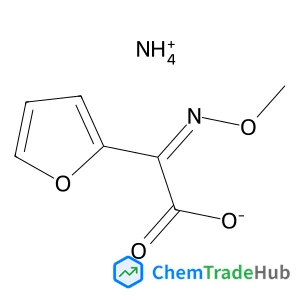
Ammonium (Z)-2-(furan-2-yl)-2-(methoxyimino)acetate
CAS Number:
97148-39-5
Molecular Formula:
C7H10N2O4
Heng-Liang Wu, Yujin Tong, Qiling Peng, Na Li, Shen Ye
The phase transition behaviors of a supported bilayer of dipalmitoylphosphatidyl-choline (DPPC) have been systematically evaluated by in situ sum frequency generation (SFG) vibrational spectroscopy and atomic force microscopy (AFM). By using an asymmetric bilayer composed of per-deuterated and per-protonated monolayers, i.e., DPPC-d75/DPPC and a symmetric bilayer of DPPC/DPPC, we were able to probe the molecular structural changes during the phase transition process of the lipid bilayer by SFG spectroscopy. It was found that the DPPC bilayer is sequentially melted from the top (adjacent to the solution) to bottom leaflet (adjacent to the substrate) over a wide temperature range. The conformational ordering of the supported bilayer does not decrease (even slightly increases) during the phase transition process. The conformational defects in the bilayer can be removed after the complete melting process. The phase transition enthalpy for the bottom leaflet was found to be approximately three times greater than that for the top leaflet, indicating a strong interaction of the lipids with the substrate. The present SFG and AFM observations revealed similar temperature dependent profiles. Based on these results, the temperature-induced structural changes in the supported lipid bilayer during its phase transition process are discussed in comparison with previous studies.
Wusheng Ren, Yongxiang Zhu, Jianfeng Ge, Xufeng Xu, Ru Sun, Najun Li, Hua Li, Qingfeng Xu, Junwei Zheng, Jianmei Lu
DOI: 10.1039/C3CP51290H
Lingling Zhang, Xinyu Huang, Changyong Qin, Kyle Brinkman, Yunhui Gong, Siwei Wang, Kevin Huang
DOI: 10.1039/C3CP52362D
Mauricio J. Prieto, Germano Tremiliosi-Filho
DOI: 10.1039/C3CP51513C
Martina Pannuzzo, Danilo Milardi, Antonio Raudino, Mikko Karttunen, Carmelo La Rosa
DOI: 10.1039/C3CP44539A
Patricia B. Lutz, Craig A. Bayse
DOI: 10.1039/C3CP51077H
Haihua Pan, Yin-Jia Zhang, Ruikang Tang
DOI: 10.1039/C3CP51466H
Simeon Boyanov, Amandine Lecocq, Jean-Pierre Bertrand, Guy Marlair
DOI: 10.1039/C3CP51315G
Massimo Malagoli, M. L. Liu, Hyeon Cheol Park, Angelo Bongiorno
DOI: 10.1039/C3CP51863A
1H-Indazole-6-carbonitrile finds applications in pharmaceuticals, where it serve...
Waste containing Dioctyl (2E)-2-butenedioate (CAS: 2997-85-5) should be collecte...
Sodium [(1,2-benzoxazol-3-ylmethyl)sulfonyl]azanide is primarily used in pharmac...
Dimethyl 4-(4,4,5,5-tetramethyl-1,3,2-dioxaborolan-2-yl)-2,6-pyridinedicarboxyla...
Waste containing 2-Fluoro-6-hydrazinopyridine (CAS: 80714-39-2) should be manage...
6-Formyl-2-pyridinecarboxylic acid is an organic compound with the molecular for...
Research trends for this compound indicate a focus on its potential applications...
9H-Tribenzo[b,d,f]azepine is typically synthesized via a multi-step process invo...
1-Cyclopropyl-7-ethoxy-6-fluoro-8-methoxy-4-oxo-1,4-dihydro-3-quinolinecarboxyli...
Waste containing Methyl 3-oxo-1,2,3,4-tetrahydro-6-quinoxalinecarboxylate (CAS: ...

Physical Chemistry Chemical Physics (PCCP) is an international journal co-owned by 19 physical chemistry and physics societies from around the world. This journal publishes original, cutting-edge research in physical chemistry, chemical physics and biophysical chemistry. To be suitable for publication in PCCP, articles must include significant innovation and/or insight into physical chemistry; this is the most important criterion that reviewers and Editors will judge against when evaluating submissions. The journal has a broad scope and welcomes contributions spanning experiment, theory, computation and data science. Topical coverage includes spectroscopy, dynamics, kinetics, statistical mechanics, thermodynamics, electrochemistry, catalysis, surface science, quantum mechanics, quantum computing and machine learning. Interdisciplinary research areas such as polymers and soft matter, materials, nanoscience, energy, surfaces/interfaces, and biophysical chemistry are welcomed if they demonstrate significant innovation and/or insight into physical chemistry. Joined experimental/theoretical studies are particularly appreciated when complementary and based on up-to-date approaches.