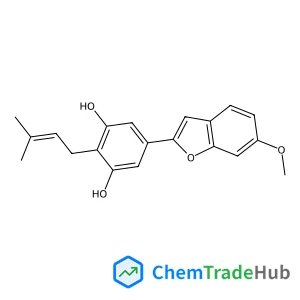
5-(6-Methoxy-1-benzofuran-2-yl)-2-(3-methyl-2-buten-1-yl)-1,3-benzenediol
CAS Number:
1017277-40-5
Molecular Formula:
C20H20O4
Oksana Travnikova, Tatiana Marchenko, Renaud Guillemin, Iyas Ismail, Roba Moussaoui, Loïc Journel, Aleksandar R. Milosavljević, John D. Bozek, Ralph Püttner, Marc Simon
Fragmentation dynamics of core-excited isolated ammonia molecules is studied by two different and complementary experimental methods, high-resolution resonant Auger spectroscopy and electron energy-selected Auger electron–photoion coincidence spectroscopy (AEPICO). The combined use of these two techniques allows obtaining information on different dissociation patterns, in particular fragmentation before relaxation, often called ultrafast dissociation (UFD), and fragmentation after relaxation. The resonant Auger spectra contain the spectral signature of both molecular and fragment final states, and therefore can provide information on all events occurring during the core-hole lifetime, in particular fragmentation before relaxation. Coincidence measurements allow correlating Auger electrons with ionic fragments from the same molecule, and relating the ionic fragments to specific Auger final electronic states, and yield additional information on which final states are dissociative, and which ionic fragments can be produced in timescales either corresponding to the core-hole lifetime or longer. Furthermore, we show that by the combined use of two complementary experimental techniques we are able to identify more electronic states of the NH2+ fragment with respect to the single one already reported in the literature.
Wen Zhu, Ying Wu, Lin Qu, Zhengping Liu
DOI: 10.1039/C6PY01488G
Patrick A. J. M. de Jongh, Mechelle R. Bennett, Greg S. Sulley
DOI: 10.1039/C6PY01553K
Lijie Li, Yong Cong, Lipeng He, Yongyue Wang, Jun Wang, Fu-Ming Zhang, Weifeng Bu
DOI: 10.1039/C6PY01580H
Xiao-hui Liu, Qiu-yan Zhang, Wen-li Di, Yan-guang Zhang, Chen Ding
DOI: 10.1039/C7PY01040K
Marc Guerre, Vincent Ladmiral, Bruno Ameduri
DOI: 10.1039/C6PY01167E
Jing Zhang, Jacques Lalevée, Jiacheng Zhao, Bernadette Graff, Martina H. Stenzel, Pu Xiao
DOI: 10.1039/C6PY01550F
Franziska Marx, Karen Strassel, Susanna Kunz, Caroline Lienert, Hartmut Komber, Richard Friend
DOI: 10.1039/C7PY00879A
When handling 2-Methyl-2-propanyl 5-amino-2-thiophenecarboxylate (CAS: 1498311-5...
5-Bromo-1,2-dichloro-3-fluorobenzene (CAS: 1000572-93-9) is a crystalline solid ...
(2R)-2-Amino-2-(4-bromophenyl)ethanol (CAS: 354153-64-3) should be stored in a c...
Methyl 4-(aminomethyl)tetrahydro-2H-pyran-4-carboxylate hydrochloride (CAS: 3627...
1,4-Dimethyl-1H-pyrazole-5-sulfonyl chloride is primarily used as an intermediat...
Dinaphtho[1,2-b:2',1'-d]furan is generally safe when handled with appropriate pe...
The market for 7-Methyl-7,9-dihydro-1H-purine-2,6,8(3H)-trione (CAS: 612-37-3) i...
2-(4-Chlorophenyl)malonaldehyde (CAS: 205676-17-1) is a colorless or light yello...
2-Methylchrysene (CAS: 3351-32-4) is typically synthesized via the reaction of c...
N-(6-aminopyrimidin-4-yl)acetamide (CAS: 89533-23-3) is generally considered saf...

Physical Chemistry Chemical Physics (PCCP) is an international journal co-owned by 19 physical chemistry and physics societies from around the world. This journal publishes original, cutting-edge research in physical chemistry, chemical physics and biophysical chemistry. To be suitable for publication in PCCP, articles must include significant innovation and/or insight into physical chemistry; this is the most important criterion that reviewers and Editors will judge against when evaluating submissions. The journal has a broad scope and welcomes contributions spanning experiment, theory, computation and data science. Topical coverage includes spectroscopy, dynamics, kinetics, statistical mechanics, thermodynamics, electrochemistry, catalysis, surface science, quantum mechanics, quantum computing and machine learning. Interdisciplinary research areas such as polymers and soft matter, materials, nanoscience, energy, surfaces/interfaces, and biophysical chemistry are welcomed if they demonstrate significant innovation and/or insight into physical chemistry. Joined experimental/theoretical studies are particularly appreciated when complementary and based on up-to-date approaches.
![methyl 6-amino-1H-pyrrolo[2,3-b]pyridine-4-carboxylate structure](https://static.chemtradehub.com/structs/119/1190315-60-6-9d9a.webp "methyl 6-amino-1H-pyrrolo[2,3-b]pyridine-4-carboxylate structure")
methyl]-N,2-dimethyl-2-propanesulfinamide structure](https://static.chemtradehub.com/structs/256/2565792-50-7-8a26.webp "N-[(R)-[3-(Benzyloxy)-2-(dicyclohexylphosphino)phenyl](phenyl)methyl]-N,2-dimethyl-2-propanesulfinamide structure")