












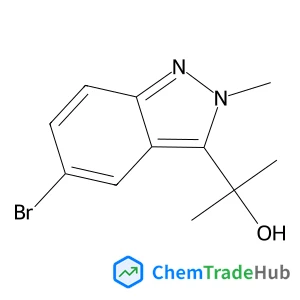
2-(5-Bromo-2-methyl-2H-indazol-3-yl)-2-propanol
CAS Number:
1823787-20-7
Molecular Formula:
C11H13BrN2O
Franziska Marx, Karen Strassel, Susanna Kunz, Caroline Lienert, Hartmut Komber, Richard Friend
Debate remains about potentially occuring non-selective C–H activation during the direct arylation polycondensation of monomers with more than two C–H bonds. Non-selective reactions with dihalides lead to undesirable kinking, branching and cross-linking of conjugated polymer chains, and thus to severe deviations of all opto-electronic properties. Using thiophene–benzothiadiazole–thiophene (TBT) having four different C–H bonds and its popular copolymer with dibromocarbazole, PCDTBT, as an example, we demonstrate that unselective C–H activation, often referred to as “β-arylation”, does not occur under typical polycondensation reactions. However, using extreme stoichiometries, i.e. a large excess of halide, model reactions reveal that in addition to the typical α-C–H activation of TBT, γ-arylation takes place. This reaction is also seen in polymer analogous reactions of PCDTBT. If γ-arylation of PCDTBT is mimicked using Suzuki polycondensation with tribrominated TBT, the reaction yield drops significantly, the charge transfer absorption band is blued-shifted and solar cell performance of the corresponding PCBM blends is reduced drastically through both a reduction in short circuit current and fill factor. While many reports have meanwhile shown that direct arylation polymerization can be employed to make well-defined conjugated polymers, this paper demonstrates that (i) unselective arylation of thiophene-based monomers is very unlikely for stoichiometry reasons, (ii) how branching can be identified in donor–acceptor copolymers on a spectroscopic basis and (iii) how the optoelectronic properties change if branching still takes place.
Katsuhiko Satoh
DOI: 10.1039/C9CP03296G
Guanghong Wei
DOI: 10.1039/C9CP03151K
Zhengxi Yin, Yafu Guan, Bina Fu, Dong H. Zhang
DOI: 10.1039/C9CP03592C
Manel Naouai, Faouzi Najar, Kamel Hammami
DOI: 10.1039/C9CP04214H
Artur Nowak, Paweł Tecmer, Katharina Boguslawski
DOI: 10.1039/C9CP03678D
Earl Matthew Davis, Giulia Berti, Helmut Kuhlenbeck, Vedran Vonk, Hans-Joachim Freund
DOI: 10.1039/C9CP04157E
Narcisse T. Tsona, Shanshan Tang, Lin Du
DOI: 10.1039/C9CP03612A
M. Gnanaprakasam, G. Saranya, S. Bandaru, N. J. English, K. Senthilkumar
DOI: 10.1039/C9CP04271G
When handling 2-Methyl-2-propanyl 5-amino-2-thiophenecarboxylate (CAS: 1498311-5...
5-Bromo-1,2-dichloro-3-fluorobenzene (CAS: 1000572-93-9) is a crystalline solid ...
(2R)-2-Amino-2-(4-bromophenyl)ethanol (CAS: 354153-64-3) should be stored in a c...
Methyl 4-(aminomethyl)tetrahydro-2H-pyran-4-carboxylate hydrochloride (CAS: 3627...
1,4-Dimethyl-1H-pyrazole-5-sulfonyl chloride is primarily used as an intermediat...
Dinaphtho[1,2-b:2',1'-d]furan is generally safe when handled with appropriate pe...
The market for 7-Methyl-7,9-dihydro-1H-purine-2,6,8(3H)-trione (CAS: 612-37-3) i...
2-(4-Chlorophenyl)malonaldehyde (CAS: 205676-17-1) is a colorless or light yello...
2-Methylchrysene (CAS: 3351-32-4) is typically synthesized via the reaction of c...
N-(6-aminopyrimidin-4-yl)acetamide (CAS: 89533-23-3) is generally considered saf...

Polymer Chemistry welcomes submissions in all areas of polymer science that have a strong focus on macromolecular chemistry. Manuscripts may cover a broad range of fields, yet no direct application focus is required.
![N-[(1-Ethyl-2-pyrrolidinyl)methyl]-2-hydroxy-5-sulfamoylbenzamide structure](https://static.chemtradehub.com/structs/673/67381-52-6-877f.webp "N-[(1-Ethyl-2-pyrrolidinyl)methyl]-2-hydroxy-5-sulfamoylbenzamide structure")





