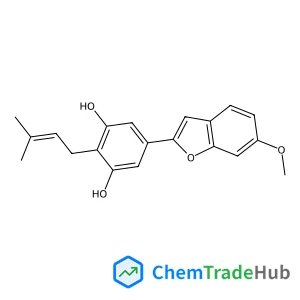
5-(6-Methoxy-1-benzofuran-2-yl)-2-(3-methyl-2-buten-1-yl)-1,3-benzenediol
CAS Number:
1017277-40-5
Molecular Formula:
C20H20O4
Tong Wei, Lingzhi Gu, Hong Yang, Ming Li, Yang Zhou
Cell permeabilization using shock-induced bubble collapse provides an attractive choice for drug delivery systems. In this work, based on a realistically human brain plasma membrane (PM) model, we investigated the focal opening of this complex model by the jet from cavitation, focusing on the effect of characteristic membrane components, particle velocity (up) and bubble diameters (D). Both high levels of cholesterol and specific cerebrosides in the PM model limit the pore opening of cavitation jets. Sphingomyelin is the opposite, but has little effect due to its low content. Two adjustable parameters of up and D can be coupled to control the opening size. The relationship between them and the maximum pore area was provided for the first time. The maximum pore area increases with the up (or the impulse that is positively related to up) in the low-speed range, which agrees with the experimentally observed impulse determinism. However, the maximum area drops in the high-speed range. Combined with D, we proposed that the jet size determines the pore size, not the impulse. Larger bubbles that can create a larger pore in the membrane have a larger jet size, but their impulse is relatively small. Finally, the recovery simulation shows that the membrane with a small pore can be quickly recovered within 300 ps, while that with a larger pore did not recover until 2 μs. These rules from this work may be helpful to optimize the choice of shock waves for the delivery of different drugs across membranes.
Felix E. Feiten, Helmut Kuhlenbeck, Hans-Joachim Freund
DOI: 10.1039/C5CP07390A
Sangram K. Rath, Saji S. Edatholath, T. Umasankar Patro, Kathi Sudarshan, P. U. Sastry, Pradeep K. Pujari, G. Harikrishnan
DOI: 10.1039/C5CP04432D
Monica Bugeanu, Roberto Di Remigio, Krzysztof Mozgawa, Simen Sommerfelt Reine, Helmut Harbrecht, Luca Frediani
DOI: 10.1039/C5CP03410H
W. H. Brito, Joice da Silva-Araújo, H. Chacham
DOI: 10.1039/C5CP04926A
Yong Fu Nie, Qian Wang, Xiang Ying Chen, Zhong Jie Zhang
DOI: 10.1039/C5CP06147D
Satoshi Maeda, Takaya Nagai
DOI: 10.1039/C5CP05139H
Lingting Ye, Shanwen Tao, Kui Xie
DOI: 10.1039/C5CP06742A
X. Yang, L. Yang, J. Lin, R. Zhou
DOI: 10.1039/C5CP06956D
ShuangYing Ma, Chaoyu He, L. Z. Sun, Haiping Lin, Youyong Li, K. W. Zhang
DOI: 10.1039/C5CP05901A
When handling 2-Methyl-2-propanyl 5-amino-2-thiophenecarboxylate (CAS: 1498311-5...
5-Bromo-1,2-dichloro-3-fluorobenzene (CAS: 1000572-93-9) is a crystalline solid ...
(2R)-2-Amino-2-(4-bromophenyl)ethanol (CAS: 354153-64-3) should be stored in a c...
Methyl 4-(aminomethyl)tetrahydro-2H-pyran-4-carboxylate hydrochloride (CAS: 3627...
1,4-Dimethyl-1H-pyrazole-5-sulfonyl chloride is primarily used as an intermediat...
Dinaphtho[1,2-b:2',1'-d]furan is generally safe when handled with appropriate pe...
The market for 7-Methyl-7,9-dihydro-1H-purine-2,6,8(3H)-trione (CAS: 612-37-3) i...
2-(4-Chlorophenyl)malonaldehyde (CAS: 205676-17-1) is a colorless or light yello...
2-Methylchrysene (CAS: 3351-32-4) is typically synthesized via the reaction of c...
N-(6-aminopyrimidin-4-yl)acetamide (CAS: 89533-23-3) is generally considered saf...

Physical Chemistry Chemical Physics (PCCP) is an international journal co-owned by 19 physical chemistry and physics societies from around the world. This journal publishes original, cutting-edge research in physical chemistry, chemical physics and biophysical chemistry. To be suitable for publication in PCCP, articles must include significant innovation and/or insight into physical chemistry; this is the most important criterion that reviewers and Editors will judge against when evaluating submissions. The journal has a broad scope and welcomes contributions spanning experiment, theory, computation and data science. Topical coverage includes spectroscopy, dynamics, kinetics, statistical mechanics, thermodynamics, electrochemistry, catalysis, surface science, quantum mechanics, quantum computing and machine learning. Interdisciplinary research areas such as polymers and soft matter, materials, nanoscience, energy, surfaces/interfaces, and biophysical chemistry are welcomed if they demonstrate significant innovation and/or insight into physical chemistry. Joined experimental/theoretical studies are particularly appreciated when complementary and based on up-to-date approaches.
![L-Lysine,N6-[2-[[(1,1-dimethylethoxy)carbonyl]amino]benzoyl]-N2-[(9H-fluoren-9-ylmethoxy)carbonyl]- structure](https://static.chemtradehub.com/structs/159/159322-59-5-c046.webp "L-Lysine,N6-[2-[[(1,1-dimethylethoxy)carbonyl]amino]benzoyl]-N2-[(9H-fluoren-9-ylmethoxy)carbonyl]- structure")