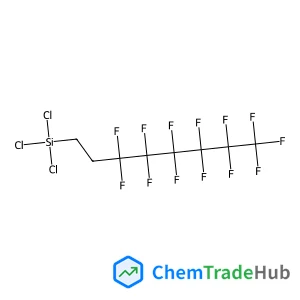
Trichloro(3,3,4,4,5,5,6,6,7,7,8,8,8-tridecafluorooctyl)silane
CAS Number:
78560-45-9
Molecular Formula:
C8H4Cl3F13Si
Lingting Ye, Shanwen Tao, Kui Xie
Ionic conduction in perovskite oxide is commonly tailored by element doping in lattices to create charge carriers, while few studies have been focused on ionic conduction enhancement through tailoring microstructures. In this work, remarkable enhancement of ionic conduction in titanate has been achieved via in situ growing active nickel nanoparticles on an oxide surface by controlling the oxide material nonstoichiometry. The combined use of XRD, SEM, XPS and EDS indicates that the exsolution/dissolution of the nickel nanoparticles is completely reversible in redox cycles. With the synergetic effect of enhanced ionic conduction of titanate and the presence of catalytic active Ni nanocatalysts, significant improvement of electrocatalytic performances of the titanate cathode is demonstrated. A current density of 0.3 A cm−2 with a Faradic efficiency of 90% has been achieved for direct carbon dioxide electrolysis in a 2 mm-thick YSZ-supported solid oxide electrolyzer with the modified titanate cathode at 2 V and 1073 K.
Anna Szemik-Hojniak, Irena Deperasińska, Krzysztof Oberda, Yuval Erez, Dan Huppert, Yakov P. Nizhnik
DOI: 10.1039/C3CP50527H
Simeon Boyanov, Amandine Lecocq, Jean-Pierre Bertrand, Guy Marlair
DOI: 10.1039/C3CP51315G
Liudmila Larina, Jae Ho Yun, Kyung Hoon Yoon, HyukSang Kwon, Byung Tae Ahn
DOI: 10.1039/C3CP50324K
Megan Murray Gessel, Nichole E. LaPointe, Thanh D. Do, Michael T. Bowers, Stuart C. Feinstein
DOI: 10.1039/C3CP00063J
Ana-Maria Chiorcea-Paquim, Paulina Viegas Santos, Ramon Eritja, Ana Maria Oliveira-Brett
DOI: 10.1039/C3CP50866H
Vipin Agarwal, Rasmus Linser, Uwe Fink
DOI: 10.1039/C3CP44653K
Jeffrey R. Brender, Deborah L. Heyl, Shyamprasad Samisetti, Samuel A. Kotler, Joshua M. Osborne, Ranadheer R. Pesaru, Ayyalusamy Ramamoorthy
DOI: 10.1039/C3CP44696D
Artur Braun, Rolf Erni, Ulrich Müller, Max Döbeli, Edwin C. Constable
DOI: 10.1039/C3CP52179F
1H-Indazole-6-carbonitrile finds applications in pharmaceuticals, where it serve...
Waste containing Dioctyl (2E)-2-butenedioate (CAS: 2997-85-5) should be collecte...
Sodium [(1,2-benzoxazol-3-ylmethyl)sulfonyl]azanide is primarily used in pharmac...
Dimethyl 4-(4,4,5,5-tetramethyl-1,3,2-dioxaborolan-2-yl)-2,6-pyridinedicarboxyla...
Waste containing 2-Fluoro-6-hydrazinopyridine (CAS: 80714-39-2) should be manage...
6-Formyl-2-pyridinecarboxylic acid is an organic compound with the molecular for...
Research trends for this compound indicate a focus on its potential applications...
9H-Tribenzo[b,d,f]azepine is typically synthesized via a multi-step process invo...
1-Cyclopropyl-7-ethoxy-6-fluoro-8-methoxy-4-oxo-1,4-dihydro-3-quinolinecarboxyli...
Waste containing Methyl 3-oxo-1,2,3,4-tetrahydro-6-quinoxalinecarboxylate (CAS: ...

Physical Chemistry Chemical Physics (PCCP) is an international journal co-owned by 19 physical chemistry and physics societies from around the world. This journal publishes original, cutting-edge research in physical chemistry, chemical physics and biophysical chemistry. To be suitable for publication in PCCP, articles must include significant innovation and/or insight into physical chemistry; this is the most important criterion that reviewers and Editors will judge against when evaluating submissions. The journal has a broad scope and welcomes contributions spanning experiment, theory, computation and data science. Topical coverage includes spectroscopy, dynamics, kinetics, statistical mechanics, thermodynamics, electrochemistry, catalysis, surface science, quantum mechanics, quantum computing and machine learning. Interdisciplinary research areas such as polymers and soft matter, materials, nanoscience, energy, surfaces/interfaces, and biophysical chemistry are welcomed if they demonstrate significant innovation and/or insight into physical chemistry. Joined experimental/theoretical studies are particularly appreciated when complementary and based on up-to-date approaches.