












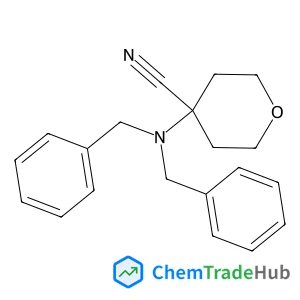
4-(Dibenzylamino)tetrahydro-2H-pyran-4-carbonitrile
CAS Number:
1630906-81-8
Molecular Formula:
C20H22N2O
Shrish Nath Upadhyay, Verma Bunty Sardar, Ashok Singh, Vikash Kumar
The oxygen reduction reaction (ORR) is an indispensable reaction in electrochemical energy converting systems such as fuel cells. Generally, reaction kinetics of the ORR is slow, and to speed it up, a practical electrocatalyst is needed. Pt-based catalysts are thermodynamically more appropriate, but due to their scarcity and high cost, they cannot be used on a commercial scale in industries. To search for non-noble metal catalysts, we have performed a theoretical study on the CsPbBr3 perovskite material as a potential candidate for the ORR. The 3D bulk crystal structure of CsPbBr3 shows a large electronic band gap (Eg) of around 2.95 eV and it cannot be used as an efficient electrocatalyst for the ORR. We have cleaved a (001) surface from the 3D CsPbBr3 perovskite and computationally designed a 2D monolayer slab structure of the CsPbBr3 material. The present study showed that the 2D monolayer structure of CsPbBr3 has a tiny band gap about 0.22 eV, and hence the 2D monolayer CsPbBr3 perovskite can be used as a cathode material for fuel cell applications. Special priority has been given to the 2D layered perovskite structure to gain insights into its ORR kinetics by employing the first principles-based density functional theory (DFT) method. This study reveals that the basal plane of the 2D CsPbBr3 perovskite exhibits excellent electrocatalytic activity toward the ORR with a four-electron reduction pathway selectivity. Both the dissociative and associative reaction mechanisms of the ORR on the surfaces of the 2D monolayer CsPbBr3 perovskite have been explored by computing the change in Gibb's free energy (ΔG). All the reaction intermediates studied here are thermodynamically favorable and the present study suggests that the ORR follows a 4e− transfer mechanism on the surface of 2D CsPbBr3 and the associative mechanism is favorable over the dissociative mechanism of the ORR. This study provides a theoretical basis for future application of 2D CsPbBr3 perovskite-based electrocatalysts for achieving an effective ORR, indicating that they are promising Pt-free candidates for fuel cell components.
Yi-Yang Sun, Shengbai Zhang
DOI: 10.1039/C5CP07109G
W. H. Brito, Joice da Silva-Araújo, H. Chacham
DOI: 10.1039/C5CP04926A
P. Anees, M. C. Valsakumar, B. K. Panigrahi
DOI: 10.1039/C5CP06111C
Linus O. Johannissen, Sam Hay, Nigel S. Scrutton
DOI: 10.1039/C5CP00614G
DOI: 10.1039/C5CP07025B
Tomofumi Tada, Kazunari Yoshizawa
DOI: 10.1039/C5CP05423K
Sergey A. Kislenko, Victoria A. Nikitina, Renat R. Nazmutdinov
DOI: 10.1039/C5CP04566E
Noemí Alarcos, Boiko Cohen, Abderrazzak Douhal
DOI: 10.1039/C5CP04548G
DOI: 10.1039/C5CP06786C
When handling 2-Methyl-2-propanyl 5-amino-2-thiophenecarboxylate (CAS: 1498311-5...
5-Bromo-1,2-dichloro-3-fluorobenzene (CAS: 1000572-93-9) is a crystalline solid ...
(2R)-2-Amino-2-(4-bromophenyl)ethanol (CAS: 354153-64-3) should be stored in a c...
Methyl 4-(aminomethyl)tetrahydro-2H-pyran-4-carboxylate hydrochloride (CAS: 3627...
1,4-Dimethyl-1H-pyrazole-5-sulfonyl chloride is primarily used as an intermediat...
Dinaphtho[1,2-b:2',1'-d]furan is generally safe when handled with appropriate pe...
The market for 7-Methyl-7,9-dihydro-1H-purine-2,6,8(3H)-trione (CAS: 612-37-3) i...
2-(4-Chlorophenyl)malonaldehyde (CAS: 205676-17-1) is a colorless or light yello...
2-Methylchrysene (CAS: 3351-32-4) is typically synthesized via the reaction of c...
N-(6-aminopyrimidin-4-yl)acetamide (CAS: 89533-23-3) is generally considered saf...

Physical Chemistry Chemical Physics (PCCP) is an international journal co-owned by 19 physical chemistry and physics societies from around the world. This journal publishes original, cutting-edge research in physical chemistry, chemical physics and biophysical chemistry. To be suitable for publication in PCCP, articles must include significant innovation and/or insight into physical chemistry; this is the most important criterion that reviewers and Editors will judge against when evaluating submissions. The journal has a broad scope and welcomes contributions spanning experiment, theory, computation and data science. Topical coverage includes spectroscopy, dynamics, kinetics, statistical mechanics, thermodynamics, electrochemistry, catalysis, surface science, quantum mechanics, quantum computing and machine learning. Interdisciplinary research areas such as polymers and soft matter, materials, nanoscience, energy, surfaces/interfaces, and biophysical chemistry are welcomed if they demonstrate significant innovation and/or insight into physical chemistry. Joined experimental/theoretical studies are particularly appreciated when complementary and based on up-to-date approaches.
![methyl 6-amino-1H-pyrrolo[2,3-b]pyridine-4-carboxylate structure](https://static.chemtradehub.com/structs/119/1190315-60-6-9d9a.webp "methyl 6-amino-1H-pyrrolo[2,3-b]pyridine-4-carboxylate structure")
![3-(benzotriazol-1-yl)-N-[[2-[(3-bromophenyl)methoxy]phenyl]methylideneamino]propanamide structure](https://static.chemtradehub.com/structs/559/5595-78-8-0a32.webp "3-(benzotriazol-1-yl)-N-[[2-[(3-bromophenyl)methoxy]phenyl]methylideneamino]propanamide structure")




