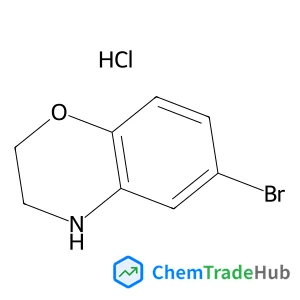
6-Bromo-3,4-dihydro-2H-1,4-benzoxazine hydrochloride (1:1)
CAS Number:
1260803-10-8
Molecular Formula:
C8H9BrClNO
Yong Du, Jochem Struppe, Barbara Perrone, Alia Hassan, Anna Codina, Yongchao Su
Solid-state nuclear magnetic resonance (ssNMR) is a high-resolution and versatile spectroscopic tool for characterizing pharmaceutical solids. However, the inherent low sensitivity of NMR remains a significant challenge in the analysis of natural abundance drug substances and products. Here, we report, for the first time, the application of a CPMAS CryoProbe™ to improve the sensitivity of 13C and 15N detection by approximately 5 to 6 times for solid-state analysis of a commercial pharmaceutical drug posaconazole (POSA). The sensitivity enhancement enables two-dimensional (2D) 13C–13C and 1H–15N correlation experiments, which are otherwise time-prohibitive using regular MAS probes, for resonance assignment and structural elucidation. These polarization transfer and correlation experiments reveal drug–drug and drug–polymer interactions in amorphous POSA and its amorphous solid dispersion formulation. Our results demonstrated that the CPMAS CryoProbe™ can be widely applied for routine pharmaceutical analysis and advanced structural investigations with significantly enhanced efficiency and throughput.
Wei Liu, Lu Fang
DOI: 10.1039/D2AN01818G
Chenhui Hao, Jinxiu Wei, Shenfei Zong, Zhuyuan Wang, Hong Wang, Yiping Cui
DOI: 10.1039/D2AN01662A
Kexuan Chen, Nan Ma, Haobo Sun, Xueji Zhang, Jinming Kong
DOI: 10.1039/D3AN00213F
Kendall A. Ryan
DOI: 10.1039/D3AN00106G
Yanxue Xu, Guihua Chen, Yunting Qin
DOI: 10.1039/D2AN02074B
Yupu Wei, Jinghui Shen, Jinlong Zhuo, Mingqi Xu, Yunliang Wang
DOI: 10.1039/D3AN00038A
Jiao Qin, Jinjin Li, Haisen Zeng, Juan Tang, Dianping Tang
DOI: 10.1039/D3AN00222E
Xuan Sun, Weiya Wang, Yanyan Chai, Zhou Zheng, Yu Wang, Jing Bi, Qian Wang, Yonggang Hu, Zhixian Gao
DOI: 10.1039/D2AN01793H
Pablo Rodríguez-González, Adriana González Gago, Eva Cernuda Morollón, Elena Lopez-Cancio, Belén Prieto García, J. Ignacio García Alonso
DOI: 10.1039/D2AN01750D
4-Nitrophenyl phosphate disodium salt hexahydrate is primarily used as a substra...
2-(Trifluoromethyl)-1,3-oxazole-4-carboxylic Acid (CAS: 1060816-01-4) is widely ...
2-Fluoro-4-biphenylcarboxylic acid should be stored in a cool, dry place at room...
Prednisolone-21-Carboxylic Acid is primarily used in the pharmaceutical industry...
4-(Hydrazinomethyl)-1,2,3-benzenetriol (CAS: 3614-72-0) should be stored in a co...
4-Amino-1-methyl-1H-pyrazole-5-carboxylic acid hydrochloride (CAS: 92534-70-8) i...
Dehydropachymic acid (CAS: 77012-31-8) is regulated by various agencies. It fall...
The market and research trends for 6-[(2,2-Dimethylpropanoyl)amino]nicotinic aci...
1,10-Phenanthroline-2,9-dicarbaldehyde should be stored in a cool, dry place awa...
5-Carbamoyl-11-oxo-10,11-dihydro-5H-dibenzo[b,f]azepin-10-yl acetate can be synt...

Analyst publishes analytical and bioanalytical research that reports premier fundamental discoveries and inventions, and the applications of those discoveries, unconfined by traditional discipline barriers.