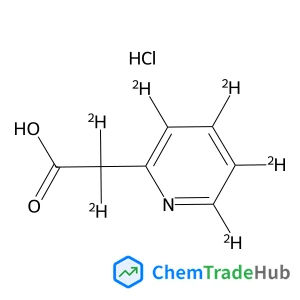
2,2-dideuterio-2-(3,4,5,6-tetradeuterio-2-pyridyl)acetic acid;hydrochloride
CAS Number:
1329799-67-8
Molecular Formula:
C7H2ClD6NO2
Nicolas Maïno, Arnaud Bertsch, Philippe Renaud
For over 30 years, carbon fiber microelectrodes have been the gold standard for measurements related to exocytosis and more generally to the processes taking place at the synaptic level. However, this method has a low throughput and molecules can escape detection due to the featureless nature of the planar microelectrodes it uses. Here we present a new electrochemical sensor that addresses these limitations. It is based on insulated protruding volcano-shaped tips of 2 μm in diameter housing two individually addressable microelectrodes. The sensor enables volume confined and parallelizable recordings of exocytosis from adherent cells. Exocytotic releases from PC12 cells measured by amperometry on our device have quantal size in agreement with commonly admitted values but happen on a much smaller time scale; mostly within half a millisecond. We demonstrate that this faster kinetics must involve a faster vesicle fusion mechanism and is plausibly due to perturbation of the plasma membrane brought by the topography of our sensor. This suggests that exocytosis kinetics may be manipulated by the adequate substrate geometry, which opens up promising new leads of investigation in the study of synaptic processes.
Neha Batra, Monika Tomar, Vinay Gupta
DOI: 10.1039/C2AN35693G
Vivek K. Rawat, Christopher J. Hogan, Jr.
DOI: 10.1039/C5AN00753D
Liang Feng, Hui Li, Yongjun Lv, Yafeng Guan
DOI: 10.1039/C2AN36215E
Hsin-Yi Li, Tzu-Hsuan Hsu, Chien-Yuan Chen, Ming-Chung Tseng, Yen-Ho Chu
DOI: 10.1039/C5AN01404B
Z. Farhane, F. Bonnier, A. Casey, A. Maguire, L. O'Neill, H. J. Byrne
DOI: 10.1039/C5AN01157D
Thiago C. Canevari, Leliz T. Arenas, Richard Landers, Rogério Custodio, Yoshitaka Gushikem
DOI: 10.1039/C2AN36170A
Kevin C. Hewitt, Hanna C. McGregor, Erin Brouwers, Michael A. Short, Samia B. Fashir, Haishan Zeng, Ian P. Alwayn
DOI: 10.1039/C5AN01080B
Melanie J. Bailey, Robert Bradshaw, Simona Francese, Tara L. Salter, Catia Costa, Roger P. Webb, Ingrid Bosman, Kim Wolff, Marcel de Puit
DOI: 10.1039/C5AN00112A
Bruce Grieve
DOI: 10.1039/C2AN35898K
Xuan Zhang, Wenjuan Zhou, Zhiqin Yuan, Chao Lu
DOI: 10.1039/C5AN01665G
4-Nitrophenyl phosphate disodium salt hexahydrate is primarily used as a substra...
2-(Trifluoromethyl)-1,3-oxazole-4-carboxylic Acid (CAS: 1060816-01-4) is widely ...
2-Fluoro-4-biphenylcarboxylic acid should be stored in a cool, dry place at room...
Prednisolone-21-Carboxylic Acid is primarily used in the pharmaceutical industry...
4-(Hydrazinomethyl)-1,2,3-benzenetriol (CAS: 3614-72-0) should be stored in a co...
4-Amino-1-methyl-1H-pyrazole-5-carboxylic acid hydrochloride (CAS: 92534-70-8) i...
Dehydropachymic acid (CAS: 77012-31-8) is regulated by various agencies. It fall...
The market and research trends for 6-[(2,2-Dimethylpropanoyl)amino]nicotinic aci...
1,10-Phenanthroline-2,9-dicarbaldehyde should be stored in a cool, dry place awa...
5-Carbamoyl-11-oxo-10,11-dihydro-5H-dibenzo[b,f]azepin-10-yl acetate can be synt...

Analyst publishes analytical and bioanalytical research that reports premier fundamental discoveries and inventions, and the applications of those discoveries, unconfined by traditional discipline barriers.
![(3R,5R)-1-[(Benzyloxy)carbonyl]-5-methyl-3-piperidinecarboxylic acid structure](https://static.chemtradehub.com/structs/126/1269757-29-0-c552.webp "(3R,5R)-1-[(Benzyloxy)carbonyl]-5-methyl-3-piperidinecarboxylic acid structure")