











Simultaneous electroanalytical determination of hydroquinone and catechol in the presence of resorcinol at an SiO2/C electrode spin-coated with a thin film of Nb2O5
Literature Information
Publication Date
2012-10-23
DOI
10.1039/C2AN36170A
Impact Factor
4.616
Authors
Thiago C. Canevari, Leliz T. Arenas, Richard Landers, Rogério Custodio, Yoshitaka Gushikem
View Original
Abstract
This paper describes the development, characterization and application of an Nb2O5 film formed on the surface of a carbon ceramic material, SiO2/C, obtained by a sol–gel method, using the spin-coating technique. The working electrode using this material will be designated as SiCNb. Hydroquinone and catechol can be oxidized at this electrode in the presence of resorcinol, allowing their simultaneous detection. The electrochemical properties of the resulting electrode were investigated using cyclic and differential pulse voltammetry techniques. Well-defined and separated oxidation peaks were observed by differential pulse voltammetry in Tris–HCl buffer solution at pH 7 containing 1 mol L−1 KCl in the supporting electrolyte solution. The SiCNb electrode exhibited high sensitivity in the simultaneous determination of hydroquinone and catechol in the presence of resorcinol, with the limits of detection for hydroquinone and catechol being 1.6 μmol L−1 and 0.8 μmol L−1, respectively. Theoretical calculations were performed to determine the ionization energies of hydroquinone, catechol and resorcinol; the results were used to explain the simultaneous determination of species by differential pulse voltammetry. The presence of resorcinol did not produce any interference in the simultaneous detection of hydroquinone and catechol on the surface of the modified electrode.
Recommended Journals
Related Literature
Peripheral cyclic β-amino acids balance the stability and edge-protection of β-sandwiches
Anasztázia Hetényi, Edit Wéber, Titanilla Szögi, Lívia Fülöp
2018-07-16
Paper
DOI: 10.1039/C8OB01322E
Synthesis of imidazo[1,5-a]pyridines via I2-mediated sp3 C–H amination
Zhiyuan Hu, Jiao Hou, Jie Liu, Wenquan Yu, Junbiao Chang
2018-07-17
Paper
DOI: 10.1039/C8OB01501E
Two catalytic protocols for Achmatowicz rearrangement using cyclic diacyl peroxides as oxidants
2018-07-17
Communication
DOI: 10.1039/C8OB01382A
Correction: Hydrazone-Pd-catalyzed direct intermolecular reaction of o-alkynylphenols with allylic acetates
Kohei Watanabe, Eri Ishikawa, Chihiro Masuda
2018-07-11
Correction
DOI: 10.1039/C8OB90094A
Ruthenium-catalyzed synthesis of arylethyl 1,3,5-triazines from arylallyl alcohols and biguanides
Chen Zhang
2018-08-07
Paper
DOI: 10.1039/C8OB01397G
Application of a bodipy–C70 dyad in triplet–triplet annihilation upconversion of perylene as a metal-free photosensitizer
Yaxiong Wei, Min Zheng, Qiaohui Zhou, Xiaoguo Zhou, Shilin Liu
2018-07-13
Paper
DOI: 10.1039/C8OB01410H
Synthesis of near-infrared absorbing and fluorescent bis(pyrrol-2-yl)squaraines and their halochromic properties
Yasuhiro Kubota, Masato Nakazawa, Junheon Lee, Ryoma Naoi, Motoki Tachikawa, Toshiyasu Inuzuka, Kazumasa Funabiki, Masaki Matsui, Taekyeong Kim
2021-09-10
Research Article
DOI: 10.1039/D1QO01169C
C–H alkylation reactions of indoles mediated by Pd(ii) and norbornene: applications and recent developments
Marcus Wegmann, Michael Henkel, Thorsten Bach
2018-07-04
Review Article
DOI: 10.1039/C8OB01025K
Nα-Amino acid containing privileged structures: design, synthesis and use in solid-phase peptide synthesis
Eva Schütznerová, Adam Přibylka
2018-07-12
Paper
DOI: 10.1039/C8OB01485J
Organocatalytic enantioselective Diels–Alder reaction between hydroxymaleimides and in situ generated nitrosoalkenes for direct preparation of chiral hemiketals with 1,2-oxazine skeleton
Fang Tian, Wen-Juan Wan, Li-Xin Wang
2021-08-30
Research Article
DOI: 10.1039/D1QO01022K
You might also like
Compound Q&A
What are the main uses of 4-Nitrophenyl phosphate disodium salt hexahydrate (CAS: 333338-18-4)?
4-Nitrophenyl phosphate disodium salt hexahydrate is primarily used as a substra...
333338-18-44-Nitrophenyl phosph...
Compound Q&A
What are the main uses of 2-(Trifluoromethyl)-1,3-oxazole-4-carboxylic Acid (CAS: 1060816-01-4)?
2-(Trifluoromethyl)-1,3-oxazole-4-carboxylic Acid (CAS: 1060816-01-4) is widely ...
1060816-01-42-(Trifluoromethyl)-...
Compound Q&A
How should 2-Fluoro-4-biphenylcarboxylic acid (CAS: 137045-30-8) be stored?
2-Fluoro-4-biphenylcarboxylic acid should be stored in a cool, dry place at room...
137045-30-82-Fluoro-4-biphenylc...
Compound Q&A
What industries use Prednisolone-21-Carboxylic Acid (CAS: 61549-70-0)?
Prednisolone-21-Carboxylic Acid is primarily used in the pharmaceutical industry...
61549-70-0Prednisolone-21-Carb...
Compound Q&A
How should 4-(Hydrazinomethyl)-1,2,3-benzenetriol (CAS: 3614-72-0) be stored?
4-(Hydrazinomethyl)-1,2,3-benzenetriol (CAS: 3614-72-0) should be stored in a co...
3614-72-04-(Hydrazinomethyl)-...
Compound Q&A
What industries use 4-Amino-1-methyl-1H-pyrazole-5-carboxylic acid hydrochloride (CAS: 92534-70-8)?
4-Amino-1-methyl-1H-pyrazole-5-carboxylic acid hydrochloride (CAS: 92534-70-8) i...
92534-70-84-Amino-1-methyl-1H-...
Compound Q&A
What regulatory guidelines apply to dehydropachymic acid (CAS: 77012-31-8)?
Dehydropachymic acid (CAS: 77012-31-8) is regulated by various agencies. It fall...
77012-31-8Dehydropachymic acid
Compound Q&A
What is the market or research trend for 6-[(2,2-Dimethylpropanoyl)amino]nicotinic acid (CAS: 898561-66-5)?
The market and research trends for 6-[(2,2-Dimethylpropanoyl)amino]nicotinic aci...
898561-66-56-[(2,2-Dimethylprop...
Compound Q&A
How should 1,10-Phenanthroline-2,9-dicarbaldehyde (CAS: 57709-62-3) be stored?
1,10-Phenanthroline-2,9-dicarbaldehyde should be stored in a cool, dry place awa...
57709-62-31,10-Phenanthroline-...
Compound Q&A
How is 5-Carbamoyl-11-oxo-10,11-dihydro-5H-dibenzo[b,f]azepin-10-yl acetate (CAS: 113952-21-9) typically synthesized?
5-Carbamoyl-11-oxo-10,11-dihydro-5H-dibenzo[b,f]azepin-10-yl acetate can be synt...
113952-21-95-Carbamoyl-11-oxo-1...
Source Journal
Analyst

CiteScore:
7.8
Self-citation Rate:
5.6%
Articles per Year:
653
Analyst publishes analytical and bioanalytical research that reports premier fundamental discoveries and inventions, and the applications of those discoveries, unconfined by traditional discipline barriers.
Recommended Compounds
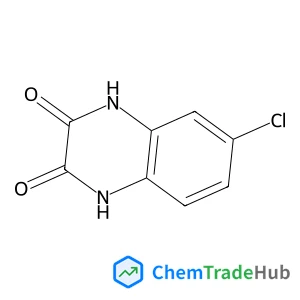
6-CHLORO-2,3-DIOXO-1,2,3,4-TETRAHYDROQUINOXALINE, 97
CAS Number:
169-14-2
Molecular Formula:
C8H5ClN2O2
Recommended Suppliers





Disclaimer
This page provides academic journal information for reference and research purposes only. We are not affiliated with any journal publishers and do not handle publication submissions. For publication-related inquiries, please contact the respective journal publishers directly.
If you notice any inaccuracies in the information displayed, please contact us at support@chemtradehub.com. We will promptly review and address your concerns.