












Synthesis of polysubstituted azetidines via cascade trifluoromethylation/cyclization of N-allyl ynamides
Literature Information
Publication Date
2021-06-14
DOI
10.1039/D1QO00559F
Impact Factor
5.281
Authors
Genlai Zhou, Jingwen Su, Tianbo Shang, Xiaojuan Wang, Yihui Bai, Zheliang Yuan, Gangguo Zhu
View Original
Abstract
Traditional methods for the transformation of N-allyl ynamides rely on the formation of a ketenimine intermediate or its equivalent, while novel reaction modes remain to be developed. Herein, a cascade trifluoromethylation/cyclization of N-allyl sulfonylynamides is realized, which provides a facile access to azetidine-fused tricyclic compounds under very mild reaction conditions. It represents a rare example of 4-exo-dig radical cyclization, thus opening up a new opportunity for constructing synthetically attractive azetidines from the readily available N-allyl ynamides.
Related Literature
Anion clusters of naphthalene and solvents: structure, ion core, and intermolecular interactions
Sang Hak Lee, Jeong Hyun Kim, Inho Chu, Jae Kyu Song
2009-08-25
Paper
DOI: 10.1039/B903626A
Molecular self-assembly in a model amphiphile system
Lorna Dougan, John L. Finney, Alan K. Soper
2010-06-10
Paper
DOI: 10.1039/C003407J
Formation and localization of a solvated electron in ground and low-lying excited states of Li(NH3)n and Li(H2O)nclusters: a comparison with Na(NH3)n and Na(H2O)n
Kenro Hashimoto, Kota Daigoku
2009-08-25
Paper
DOI: 10.1039/B907766A
Inelastic neutron scattering and Raman spectroscopic investigation of l-alanine alaninium nitrate, a homologue of a ferroelectric material
Matthew R. Hudson, Damian G. Allis, Wayne Ouellette, Bruce S. Hudson
2009-08-21
Paper
DOI: 10.1039/B905070A
Facile method for spectroscopic examination of radical ions of hydrophilic carotenoids
K. Razi Naqvi, Thor Bernt Melø, Tamás Jávorfi, Sergio González-Pérez
2009-06-09
Paper
DOI: 10.1039/B905454E
Vibrational spectroscopy and DFT calculations of the di-amino acid peptidel-aspartyl-l-glutamic acid in the zwitterionic state
Nighat Kausar, Trevor J. Dines, Babur Z. Chowdhry, Bruce D. Alexander
2009-06-11
Paper
DOI: 10.1039/B903131F
You might also like
Compound Q&A
How should waste containing N-Methoxy-N-methyl-1,3-thiazole-5-carboxamide (CAS: 898825-89-3) be handled?
Waste containing N-Methoxy-N-methyl-1,3-thiazole-5-carboxamide (CAS: 898825-89-3...
898825-89-3N-Methoxy-N-methyl-1...
Compound Q&A
How should N-(4-Biphenylyl)dibenzo[b,d]furan-4-amine (CAS: 1318338-47-4) be stored?
N-(4-Biphenylyl)dibenzo[b,d]furan-4-amine should be stored in a tightly sealed c...
1318338-47-4N-(4-Biphenylyl)dibe...
Compound Q&A
What is the market or research trend for 3-Acetamido-5-amino-2,4,6-triiodobenzoic acid (CAS: 1713-07-1)?
The market for 3-Acetamido-5-amino-2,4,6-triiodobenzoic acid (CAS: 1713-07-1) is...
1713-07-13-Acetamido-5-amino-...
Compound Q&A
How should Benzyl 2-O-acetyl-3,4,6-tri-O-benzyl-beta-D-galactopyranoside (CAS: 61820-03-9) be stored?
Benzyl 2-O-acetyl-3,4,6-tri-O-benzyl-beta-D-galactopyranoside (CAS: 61820-03-9) ...
61820-03-9Benzyl 2-O-acetyl-3,...
Compound Q&A
What regulatory guidelines apply to 2-Ethylpiperazine dihydrochloride (CAS: 438050-52-3)?
2-Ethylpiperazine dihydrochloride (CAS: 438050-52-3) is regulated under the Glob...
438050-52-32-Ethylpiperazine di...
Compound Q&A
What regulatory guidelines apply to 1,1'-[1,3-Phenylenebis(methylene)]bis(3-methyl-1H-pyrrole-2,5-dione) (CAS: 119462-56-5)?
1,1'-[1,3-Phenylenebis(methylene)]bis(3-methyl-1H-pyrrole-2,5-dione) (CAS: 11946...
119462-56-51,1'-[1,3-Phenyleneb...
Compound Q&A
Are there alternatives to 5-Fluoro-2-(1-pyrrolidinyl)pyridine (CAS: 1287217-79-1) in synthesis?
Several alternatives can be used in the synthesis of 5-Fluoro-2-(1-pyrrolidinyl)...
1287217-79-15-Fluoro-2-(1-pyrrol...
Compound Q&A
What precautions should be taken when handling 1-((2R,3R,4R,5R)-5-((bis(4-methoxyphenyl)(phenyl)methoxy)methyl)-4-hydroxy-3-methoxytetrahydrofuran-2-yl)-5-methylpyrimidine-2,4(1H,3H)-dione (CAS: 153631-19-7)?
Proper personal protective equipment (PPE) must be worn when handling this compo...
153631-19-71-((2R,3R,4R,5R)-5-(...
Compound Q&A
What precautions should be taken when handling 6-Bromoimidazo[1,2-a]pyridin-8-amine (CAS: 676371-00-9)?
When handling 6-Bromoimidazo[1,2-a]pyridin-8-amine, it is important to wear appr...
676371-00-96-Bromoimidazo[1,2-a...
Compound Q&A
Are there alternatives to (2S,4R)-4-(4-Nitrobenzyl)pyrrolidine-2-carboxylic acid hydrochloride (CAS: 1049740-22-8) in synthesis?
Alternatives to (2S,4R)-4-(4-Nitrobenzyl)pyrrolidine-2-carboxylic acid hydrochlo...
1049740-22-8(2S,4R)-4-(4-Nitrobe...
Source Journal
Organic Chemistry Frontiers

CiteScore:
7.8
Self-citation Rate:
8.7%
Articles per Year:
724
Organic Chemistry Frontiers publishes high-quality research from across organic chemistry. Emphases are placed on studies that make significant contributions to the field of organic chemistry by reporting either new or significantly improved protocols or methodologies. Topics include, but are not limited to the following: Organic synthesis Development of synthetic methodologies Catalysis Natural products Functional organic materials Supramolecular and macromolecular chemistry Physical and computational organic chemistry
Recommended Compounds



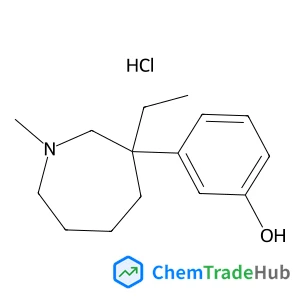
3-(3-Ethyl-1-methyl-3-azepanyl)phenol hydrochloride (1:1)
CAS Number:
59263-76-2
Molecular Formula:
C15H24ClNO
Recommended Suppliers






Disclaimer
This page provides academic journal information for reference and research purposes only. We are not affiliated with any journal publishers and do not handle publication submissions. For publication-related inquiries, please contact the respective journal publishers directly.
If you notice any inaccuracies in the information displayed, please contact us at support@chemtradehub.com. We will promptly review and address your concerns.