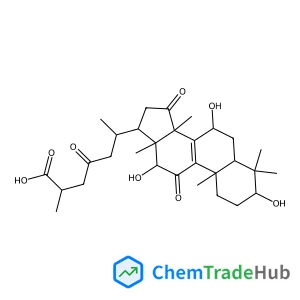
(3beta,7beta,12beta)-3,7,12-Trihydroxy-11,15,23-trioxolanost-8-en-26-oic acid
CAS Number:
98665-22-6
Molecular Formula:
C30H44O8
The concept of detailed balance is central to the field of chemical kinetics and provides important constraints on relationships between equilibrium and rate constants. Miller et al. [Phys. Chem. Chem. Phys., 2009, 11, 1128] have recently proposed that having the ratio of forward and reverse rate constants equal to the equilibrium constant—a relationship they equate with detailed balance—is a sufficient condition to guarantee that a chemical system eventually relaxes to equilibrium. This assertion is true, however, only for an isolated system. In a closed system, where energy exchange between the system and the environment occurs, input of energy in the form of an externally driven oscillation of a thermodynamic parameter (e.g. pressure or electric field strength), can maintain a chemical system in a stationary state away from equilibrium even if the ratio of the forward and backward rate constants for each elementary reaction equals the equilibrium constant at every instant. This fact allows appropriately designed molecules to serve as free-energy transducers and molecular machines.

Organic Preparations and Procedures International

Proceedings of the National Academy of Sciences of the United States of America

Journal of Catalysis

Journal of Medicinal Chemistry

Pure and Applied Chemistry

Molecular Pharmacology

Fibre Chemistry

Science Progress

Kinetics and Catalysis

Israel Journal of Chemistry
B. V. Nazarchuk, V. V. Golovanova, N. V. Tkachenko, T. T. Rantala
DOI: 10.1039/C7CP00833C
E. Avellanal-Zaballa, G. Durán-Sampedro, A. Prieto-Castañeda, A. R. Agarrabeitia, I. García-Moreno, I. López-Arbeloa, J. Bañuelos, M. J. Ortiz
DOI: 10.1039/C7CP01626C
Elena Castellucci, Laura Bussotti, Lorenzo Zani, Gianna Reginato
DOI: 10.1039/C7CP01956D
Francesco Nastasi, Giuseppina La Ganga, Sebastiano Campagna, Zois Syrgiannis, Francesco Rigodanza, Stefania Vitale, Antonino Licciardello
DOI: 10.1039/C7CP01597F
Hongbao Li, Jun Jiang
DOI: 10.1039/C7CP01380A
P. Anees, M. C. Valsakumar, B. K. Panigrahi
DOI: 10.1039/C6CP08635G
Fang Niu, Rainer Schulz, Arcesio Castañeda Medina, Rochus Schmid
DOI: 10.1039/C6CP08908A
Arseniy A. Otlyotov, Jan-Hendrik Lamm, Sebastian Blomeyer, Norbert W. Mitzel, Vladimir V. Rybkin, Yuriy A. Zhabanov, Natalya V. Tverdova, Nina I. Giricheva, Georgiy V. Girichev
DOI: 10.1039/C7CP01781B
Xiaodan Xu, Lu Cai, Xiaoli Zheng, Qun Xu
DOI: 10.1039/C7CP01277B
Waste containing N-Methoxy-N-methyl-1,3-thiazole-5-carboxamide (CAS: 898825-89-3...
N-(4-Biphenylyl)dibenzo[b,d]furan-4-amine should be stored in a tightly sealed c...
The market for 3-Acetamido-5-amino-2,4,6-triiodobenzoic acid (CAS: 1713-07-1) is...
Benzyl 2-O-acetyl-3,4,6-tri-O-benzyl-beta-D-galactopyranoside (CAS: 61820-03-9) ...
2-Ethylpiperazine dihydrochloride (CAS: 438050-52-3) is regulated under the Glob...
1,1'-[1,3-Phenylenebis(methylene)]bis(3-methyl-1H-pyrrole-2,5-dione) (CAS: 11946...
Several alternatives can be used in the synthesis of 5-Fluoro-2-(1-pyrrolidinyl)...
Proper personal protective equipment (PPE) must be worn when handling this compo...
When handling 6-Bromoimidazo[1,2-a]pyridin-8-amine, it is important to wear appr...
Alternatives to (2S,4R)-4-(4-Nitrobenzyl)pyrrolidine-2-carboxylic acid hydrochlo...

Physical Chemistry Chemical Physics (PCCP) is an international journal co-owned by 19 physical chemistry and physics societies from around the world. This journal publishes original, cutting-edge research in physical chemistry, chemical physics and biophysical chemistry. To be suitable for publication in PCCP, articles must include significant innovation and/or insight into physical chemistry; this is the most important criterion that reviewers and Editors will judge against when evaluating submissions. The journal has a broad scope and welcomes contributions spanning experiment, theory, computation and data science. Topical coverage includes spectroscopy, dynamics, kinetics, statistical mechanics, thermodynamics, electrochemistry, catalysis, surface science, quantum mechanics, quantum computing and machine learning. Interdisciplinary research areas such as polymers and soft matter, materials, nanoscience, energy, surfaces/interfaces, and biophysical chemistry are welcomed if they demonstrate significant innovation and/or insight into physical chemistry. Joined experimental/theoretical studies are particularly appreciated when complementary and based on up-to-date approaches.