













Electrochemical oxidative synthesis of 1,3,4-thiadiazoles from isothiocyanates and hydrazones
Literature Information
Publication Date
2021-03-04
DOI
10.1039/D1QO00168J
Impact Factor
5.281
Authors
Zhongxiao Ma, Xiao Hu, Yanni Li, Deqiang Liang, Ying Dong, Baoling Wang, Weili Li
View Original
Abstract
A 2,3-dichloro-5,6-dicyano-1,4-benzoquinone (DDQ)-catalysed electrochemical synthesis of 2-amino-1,3,4-thiadiazoles from isothiocyanates and hydrazones is presented. This protocol is mild, practical, metal-free and exogenous oxidant-free, and features a broad substrate scope. Extensive mechanistic investigations revealed that the reaction proceeds via a tandem addition/chemoselective C–S coupling sequence, and it is the hydrogenated DDQ that is oxidized at the anode, not the intermediate thiosemicarbazides.
Related Literature
Reversible transient hydrogenstorage in a fuelcell–supercapacitor hybrid device
Jesus E. Zerpa Unda, Emil Roduner
2012-02-09
Paper
DOI: 10.1039/C2CP23140A
Finite-element simulations of the influence of pore wall adsorption on cyclic voltammetry of ion transfer across a liquid–liquid interface formed at a micropore
Jonathan S. Ellis, Jörg Strutwolf, Damien W. M. Arrigan
2012-01-16
Paper
DOI: 10.1039/C2CP23052F
On the modeling of aggregates of an optically active regioregular polythiophene
Juan Torras, Cristina Sanchez-Navas, Oscar Bertran
2011-12-06
Paper
DOI: 10.1039/C2CP23122K
First-principles investigation of transition metal atom M (M = Cu, Ag, Au) adsorption on CeO2(110)
Yuanhao Tang, Hua Zhang, Louis G. Hector, Jr., Chuying Ouyang, Hong Li, Liquan Chen
2012-01-09
Paper
DOI: 10.1039/C2CP22720G
Lyotropic liquid crystalline phase behaviour in amphiphile–protic ionic liquid systems
Tamar L. Greaves, Celesta Fong, Calum J. Drummond
2012-01-19
Paper
DOI: 10.1039/C2CP23698B
An operando DRIFTS investigation into the resistance against CO2 poisoning of a Rh/alumina catalyst during toluenehydrogenation
Julien Scalbert, Frederic C. Meunier, Cecile Daniel, Yves Schuurman
2011-10-11
Paper
DOI: 10.1039/C1CP22620G
Proton magnetic resonance imaging with para-hydrogen induced polarization
Lisandro Buljubasich, Laura M. Schreiber, Hans W. Spiess, Kerstin Münnemann
2012-01-12
Paper
DOI: 10.1039/C2CP22822J
Cooperative effect of temperature and linker functionality on CO2 capture from industrial gas mixtures in metal–organic frameworks: a combined experimental and molecular simulation study
Wenjuan Zhang, Hongliang Huang, Chongli Zhong, Dahuan Liu
2011-12-08
Paper
DOI: 10.1039/C2CP23839J
You might also like
Compound Q&A
What are the main uses of (3.beta.)-3-Hydroxy-N,N-dimethyl-chol-5-en-24-amide (CAS: 79066-03-8)?
(3.beta.)-3-Hydroxy-N,N-dimethyl-chol-5-en-24-amide (CAS: 79066-03-8) is primari...
79066-03-8(3.beta.)-3-Hydroxy-...
Compound Q&A
What regulatory guidelines apply to 5-(aminomethyl)-2-methoxyphenol (CAS: 89702-89-6)?
5-(Aminomethyl)-2-methoxyphenol (CAS: 89702-89-6) is classified under GHS as a s...
89702-89-65-(aminomethyl)-2-me...
Compound Q&A
What is Thieno[2,3-c]pyridin-7(6H)-one (CAS: 28981-13-7)?
Thieno[2,3-c]pyridin-7(6H)-one (CAS: 28981-13-7) is a heterocyclic organic compo...
28981-13-7Thieno[2,3-c]pyridin...
Compound Q&A
Is 1-[(6-Methoxy-3-pyridinyl)methyl]-4-piperidinamine dihydrochloride (CAS: 1185311-28-7) safe?
1-[(6-Methoxy-3-pyridinyl)methyl]-4-piperidinamine dihydrochloride is generally ...
1185311-28-71-[(6-Methoxy-3-pyri...
Compound Q&A
What regulatory guidelines apply to [(2E)-3-Phenyl-2-propen-1-yl]phosphonic acid (CAS: 146404-58-2)?
[(2E)-3-Phenyl-2-propen-1-yl]phosphonic acid (CAS: 146404-58-2) is regulated und...
146404-58-2[(2E)-3-Phenyl-2-pro...
Compound Q&A
What regulatory guidelines apply to 6-Bromo-7-methoxyquinoline (CAS: 1620515-86-7)?
6-Bromo-7-methoxyquinoline (CAS: 1620515-86-7) falls under the scope of the Glob...
1620515-86-76-Bromo-7-methoxyqui...
Compound Q&A
What industries use (2R)-1-(1-Benzofuran-2-yl)-N-propyl-2-pentanamine (CAS: 260550-89-8)?
This compound is primarily used in the pharmaceutical industry for the developme...
260550-89-8(2R)-1-(1-Benzofuran...
Compound Q&A
What are the main uses of 1-Ethyl-7-[2-methyl-6-(4H-1,2,4-triazol-3-yl)-3-pyridinyl]-3,5-dihydropyrazino[2,3-b]pyrazin-2(1H)-one (CAS: 1228013-15-7)?
1-Ethyl-7-[2-methyl-6-(4H-1,2,4-triazol-3-yl)-3-pyridinyl]-3,5-dihydropyrazino[2...
1228013-15-71-Ethyl-7-[2-methyl-...
Compound Q&A
Are there alternatives to {5-(Acryloylamino)-2-[(dimethylamino)methyl]phenyl}boronic acid (CAS: 1217500-78-1) in synthesis?
Alternative reagents such as 2-[(dimethylamino)methyl]phenylboronic acid or rela...
1217500-78-1{5-(Acryloylamino)-2...
Compound Q&A
What is 3-(Piperidin-4-yloxy)pyridine (CAS: 310881-48-2)?
3-(Piperidin-4-yloxy)pyridine (CAS: 310881-48-2) is an organic compound with the...
310881-48-23-(Piperidin-4-yloxy...
Source Journal
Organic Chemistry Frontiers

CiteScore:
7.8
Self-citation Rate:
8.7%
Articles per Year:
724
Organic Chemistry Frontiers publishes high-quality research from across organic chemistry. Emphases are placed on studies that make significant contributions to the field of organic chemistry by reporting either new or significantly improved protocols or methodologies. Topics include, but are not limited to the following: Organic synthesis Development of synthetic methodologies Catalysis Natural products Functional organic materials Supramolecular and macromolecular chemistry Physical and computational organic chemistry
Recommended Compounds
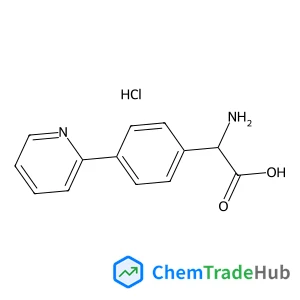
2-Amino-2-(4-(pyridin-2-YL)phenyl)acetic acid hydrochloride
CAS Number:
1135818-89-1
Molecular Formula:
C13H13ClN2O2

(4aS,10aS)-7-Isopropyl-1,4a-dimethyl-5,8-dioxo-3,4,4a,5,8,9,10,10a-octahydro-2-phenanthrenecarboxylic acid
CAS Number:
142950-86-5
Molecular Formula:
C20H24O4
Recommended Suppliers



Disclaimer
This page provides academic journal information for reference and research purposes only. We are not affiliated with any journal publishers and do not handle publication submissions. For publication-related inquiries, please contact the respective journal publishers directly.
If you notice any inaccuracies in the information displayed, please contact us at support@chemtradehub.com. We will promptly review and address your concerns.