












Cooperative effect of temperature and linker functionality on CO2 capture from industrial gas mixtures in metal–organic frameworks: a combined experimental and molecular simulation study
Literature Information
Publication Date
2011-12-08
DOI
10.1039/C2CP23839J
Impact Factor
3.676
Authors
Wenjuan Zhang, Hongliang Huang, Chongli Zhong, Dahuan Liu
View Original
Abstract
In this work, the cooperative effect of temperature and linker functionality on CO2 capture in metal–organic frameworks (MOFs) was investigated using experimental measurements in combination with molecular simulations. To do this, four MOFs with identical topology but different functional groups on the linkers and three important CO2-containing industrial gas mixtures were adopted. The interplay between linker functionality and temperature was analyzed in terms of CO2 storage capacity, adsorption selectivity, working capacity of CO2 in temperature swing adsorption (TSA) processes, as well as sorbent selection parameter (Sssp). The results show that the effect of linker functionality on CO2 capture performance in the MOFs is strongly interconnected with temperature: up to moderate pressures, the lower the temperature, the larger the effect of the functional groups. Furthermore, the modification of a MOF by introducing more complex functional groups can not only improve the affinity of framework for CO2, but also reduce the free volume, and thus may contribute negatively to CO2 capture capability when the packing effect is obvious. Therefore, when we design a new MOF for a certain CO2 capture process operated at a certain temperature, the MOF should be designed to have maximized affinity for CO2 but with a negligible or small effect caused by the reduction of free volume at that temperature and the corresponding operating pressure.
Recommended Journals
Related Literature
The effects of polymer topology and chain length on the antimicrobial activity and hemocompatibility of amphiphilic ternary copolymers
Rashin Namivandi-Zangeneh, Rebecca J. Kwan, Thuy-Khanh Nguyen, Jonathan Yeow, Frances L. Byrne, Edgar H. H. Wong, Cyrille Boyer
2017-08-18
Paper
DOI: 10.1039/C7PY01069A
Polyallene-based amphiphilic triblock copolymer via successive free radical polymerization and ATRP
Hao Guo, Xiaoyu Huang
2017-11-27
Paper
DOI: 10.1039/C7PY01407D
Cd2+ coordination: an efficient structuring switch for polypeptide polymers
2018-06-13
Communication
DOI: 10.1039/C8PY00810H
Nanogel-like UCST triblock copolymer micelles showing large volume expansion before abrupt dissolution
Amélie Augé, Daniel Fortin, Xia Tong, Yue Zhao
2018-08-13
Paper
DOI: 10.1039/C8PY00960K
Photoinduced Fe-mediated atom transfer radical polymerization in aqueous media
Chao Bian, Yin-Ning Zhou, Jun-Kang Guo, Zheng-Hong Luo
2017-11-08
Paper
DOI: 10.1039/C7PY01762F
ROS-responsive poly(ε-caprolactone) with pendent thioether and selenide motifs
Li Yu, Mei Zhang, Fu-Sheng Du, Zi-Chen Li
2018-06-21
Paper
DOI: 10.1039/C8PY00620B
Branching and molar mass analysis of low density polyethylene using the multiple preparative fractionation concept
P. S. Eselem Bungu, H. Pasch
2018-02-08
Paper
DOI: 10.1039/C7PY02076G
Generation of a carbon dots/ammonium persulfate redox initiator couple for free radical frontal polymerization
2017-12-21
Paper
DOI: 10.1039/C7PY01969F
You might also like
Compound Q&A
What are the main uses of (3.beta.)-3-Hydroxy-N,N-dimethyl-chol-5-en-24-amide (CAS: 79066-03-8)?
(3.beta.)-3-Hydroxy-N,N-dimethyl-chol-5-en-24-amide (CAS: 79066-03-8) is primari...
79066-03-8(3.beta.)-3-Hydroxy-...
Compound Q&A
What regulatory guidelines apply to 5-(aminomethyl)-2-methoxyphenol (CAS: 89702-89-6)?
5-(Aminomethyl)-2-methoxyphenol (CAS: 89702-89-6) is classified under GHS as a s...
89702-89-65-(aminomethyl)-2-me...
Compound Q&A
What is Thieno[2,3-c]pyridin-7(6H)-one (CAS: 28981-13-7)?
Thieno[2,3-c]pyridin-7(6H)-one (CAS: 28981-13-7) is a heterocyclic organic compo...
28981-13-7Thieno[2,3-c]pyridin...
Compound Q&A
Is 1-[(6-Methoxy-3-pyridinyl)methyl]-4-piperidinamine dihydrochloride (CAS: 1185311-28-7) safe?
1-[(6-Methoxy-3-pyridinyl)methyl]-4-piperidinamine dihydrochloride is generally ...
1185311-28-71-[(6-Methoxy-3-pyri...
Compound Q&A
What regulatory guidelines apply to [(2E)-3-Phenyl-2-propen-1-yl]phosphonic acid (CAS: 146404-58-2)?
[(2E)-3-Phenyl-2-propen-1-yl]phosphonic acid (CAS: 146404-58-2) is regulated und...
146404-58-2[(2E)-3-Phenyl-2-pro...
Compound Q&A
What regulatory guidelines apply to 6-Bromo-7-methoxyquinoline (CAS: 1620515-86-7)?
6-Bromo-7-methoxyquinoline (CAS: 1620515-86-7) falls under the scope of the Glob...
1620515-86-76-Bromo-7-methoxyqui...
Compound Q&A
What industries use (2R)-1-(1-Benzofuran-2-yl)-N-propyl-2-pentanamine (CAS: 260550-89-8)?
This compound is primarily used in the pharmaceutical industry for the developme...
260550-89-8(2R)-1-(1-Benzofuran...
Compound Q&A
What are the main uses of 1-Ethyl-7-[2-methyl-6-(4H-1,2,4-triazol-3-yl)-3-pyridinyl]-3,5-dihydropyrazino[2,3-b]pyrazin-2(1H)-one (CAS: 1228013-15-7)?
1-Ethyl-7-[2-methyl-6-(4H-1,2,4-triazol-3-yl)-3-pyridinyl]-3,5-dihydropyrazino[2...
1228013-15-71-Ethyl-7-[2-methyl-...
Compound Q&A
Are there alternatives to {5-(Acryloylamino)-2-[(dimethylamino)methyl]phenyl}boronic acid (CAS: 1217500-78-1) in synthesis?
Alternative reagents such as 2-[(dimethylamino)methyl]phenylboronic acid or rela...
1217500-78-1{5-(Acryloylamino)-2...
Compound Q&A
What is 3-(Piperidin-4-yloxy)pyridine (CAS: 310881-48-2)?
3-(Piperidin-4-yloxy)pyridine (CAS: 310881-48-2) is an organic compound with the...
310881-48-23-(Piperidin-4-yloxy...
Source Journal
Physical Chemistry Chemical Physics

CiteScore:
5.5
Self-citation Rate:
10.3%
Articles per Year:
3036
Physical Chemistry Chemical Physics (PCCP) is an international journal co-owned by 19 physical chemistry and physics societies from around the world. This journal publishes original, cutting-edge research in physical chemistry, chemical physics and biophysical chemistry. To be suitable for publication in PCCP, articles must include significant innovation and/or insight into physical chemistry; this is the most important criterion that reviewers and Editors will judge against when evaluating submissions. The journal has a broad scope and welcomes contributions spanning experiment, theory, computation and data science. Topical coverage includes spectroscopy, dynamics, kinetics, statistical mechanics, thermodynamics, electrochemistry, catalysis, surface science, quantum mechanics, quantum computing and machine learning. Interdisciplinary research areas such as polymers and soft matter, materials, nanoscience, energy, surfaces/interfaces, and biophysical chemistry are welcomed if they demonstrate significant innovation and/or insight into physical chemistry. Joined experimental/theoretical studies are particularly appreciated when complementary and based on up-to-date approaches.
Recommended Compounds
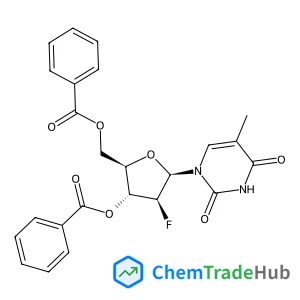
1-(3',5'-Di-O-benzoyl-2'-deoxy-2'-fluoro-b-D-arabinofuranosyl)thymine
CAS Number:
97614-47-6
Molecular Formula:
C24H21FN2O7
Recommended Suppliers





Disclaimer
This page provides academic journal information for reference and research purposes only. We are not affiliated with any journal publishers and do not handle publication submissions. For publication-related inquiries, please contact the respective journal publishers directly.
If you notice any inaccuracies in the information displayed, please contact us at support@chemtradehub.com. We will promptly review and address your concerns.