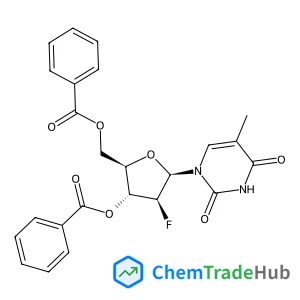
1-(3',5'-Di-O-benzoyl-2'-deoxy-2'-fluoro-b-D-arabinofuranosyl)thymine
CAS Number:
97614-47-6
Molecular Formula:
C24H21FN2O7
Juan Torras, Cristina Sanchez-Navas, Oscar Bertran
The conformational properties of the optically active regioregular poly[(R)-3-(4-(4-ethyl-2-oxazolin-2-yl) phenyl) thiophene] (PEOPT) were explored by molecular dynamics on a single chain using several solvents of increasing polarity. Furthermore, their aggregate formation was studied over a wide range of temperatures using a replica exchange molecular dynamics simulation providing simulation data representative of the equilibrium behaviour of their aggregates. Results show a clear tendency of PEOPT to keep a syn–gauche conformation between continuous backbone thiophene rings favouring a bent chain structure in solvent. After studying their aggregation behaviour in acetonitrile, a strong tendency to pack stabilizing structures that reinforce the chirality of the polymer, in concordance with experimental data, was found. Two different aggregated structures were observed depending on oligomer length, a self-assembled helical aggregate based on stacked octamers and a bent double helix aggregate in large oligomers.
DOI: 10.1039/C8PY00810H
R. W. M. Davidson, G. W. Simpson, J. Chiefari, M. J. Fuchter
DOI: 10.1039/C7PY01363A
Rongzong Zheng, Jiaqiang Zhang, Chunyang Jia, Zhongquan Wan, Yaru Fan, Xiaolong Weng, Jianliang Xie, Longjiang Deng
DOI: 10.1039/C7PY01434A
Amélie Augé, Daniel Fortin, Xia Tong, Yue Zhao
DOI: 10.1039/C8PY00960K
Rodinel Ardeleanu, Andrei I. Dascalu, Dragos Peptanariu, Cristina M. Uritu, Alina Nicolescu, Mihail Barboiu, Mariana Pinteala
DOI: 10.1039/C7PY01256J
Xin Liu, Qin Zhang, Yanchao Qiao, Lijie Duan, Guanghui Gao
DOI: 10.1039/C8PY00868J
Xiao-Yan Wang, Xiu-Li Sun, Zhi-Hao Chen, Feng Wang, Sunewang R. Wang, Yong Tang
DOI: 10.1039/C8PY00797G
Rashin Namivandi-Zangeneh, Rebecca J. Kwan, Thuy-Khanh Nguyen, Jonathan Yeow, Frances L. Byrne, Edgar H. H. Wong, Cyrille Boyer
DOI: 10.1039/C7PY90140B
(3.beta.)-3-Hydroxy-N,N-dimethyl-chol-5-en-24-amide (CAS: 79066-03-8) is primari...
5-(Aminomethyl)-2-methoxyphenol (CAS: 89702-89-6) is classified under GHS as a s...
Thieno[2,3-c]pyridin-7(6H)-one (CAS: 28981-13-7) is a heterocyclic organic compo...
1-[(6-Methoxy-3-pyridinyl)methyl]-4-piperidinamine dihydrochloride is generally ...
[(2E)-3-Phenyl-2-propen-1-yl]phosphonic acid (CAS: 146404-58-2) is regulated und...
6-Bromo-7-methoxyquinoline (CAS: 1620515-86-7) falls under the scope of the Glob...
This compound is primarily used in the pharmaceutical industry for the developme...
1-Ethyl-7-[2-methyl-6-(4H-1,2,4-triazol-3-yl)-3-pyridinyl]-3,5-dihydropyrazino[2...
Alternative reagents such as 2-[(dimethylamino)methyl]phenylboronic acid or rela...
3-(Piperidin-4-yloxy)pyridine (CAS: 310881-48-2) is an organic compound with the...

Physical Chemistry Chemical Physics (PCCP) is an international journal co-owned by 19 physical chemistry and physics societies from around the world. This journal publishes original, cutting-edge research in physical chemistry, chemical physics and biophysical chemistry. To be suitable for publication in PCCP, articles must include significant innovation and/or insight into physical chemistry; this is the most important criterion that reviewers and Editors will judge against when evaluating submissions. The journal has a broad scope and welcomes contributions spanning experiment, theory, computation and data science. Topical coverage includes spectroscopy, dynamics, kinetics, statistical mechanics, thermodynamics, electrochemistry, catalysis, surface science, quantum mechanics, quantum computing and machine learning. Interdisciplinary research areas such as polymers and soft matter, materials, nanoscience, energy, surfaces/interfaces, and biophysical chemistry are welcomed if they demonstrate significant innovation and/or insight into physical chemistry. Joined experimental/theoretical studies are particularly appreciated when complementary and based on up-to-date approaches.
![5,7-Dihydroxy-3-(4-hydroxyphenyl)-6-[(1R,6R)-3-methyl-6-prop-1-en-2-ylcyclohex-2-en-1-yl]chromen-4-one structure](https://static.chemtradehub.com/structs/191/1914963-20-4-2b05.webp "5,7-Dihydroxy-3-(4-hydroxyphenyl)-6-[(1R,6R)-3-methyl-6-prop-1-en-2-ylcyclohex-2-en-1-yl]chromen-4-one structure")
![7-Bromo-5-chloro-1H-pyrazolo[4,3-b]pyridine structure](https://static.chemtradehub.com/structs/135/1351813-70-1-a716.webp "7-Bromo-5-chloro-1H-pyrazolo[4,3-b]pyridine structure")