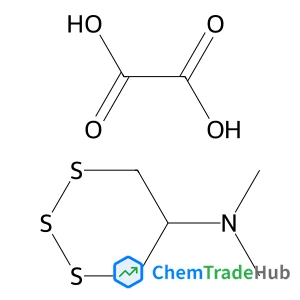
Oxalic acid compound with cyclohexylsulfamothioic O-acid (11)
CAS Number:
31895-22-4
Molecular Formula:
C7H13NO4S3
Cansu Esen, Markus Antonietti, Baris Kumru
Functional polymers remain at the core of polymer science in the second century of macromolecular material research. Lactones are known as monomers for ring-opening polymerizations; however, polymers containing lactone rings as pendant groups are rare. In this study, we revive an overlooked monomer, mevalonic lactone methacrylate, by demonstrating its radical polymerization, reporting the properties of the polymer product, and providing information on the thermal, UV, and hydrolytic stabilities of both the monomer and polymer. Controlled polymerization (via RAFT) provides synthetic precision and active terminal groups; thus, the formation of a simple block copolymer based on the aforementioned polymer is presented. The pendant ring accepts nucleophilic attacks, so the initially hydrophobic polymer can be altered to make it hydrophilic via reactions with nucleophiles in just seconds. Thus, the polymer film provides responsive surface formation.
Marion Jasnin, Lambert van Eijck, Michael Marek Koza, Cédric Laguri, Hugues Lortat-Jacob
DOI: 10.1039/B923878F
Elna Deglint, Heather Martens, Essex Edwards, Nicholas Boon, Paul Dance
DOI: 10.1039/C0CP01570A
DOI: 10.1039/C0CP01318H
Paul S. Campbell, Catherine C. Santini, Denis Bouchu, Bernard Fenet, Karine Philippot, Bruno Chaudret, Agílio A. H. Pádua, Yves Chauvin
DOI: 10.1039/B925329G
Shiguo Sun, Wenyan Gao, Fengyu Liu, Fusheng Li, Jiangli Fan, Xiaojun Peng
DOI: 10.1039/C0CP00712A
Yongfeng Liu, Chu Liang, Zhijun Wei, Ying Jiang, Mingxia Gao, Hongge Pan, Qidong Wang
DOI: 10.1039/C000271B
Dinesh Chandra Khara, Anunay Samanta
DOI: 10.1039/B925099A
Sandra Carolina Gómez-Carrillo
DOI: 10.1039/C0CP00534G
Waste containing (6-Bromo-2-naphthyl)oxy](dimethyl)(2-methyl-2-propanyl)silane (...
7-Fluoro-4-isoquinolinecarboxylic acid can be synthesized via a multi-step proce...
2,3,5,6-Tetrabromothieno[3,2-b]thiophene is a crystalline compound with a high m...
1-[4-(Benzylamino)-7,8-dihydro-5H-pyrano[4,3-d]pyrimidin-2-yl]-2-methyl-1H-indol...
The market for imidazo[5,1-d]-1,2,3,5-tetrazine-8-carboxylic acid, 3,4-dihydro-3...
3-(Triisopropylsilyl)propiolaldehyde is a synthetic organic compound with the CA...
6-Nitro-2H-1,4-benzoxazin-3(4H)-one (CAS: 81721-87-1) is subject to various regu...
Waste containing (3-Fluorophenyl)(4-{[(2-methyl-2-propanyl)oxy]carbonyl}-1-piper...
N,N'-4,4'-Biphenyldiyldiisonicotinamide is a white crystalline solid with a mole...
6-Bromo-8-fluoro-2-quinazolinol is primarily used in the pharmaceutical industry...

Polymer Chemistry welcomes submissions in all areas of polymer science that have a strong focus on macromolecular chemistry. Manuscripts may cover a broad range of fields, yet no direct application focus is required.
![(2S)-2-({[(2-Methyl-2-propanyl)oxy]carbonyl}amino)-4-pentynoic acid structure](https://static.chemtradehub.com/structs/630/63039-48-5-b66d.webp "(2S)-2-({[(2-Methyl-2-propanyl)oxy]carbonyl}amino)-4-pentynoic acid structure")