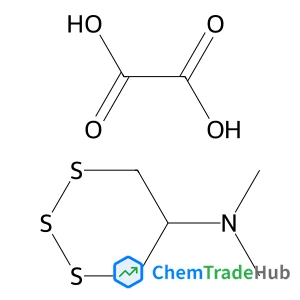
Oxalic acid compound with cyclohexylsulfamothioic O-acid (11)
CAS Number:
31895-22-4
Molecular Formula:
C7H13NO4S3
Mateusz Gosecki, Monika Gosecka, Malgorzata Urbaniak
Polyester polyols synthesized via a polycondensation reaction of diols with diacids or their diesters are commonly used as polyurethane building blocks. Herein, we demonstrate an alternative route to polyester polyols via oxidative esterification of aliphatic α,ω-diols. Unlike the polycondensation reaction, this process is carried out in aqueous media at 30 °C under atmospheric pressure. In situ generated hypobromous acid from the mixture of NaBr, NaBrO3 and H2SO4 is used to trigger the reaction. The reaction progress can be conveniently controlled with the Br/OH molar ratio. The properties of the obtained polyesters are determined by the applied diol and can be tailored using a mixture of diols. The composition of polymers is determined with GPC, NMR, and MALDI-TOF MS. It is shown that polyesters obtained with this method can be used as precursors for polyurethane synthesis. This work provides a quick and convenient route to polyester polyol synthesis, feasible in any laboratory.
Armin Hoffmann, Krishna Neupane
DOI: 10.1039/C3CP44564J
C. J. Benmore, M. C. Wilding, S. K. Tumber
DOI: 10.1039/C3CP44347G
Jaehyun Moon, Jin-Ah Park, Su-Jae Lee, Jeong-Ik Lee, Taehyong Zyung, Eui-Chol Shin, Jong-Sook Lee
DOI: 10.1039/C3CP44684K
Uttam Anand, Saptarshi Mukherjee
DOI: 10.1039/C3CP50207D
Ting Liao, Ziqi Sun, Aijun Du, Sean Smith
DOI: 10.1039/C3CP50654A
Hui-Juan Cui, Xian-Lei Sheng, Qing-Bo Yan, Qing-Rong Zheng, Gang Su
DOI: 10.1039/C3CP44457K
Masatoshi Nakatani, Atsushi Nobuhiro, Nobuhiko Yokoshi, Hajime Ishihara
DOI: 10.1039/C3CP43834A
Rajamani Krishna, Jasper M. van Baten
DOI: 10.1039/C3CP50449B
Andrew J. Atkins, Matthias Bauer, Christoph R. Jacob
DOI: 10.1039/C3CP50999K
Waste containing (6-Bromo-2-naphthyl)oxy](dimethyl)(2-methyl-2-propanyl)silane (...
7-Fluoro-4-isoquinolinecarboxylic acid can be synthesized via a multi-step proce...
2,3,5,6-Tetrabromothieno[3,2-b]thiophene is a crystalline compound with a high m...
1-[4-(Benzylamino)-7,8-dihydro-5H-pyrano[4,3-d]pyrimidin-2-yl]-2-methyl-1H-indol...
The market for imidazo[5,1-d]-1,2,3,5-tetrazine-8-carboxylic acid, 3,4-dihydro-3...
3-(Triisopropylsilyl)propiolaldehyde is a synthetic organic compound with the CA...
6-Nitro-2H-1,4-benzoxazin-3(4H)-one (CAS: 81721-87-1) is subject to various regu...
Waste containing (3-Fluorophenyl)(4-{[(2-methyl-2-propanyl)oxy]carbonyl}-1-piper...
N,N'-4,4'-Biphenyldiyldiisonicotinamide is a white crystalline solid with a mole...
6-Bromo-8-fluoro-2-quinazolinol is primarily used in the pharmaceutical industry...

Polymer Chemistry welcomes submissions in all areas of polymer science that have a strong focus on macromolecular chemistry. Manuscripts may cover a broad range of fields, yet no direct application focus is required.