












A fluoropolymer with a low dielectric constant at a high frequency derived from bio-based anethole
Literature Information
Publication Date
2021-07-13
DOI
10.1039/D1PY00573A
Impact Factor
5.582
Authors
Minghui Li, Jing Sun, Qiang Fang
View Original
Abstract
A new fluoro-containing monomer (M1) with a high fluoro content derived from anethole was synthesized, which was copolymerized with a monomer (M2) having benzocyclobutene units to give a resin, showing a dielectric constant (Dk) of 2.50 and a dielectric loss (Df) of 1.4 × 10⁻³ at a high frequency of 5 GHz. This resin also exhibited a 5% weight loss temperature of up to 460 °C and a water uptake of 0.14%. These data indicate that this bio-based fluoro-containing monomer is suitable as an encapsulation material for application in microelectric fields. The cured resins with different molar ratios of M1 to M2 show that the resin with a molar ratio of 1 to 1 exhibits the best dielectric properties. With the increase of M2, the cured resins show higher heat resistance.
Recommended Journals
Related Literature
Stabilization of CeO2nanoparticles in a CO2 rich solvent
Martin J. Hollamby, Kieran Trickett, Ana Vesperinas, Carl Rivett, David C. Steytler, Zoe Schnepp, Jon Jones, Richard K. Heenan, Robert M. Richardson, Otto Glatter, Julian Eastoe
2008-09-29
Communication
DOI: 10.1039/B811563J
Dendrimer design using CuI-catalyzed alkyne–azide “click-chemistry”
Grégory Franc, Ashok Kakkar
2008-09-17
Feature Article
DOI: 10.1039/B809870K
Sonication treatment of CdTe/CdS semiconductor nanocrystals and their bio-application
Kyung Nam Kim, Pan Kee Bae, Hyun Ju Chang, Yong-Rok Kim, Joung Kyu Park
2008-09-24
Communication
DOI: 10.1039/B812317A
Facile construction of functionalized 4H-chromenevia tandem benzylation and cyclization
Jinmin Fan, Zhiyong Wang
2008-09-17
Communication
DOI: 10.1039/B812046C
Synthesis, characterization and oxidizing properties of a diorgano tellurone carrying bulky aromatic substituents
Makoto Oba, Yasunori Okada, Kozaburo Nishiyama, Shigeru Shimada, Wataru Ando
2008-09-17
Communication
DOI: 10.1039/B811112J
Single-molecule fluorescence spectroelectrochemistry of cresyl violet
Chenghong Lei, Dehong Hu, Eric J. Ackerman
2008-09-12
Communication
DOI: 10.1039/B812161C
Internal amide-triggered cycloaromatization of maduropeptin-like nine-membered enediyne
Yutaro Norizuki, Kazuo Komano, Itaru Sato, Masahiro Hirama
2008-09-15
Communication
DOI: 10.1039/B811355F
You might also like
Compound Q&A
What are the main uses of 1H-Indazole-6-carbonitrile (CAS: 141290-59-7)?
1H-Indazole-6-carbonitrile finds applications in pharmaceuticals, where it serve...
141290-59-71H-Indazole-6-carbon...
Compound Q&A
How should waste containing Dioctyl (2E)-2-butenedioate (CAS: 2997-85-5) be handled?
Waste containing Dioctyl (2E)-2-butenedioate (CAS: 2997-85-5) should be collecte...
2997-85-5Dioctyl (2E)-2-buten...
Compound Q&A
What industries use Sodium [(1,2-benzoxazol-3-ylmethyl)sulfonyl]azanide (CAS: 68291-98-5)?
Sodium [(1,2-benzoxazol-3-ylmethyl)sulfonyl]azanide is primarily used in pharmac...
68291-98-5Sodium [(1,2-benzoxa...
Compound Q&A
Are there alternatives to Dimethyl 4-(4,4,5,5-tetramethyl-1,3,2-dioxaborolan-2-yl)-2,6-pyridinedicarboxylate (CAS: 741709-66-0) in synthesis?
Dimethyl 4-(4,4,5,5-tetramethyl-1,3,2-dioxaborolan-2-yl)-2,6-pyridinedicarboxyla...
741709-66-0Dimethyl 4-(4,4,5,5-...
Compound Q&A
How should waste containing 2-Fluoro-6-hydrazinopyridine (CAS: 80714-39-2) be handled?
Waste containing 2-Fluoro-6-hydrazinopyridine (CAS: 80714-39-2) should be manage...
80714-39-22-Fluoro-6-hydrazino...
Compound Q&A
What is 6-Formyl-2-pyridinecarboxylic acid (CAS: 499214-11-8)?
6-Formyl-2-pyridinecarboxylic acid is an organic compound with the molecular for...
499214-11-86-Formyl-2-pyridinec...
Compound Q&A
What is the market or research trend for 3-(3,4-dimethoxyphenyl)-2,5-dimethyl-N-(2-morpholin-4-ylethyl)pyrazolo[1,5-a]pyrimidin-7-amine (CAS: 900874-91-1)?
Research trends for this compound indicate a focus on its potential applications...
900874-91-13-(3,4-dimethoxyphen...
Compound Q&A
How is 9H-Tribenzo[b,d,f]azepine (CAS: 29875-73-8) typically synthesized?
9H-Tribenzo[b,d,f]azepine is typically synthesized via a multi-step process invo...
29875-73-89H-Tribenzo[b,d,f]az...
Compound Q&A
How is 1-Cyclopropyl-7-ethoxy-6-fluoro-8-methoxy-4-oxo-1,4-dihydro-3-quinolinecarboxylic acid (CAS: 1797982-51-4) typically synthesized?
1-Cyclopropyl-7-ethoxy-6-fluoro-8-methoxy-4-oxo-1,4-dihydro-3-quinolinecarboxyli...
1797982-51-41-Cyclopropyl-7-etho...
Compound Q&A
How should waste containing Methyl 3-oxo-1,2,3,4-tetrahydro-6-quinoxalinecarboxylate (CAS: 671820-52-3) be handled?
Waste containing Methyl 3-oxo-1,2,3,4-tetrahydro-6-quinoxalinecarboxylate (CAS: ...
671820-52-3Methyl 3-oxo-1,2,3,4...
Source Journal
Polymer Chemistry

CiteScore:
8.6
Self-citation Rate:
7.3%
Articles per Year:
457
Polymer Chemistry welcomes submissions in all areas of polymer science that have a strong focus on macromolecular chemistry. Manuscripts may cover a broad range of fields, yet no direct application focus is required.
Recommended Compounds
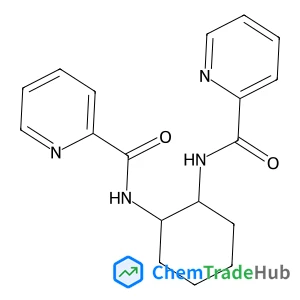
N,N'-(1R,2R)-1,2-Cyclohexanediyldi(2-pyridinecarboxamide)
CAS Number:
218290-24-5
Molecular Formula:
C18H20N4O2
Recommended Suppliers





Disclaimer
This page provides academic journal information for reference and research purposes only. We are not affiliated with any journal publishers and do not handle publication submissions. For publication-related inquiries, please contact the respective journal publishers directly.
If you notice any inaccuracies in the information displayed, please contact us at support@chemtradehub.com. We will promptly review and address your concerns.