


Insights from computational analysis: how does the SARS-CoV-2 Delta (B.1.617.2) variant hijack ACE2 more effectively?
Literature Information
Publication Date
2022-03-21
DOI
10.1039/D2CP00843B
Impact Factor
3.676
Authors
Danyang Xiong, Xiaoyu Zhao, Song Luo, Lili Duan
View Original
Abstract
The SARS-CoV-2 Delta (B.1.617.2) variant was identified in India in October 2020, and it has quickly become the mainstream strain with strong toxicity and spread, posing great challenges to epidemic control. However, the molecular mechanism of its powerful infectivity remains unclear. It is meaningful to investigate the process of Delta variant's receptor-binding domain (RBD) binding to angiotensin-converting enzyme 2 (ACE2). Here, we performed three repeated molecular dynamics simulations for each system to avoid accidents, and the alanine scanning combined with the interaction entropy (ASIE) method was utilized to evaluate the binding free energy. Through the detailed energy and conformational analysis, the binding mechanism of the Delta variant was illustrated. The results showed that the existence of L452R and T478K mutations can trigger the effective hijacking of ACE2 by the Delta variant through the following three ways: (i) these two mutations can significantly enhance the electrostatic energy of the system by the introduction of two positively charged amino acids (Arg and Lys), thereby increasing the binding affinity of RBD and ACE2, (ii) the Loops 1, 3, and 4 in the receptor-binding motif (RBM) of RBD form a tighter conformation under the dominance of the T478K mutation, allowing ACE2 to be captured more effectively than the wild-type system, and (iii) these conformational changes lead to a more stable hydrogen bond in the Delta variant, which further ensures the stability of the binding. In addition, to explore the effect of mutations on the antibody, the key residues contributing to the changes in the binding ability of RBD in the Delta variant with the existing 42 neutralizing monoclonal antibodies (mAbs) have been preliminarily evaluated. The present study reveals the molecular mechanism for the increased infectivity of SARS-CoV-2 caused by mutations, and the key sites that cause antigenic changes were screened. It provides important theoretical insights for the development of novel targeted RBD drugs and antibodies.
Recommended Journals

Russian Journal of Bioorganic Chemistry

Chemical Communications

Russian Journal of Organic Chemistry

Current Opinion in Solid State & Materials Science

Organic Process Research & Development

Crystallography Reports

Nature Medicine

New Journal of Chemistry

Drug Discovery Today

Russian Journal of Applied Chemistry
Related Literature
Biocompatible and thermo-responsive nanocapsule synthesis through vesicle templating
Garbiñe Aguirre, Jose Ramos, Johan P. A. Heuts, Jacqueline Forcada
2014-04-08
Paper
DOI: 10.1039/C4PY00297K
Efficient and economical synthesis of dendrimer-like polystyrene with long subchains through arm-first divergent strategy
Xue-Song Ge, Chen He, Wei-Dong He, Sheng-Qi Chen
2014-04-28
Paper
DOI: 10.1039/C4PY00425F
Synthesis of multi-functionalized hydrogels by a thiolactone-based synthetic protocol
Stefan Reinicke, Pieter Espeel, Milan M. Stamenović, Filip E. Du Prez
2014-05-20
Paper
DOI: 10.1039/C4PY00468J
Stability of star-shaped RAFT polystyrenes under mechanical and thermal stress
Mahdi Abbasi, Kamran Riazi, Nico Dingenouts, Manfred Wilhelm
2014-05-08
Paper
DOI: 10.1039/C4PY00484A
Highly stable hybrid selenophene-3,4-ethylenedioxythiophene as electrically conducting and electrochromic polymers
Shijie Zhen, Shimin Zhang, Guoqun Zhao
2014-05-29
Paper
DOI: 10.1039/C4PY00529E
Synthesis of polyethylene and polystyrene miktoarm star copolymers using an “in–out” strategy
Bo-Geng Li
2014-05-23
Paper
DOI: 10.1039/C4PY00622D
You might also like
Compound Q&A
What precautions should be taken when handling lithium chloride hydrate (1:1:1) (CAS: 16712-20-2)?
When handling lithium chloride hydrate (1:1:1) (CAS: 16712-20-2), it is importan...
16712-20-2Lithium chloride hyd...
Compound Q&A
Is 4-(4H-1,2,4-Triazol-4-yl)piperidine (CAS: 690261-92-8) safe?
4-(4H-1,2,4-Triazol-4-yl)piperidine is generally considered safe for use in phar...
690261-92-84-(4H-1,2,4-Triazol-...
Compound Q&A
How should waste containing 1,3-Thiazole-2-carboxamide (CAS: 16733-85-0) be handled?
Waste containing 1,3-Thiazole-2-carboxamide (CAS: 16733-85-0) should be collecte...
16733-85-01,3-Thiazole-2-carbo...
Compound Q&A
What regulatory guidelines apply to 5-(Difluoromethyl)-2-fluorobenzonitrile (CAS: 934175-58-3)?
5-(Difluoromethyl)-2-fluorobenzonitrile (CAS: 934175-58-3) is subject to regulat...
934175-58-35-(Difluoromethyl)-2...
Compound Q&A
How is Methyl 3-acetamido-2-thiophenecarboxylate (CAS: 22288-79-5) typically synthesized?
Methyl 3-acetamido-2-thiophenecarboxylate can be synthesized by the reaction of ...
22288-79-5Methyl 3-acetamido-2...
Compound Q&A
What is 4-Isoquinolinecarbonitrile (CAS: 34846-65-6)?
4-Isoquinolinecarbonitrile is a chemical compound with the CAS number 34846-65-6...
34846-65-64-Isoquinolinecarbon...
Compound Q&A
How should Methyl 1H-1,2,3-triazole-4-carboxylate (CAS: 877309-59-6) be stored?
Store Methyl 1H-1,2,3-triazole-4-carboxylate (CAS: 877309-59-6) in a cool, dry p...
877309-59-6Methyl 1H-1,2,3-tria...
Compound Q&A
What regulatory guidelines apply to 6-Bromo[1,3]thiazolo[5,4-b]pyridin-2-amine (CAS: 1160791-13-8)?
6-Bromo[1,3]thiazolo[5,4-b]pyridin-2-amine (CAS: 1160791-13-8) is subject to the...
1160791-13-86-Bromo[1,3]thiazolo...
Compound Q&A
Is (2S,3S)-2-Ammonio-3-(3,4-dihydroxyphenyl)-3-hydroxypropanoate (CAS: 23651-95-8) safe?
(2S,3S)-2-Ammonio-3-(3,4-dihydroxyphenyl)-3-hydroxypropanoate (CAS: 23651-95-8) ...
23651-95-8(2S,3S)-2-Ammonio-3-...
Compound Q&A
What are the physical and chemical properties of 7-bromo-3-methyl-3,4-dihydroquinazolin-4-one (CAS: 1293987-84-4)?
7-Bromo-3-methyl-3,4-dihydroquinazolin-4-one is a solid with a crystalline form....
1293987-84-47-bromo-3-methyl-3,4...
Source Journal
Physical Chemistry Chemical Physics

CiteScore:
5.5
Self-citation Rate:
10.3%
Articles per Year:
3036
Physical Chemistry Chemical Physics (PCCP) is an international journal co-owned by 19 physical chemistry and physics societies from around the world. This journal publishes original, cutting-edge research in physical chemistry, chemical physics and biophysical chemistry. To be suitable for publication in PCCP, articles must include significant innovation and/or insight into physical chemistry; this is the most important criterion that reviewers and Editors will judge against when evaluating submissions. The journal has a broad scope and welcomes contributions spanning experiment, theory, computation and data science. Topical coverage includes spectroscopy, dynamics, kinetics, statistical mechanics, thermodynamics, electrochemistry, catalysis, surface science, quantum mechanics, quantum computing and machine learning. Interdisciplinary research areas such as polymers and soft matter, materials, nanoscience, energy, surfaces/interfaces, and biophysical chemistry are welcomed if they demonstrate significant innovation and/or insight into physical chemistry. Joined experimental/theoretical studies are particularly appreciated when complementary and based on up-to-date approaches.
Recommended Compounds
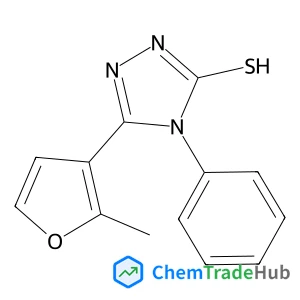
5-(2-Methyl-3-furyl)-4-phenyl-2,4-dihydro-3H-1,2,4-triazole-3-thione
CAS Number:
346464-59-3
Molecular Formula:
C13H11N3OS
Recommended Suppliers






Disclaimer
This page provides academic journal information for reference and research purposes only. We are not affiliated with any journal publishers and do not handle publication submissions. For publication-related inquiries, please contact the respective journal publishers directly.
If you notice any inaccuracies in the information displayed, please contact us at support@chemtradehub.com. We will promptly review and address your concerns.