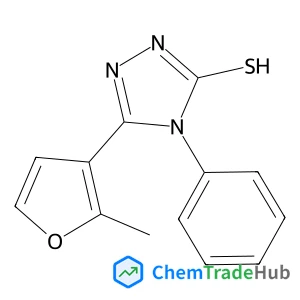
5-(2-Methyl-3-furyl)-4-phenyl-2,4-dihydro-3H-1,2,4-triazole-3-thione
CAS Number:
346464-59-3
Molecular Formula:
C13H11N3OS
Moumita Mukherjee, Sayan Dutta, Madhusudan Ghosh, Partha Basuchowdhuri, Ayan Datta
Developing a cost-effective and environmentally benign substitute for the energy-intensive Haber–Bosch process for the production of ammonia is a global challenge. The electrocatalytic nitrogen reduction reaction (NRR) under ambient conditions through the six proton–electron process has attracted significant interest. Herein, a series of transition-metal (TM) based single atom catalysts (SAC) embedded on carbon nitride (C6N6) have been chosen to explore the NRR activity. The promising metals have been primarily screened through density functional theory (DFT) by calculating their adsorption energies on C6N6 – energies for dinitrogen binding and the barriers at the rate determining step. Based on these criteria, amongst the 18 metal centers, Ta based C6N6 emerges as a good candidate for the reduction of nitrogen to NH3. On the other hand, for the Machine Learning (ML) regression models, the covalent radius and the d-band center of the TM have been identified as the most correlated descriptors for predicting the adsorption energy of nitrogen on the active metal center. Besides, probabilistic modeling using the soft voting technique in the classification model allows us to predict the most efficient single atom catalyst. Despite the realistic bottleneck of having only a limited number of TMs to choose from, this technique effectively predicts the best catalyst from a modest dataset. With the highest probabilistic score, Ta based C6N6 dominates over the other catalysts in a good agreement with DFT findings. This letter manifests the effectiveness of the soft voting technique in an ensemble-based classification model.
S. Wiktorowicz, H. Tenhu, V. Aseyev
DOI: 10.1039/C4PY00298A
Zhigang Xie, Xuesi Chen, Xiabin Jing, Yubin Huang
DOI: 10.1039/C4PY00227J
Zhenguo Wang, Ying Li, Qiang Peng
DOI: 10.1039/C4PY00273C
Xiaofu Wu, Hui Tong, Lixiang Wang
DOI: 10.1039/C4PY00305E
Mingming Zhang, Qingqing Xiong, Yinsong Wang, Zhibao Zhang, Wei Shen, Lingrong Liu, Quanyao Wang
DOI: 10.1039/C4PY00311J
Hiroki Iida, Tomoko Yamaguchi, Koutarou Hayashi, Daisuke Kumano, Jeanne Crassous, Nicolas Vanthuyne, Christian Roussel, Eiji Yashima
DOI: 10.1039/C4PY00692E
Lie Chen, Shaojie Tian
DOI: 10.1039/C4PY00095A
Morgane Le Neindre, Renaud Nicolaÿ
DOI: 10.1039/C4PY00293H
Tao Zhang, Tao Chen, Ihsan Amin, Rainer Jordan
DOI: 10.1039/C4PY00346B
When handling lithium chloride hydrate (1:1:1) (CAS: 16712-20-2), it is importan...
4-(4H-1,2,4-Triazol-4-yl)piperidine is generally considered safe for use in phar...
Waste containing 1,3-Thiazole-2-carboxamide (CAS: 16733-85-0) should be collecte...
5-(Difluoromethyl)-2-fluorobenzonitrile (CAS: 934175-58-3) is subject to regulat...
Methyl 3-acetamido-2-thiophenecarboxylate can be synthesized by the reaction of ...
4-Isoquinolinecarbonitrile is a chemical compound with the CAS number 34846-65-6...
Store Methyl 1H-1,2,3-triazole-4-carboxylate (CAS: 877309-59-6) in a cool, dry p...
6-Bromo[1,3]thiazolo[5,4-b]pyridin-2-amine (CAS: 1160791-13-8) is subject to the...
(2S,3S)-2-Ammonio-3-(3,4-dihydroxyphenyl)-3-hydroxypropanoate (CAS: 23651-95-8) ...
7-Bromo-3-methyl-3,4-dihydroquinazolin-4-one is a solid with a crystalline form....

Physical Chemistry Chemical Physics (PCCP) is an international journal co-owned by 19 physical chemistry and physics societies from around the world. This journal publishes original, cutting-edge research in physical chemistry, chemical physics and biophysical chemistry. To be suitable for publication in PCCP, articles must include significant innovation and/or insight into physical chemistry; this is the most important criterion that reviewers and Editors will judge against when evaluating submissions. The journal has a broad scope and welcomes contributions spanning experiment, theory, computation and data science. Topical coverage includes spectroscopy, dynamics, kinetics, statistical mechanics, thermodynamics, electrochemistry, catalysis, surface science, quantum mechanics, quantum computing and machine learning. Interdisciplinary research areas such as polymers and soft matter, materials, nanoscience, energy, surfaces/interfaces, and biophysical chemistry are welcomed if they demonstrate significant innovation and/or insight into physical chemistry. Joined experimental/theoretical studies are particularly appreciated when complementary and based on up-to-date approaches.
![[(2R)-6,6-Dimethyl-2-morpholinyl]methanol hydrochloride (1:1) structure](https://static.chemtradehub.com/structs/141/1416444-88-6-e06a.webp "[(2R)-6,6-Dimethyl-2-morpholinyl]methanol hydrochloride (1:1) structure")
![tert-butyl 8-benzyl-2,8-diazaspiro[4.5]decane-2-carboxylate structure](https://static.chemtradehub.com/structs/336/336191-16-3-bb55.webp "tert-butyl 8-benzyl-2,8-diazaspiro[4.5]decane-2-carboxylate structure")