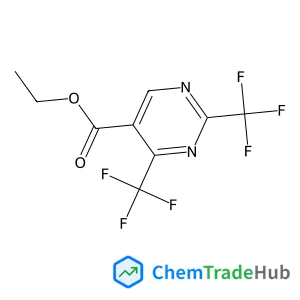
Ethyl 2,4-bis(trifluoromethyl)-5-pyrimidinecarboxylate
CAS Number:
188781-15-9
Molecular Formula:
C9H6F6N2O2
Mohaddeseh Habibzadeh Mashatooki, Bahram Ghalami-Choobar
The competitive aggregated adsorption and molecular interactions between paclitaxel (PX) and mitomycin C (MMC) molecules on the surface of boron nitride nanosheets (BNNSs) were investigated using a molecular dynamics method. The potential capability of BNNSs to immobilize PX and MMC molecules was examined in detail. Structural parameters such as the radius of gyration of the drugs on the considered surface were calculated. The results indicate rapid and efficient adsorption of PX and MMC ligands onto BNNSs. The electrostatic contribution confirms the efficient self-aggregation of each drug onto the BNNS surface during the adsorption process in 100 ns simulation trajectories. The radial distribution function and dipole moments of water molecules have been considered to estimate the effect of water molecules on the adsorption of PX and MMC ligands onto BNNSs. The aggregation of MMC molecules onto BNNSs does not affect the aggregated adsorption of PX molecules. The maximum values of interaction energies and hydrogen bonds for PX molecules indicate that PX molecules overtake MMC molecules via competitive aggregation. The efficient and favorable delivery capability of boron nitride nanosheets to adsorb and deliver self-aggregated PX and MMC molecules has been revealed by molecular dynamics simulation results.

Current Opinion in Colloid & Interface Science

Acta Materialia

Russian Journal of Bioorganic Chemistry

Journal of Saudi Chemical Society

Journal of Peptide Science

Russian Journal of General Chemistry

Russian Journal of Coordination Chemistry

Chemical Communications

Russian Chemical Bulletin

Journal of Natural Medicines
Hang Lin, Wang Xiao, Si-Yong Qin, Si-Xue Cheng, Xian-Zheng Zhang
DOI: 10.1039/C4PY00564C
Rui Sun, Qiaojie Luo, Chen Gao, Ying Wang, Lilong Gao, Hong Du, Ying Huang, Xiaodong Li, Zhiquan Shen, Weipu Zhu
DOI: 10.1039/C4PY00577E
DOI: 10.1039/C4PY00473F
Bo-Geng Li
DOI: 10.1039/C4PY00622D
Victor R. de la Rosa, Eva Bauwens, Bryn D. Monnery, Bruno G. De Geest, Richard Hoogenboom
DOI: 10.1039/C4PY00355A
Longhe Zhang, Qiang Tang, R. A. Weiss, Kevin A. Cavicchi
DOI: 10.1039/C4PY00615A
Dianming Sun, Zhaomin Yang, Xiaoli Sun, Huihui Li, Zhongjie Ren, Junteng Liu, Dongge Ma, Shouke Yan
DOI: 10.1039/C4PY00450G
When handling lithium chloride hydrate (1:1:1) (CAS: 16712-20-2), it is importan...
4-(4H-1,2,4-Triazol-4-yl)piperidine is generally considered safe for use in phar...
Waste containing 1,3-Thiazole-2-carboxamide (CAS: 16733-85-0) should be collecte...
5-(Difluoromethyl)-2-fluorobenzonitrile (CAS: 934175-58-3) is subject to regulat...
Methyl 3-acetamido-2-thiophenecarboxylate can be synthesized by the reaction of ...
4-Isoquinolinecarbonitrile is a chemical compound with the CAS number 34846-65-6...
Store Methyl 1H-1,2,3-triazole-4-carboxylate (CAS: 877309-59-6) in a cool, dry p...
6-Bromo[1,3]thiazolo[5,4-b]pyridin-2-amine (CAS: 1160791-13-8) is subject to the...
(2S,3S)-2-Ammonio-3-(3,4-dihydroxyphenyl)-3-hydroxypropanoate (CAS: 23651-95-8) ...
7-Bromo-3-methyl-3,4-dihydroquinazolin-4-one is a solid with a crystalline form....

Physical Chemistry Chemical Physics (PCCP) is an international journal co-owned by 19 physical chemistry and physics societies from around the world. This journal publishes original, cutting-edge research in physical chemistry, chemical physics and biophysical chemistry. To be suitable for publication in PCCP, articles must include significant innovation and/or insight into physical chemistry; this is the most important criterion that reviewers and Editors will judge against when evaluating submissions. The journal has a broad scope and welcomes contributions spanning experiment, theory, computation and data science. Topical coverage includes spectroscopy, dynamics, kinetics, statistical mechanics, thermodynamics, electrochemistry, catalysis, surface science, quantum mechanics, quantum computing and machine learning. Interdisciplinary research areas such as polymers and soft matter, materials, nanoscience, energy, surfaces/interfaces, and biophysical chemistry are welcomed if they demonstrate significant innovation and/or insight into physical chemistry. Joined experimental/theoretical studies are particularly appreciated when complementary and based on up-to-date approaches.
![Ethyl 4-[8-chloro(5,5,6,6,7-~2~H_5_)-5,6-dihydro-11H-benzo[5,6]cyclohepta[1,2-b]pyridin-11-ylidene]-1-piperidinecarboxylate structure](https://static.chemtradehub.com/structs/102/1020719-57-6-37e2.webp "Ethyl 4-[8-chloro(5,5,6,6,7-~2~H_5_)-5,6-dihydro-11H-benzo[5,6]cyclohepta[1,2-b]pyridin-11-ylidene]-1-piperidinecarboxylate structure")
![N-[2-(2-Pyridinyl)ethyl]-1-propanamine structure](https://static.chemtradehub.com/structs/554/55496-57-6-22b4.webp "N-[2-(2-Pyridinyl)ethyl]-1-propanamine structure")