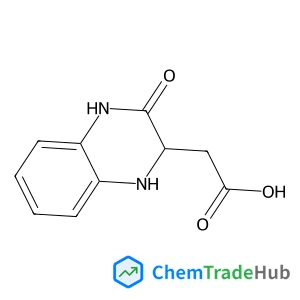
(3-Oxo-1,2,3,4-tetrahydro-2-quinoxalinyl)acetic acid
CAS Number:
136584-14-0
Molecular Formula:
C10H10N2O3
Virender Kumar Sharma, Ankur Biswas, Mayurika Lahiri, Sudipta Basu
The endoplasmic reticulum (ER) is one of the crucial sub-cellular organelles controlling myriads of functions including protein biosynthesis, folding, misfolding and unfolding. As a result, dysregulation of these pathways in the ER is implicated in cancer development and progression. Subsequently, targeting the ER in cancer cells emerged as an interesting unorthodox strategy in next-generation anticancer therapy. However, development of small molecules to selectively target the ER for cancer therapy remained elusive and unexplored. To address this, herein, we have developed a novel small molecule library of sulfonylhydrazide-hydrazones through a short and concise chemical synthetic strategy. We identified a fluorescent small molecule that localized into the endoplasmic reticulum (ER) of HeLa cells, induced ER stress followed by triggering autophagy which was subsequently inhibited by chloroquine (autophagy inhibitor) to initiate apoptosis. This small molecule showed remarkable cancer cell killing efficacy in different cancer cells as mono and combination therapy with chloroquine, thus opening a new direction to illuminate ER-biology towards the development of novel anticancer therapeutics.
Sandeep P. Patil, Sri Harsha Chilakamarri, Bernd Markert
DOI: 10.1039/C8CP01061G
Fangjia Fu, Li Li, Zhen Yang, Zheng Wan, Yi Luo, Na Hu, Xiangshu Chen, Guixiang Zeng
DOI: 10.1039/C8CP00839F
Maria Wächtler
DOI: 10.1039/C8CP01007B
Sepehr Ebadi
DOI: 10.1039/C7CP08481A
M. A. Peck, G. R. Hearne, C. Obuah, J. Darkwa
DOI: 10.1039/C8CP01135D
Gérôme Melaet, Vitalie Stavila, Lennie Klebanoff
DOI: 10.1039/C7CP07015B
Wenhao Yuan, Tianyu Li, Wei Li, Jiuzhong Yang
DOI: 10.1039/C7CP08518D
Qing-Lu Liu, Zong-Yan Zhao, Jian-Hong Yi
DOI: 10.1039/C8CP00432C
I. Rosbottom, J. H. Pickering, B. Etbon, R. B. Hammond, K. J. Roberts
DOI: 10.1039/C7CP08354H
This compound is mainly used as an intermediate in the synthesis of antipsychoti...
Waste containing 1-(D-Ribofuranosyl)-1,4-dihydro-3-pyridinecarboxamide (CAS: 191...
2-Methyl-2-propanyl 3-bromo-3-(hydroxymethyl)-1-azetidinecarboxylate (CAS: 20079...
N-(4-Chloro-2-pyridinyl)acetamide (CAS: 245056-66-0) is a chemical compound with...
5-Chloro-2-hydroxybenzoic acid, also known as 5-chlorosalicylic acid, is an arom...
When handling 1,1-Dichloro-1-fluoroethane (CAS: 1717-00-6), it is important to u...
Fmoc-(2S,3R)-3-phenylpyrrolidine-2-carboxylic acid is a white crystalline solid ...
4-Amino-5-bromo-2-pyridinecarboxylic acid is primarily used as a precursor in th...
Handling this compound should be done with personal protective equipment (PPE) i...
When handling 8-bromo-2,2-dimethyl-3,4-dihydro-2H-1,4-benzoxazin-3-one, use prop...
![Methyl 4-({[(2-methyl-2-propanyl)oxy]carbonyl}amino)bicyclo[2.2.2]octane-1-carboxylate structure](https://static.chemtradehub.com/structs/943/943845-74-7-b7e5.webp "Methyl 4-({[(2-methyl-2-propanyl)oxy]carbonyl}amino)bicyclo[2.2.2]octane-1-carboxylate structure")