














Zinc oxide heterostructures: advances in devices from self-powered photodetectors to self-charging supercapacitors
Literature Information
Publication Date
2021-09-09
DOI
10.1039/D1MA00670C
Impact Factor
0
Authors
Sukanta Nandi, Sumana Kumar, Abha Misra
View Original
Abstract
Over the years, zinc oxide (ZnO) has become a well-studied material due its versatile properties including both wide bandgap and large room temperature excitonic binding energy. The thermally-stable phase of ZnO allows it to grow in various nanostructures with high surface to volume ratio. So far, ZnO-based ultraviolet photodetectors (PD) have been a popular application in various heterostructures (HSs), and its piezoelectric properties have been exploited for the self-powering capability of devices. Both optical and mechanical excitations in combination provide a unique capability for the generation of excitons with built-in potential that has currently developed a vast interest in self-powered PDs as well as the energy storage capability in supercapacitors (SCs). This review provides a comprehensive detail of ZnO-based HSs exploited for interface engineering to provide a zero bias photoresponse and further being utilized for optically-activated SC applications. The self-powered photoresponse in ZnO is achieved through bandgap engineering by combining various semiconducting interfaces for broadband responses, fast response time, flexible devices, etc. Moreover, the ZnO interface along with electroactive materials in SC electrodes not only provides electrochemical routes for charge generation and separation but also the optical response, which is further attributed to self-powered voltage generation for efficient charge separation. The review describes the fundamental structural properties of ZnO along with its optical, electronic, and mechanical properties. The characteristics and significance of HSs in the field of science and technology is discussed in detail with emphasis on ZnO-based HSs. Thereafter, the optical interaction in ZnO-based HS is extended for two prominent applications targeting its self-powering/charging capability, i.e., PDs and SCs. Apart from the optical response, the contribution of mechanical and thermal stimuli toward these self-operating systems is also presented.
Recommended Journals
Related Literature
Silver-mediated synthesis of novel 3-CF3/CN/phosphonate-substituted pyrazoles as pyrrolomycin analogues from 3-formylchromones and diazo compounds
Xiaofei Zhang
2019-03-29
Research Article
DOI: 10.1039/C9QO00324J
CuBr-mediated radical cascade difluoroacetamidation of acrylamides using α,α-difluoro-α-(TMS)-acetamides
Kai Liu, Lin-Chao Sui, Qiao Jin, Deng-Yuan Li, Pei-Nian Liu
2017-05-08
Research Article
DOI: 10.1039/C7QO00209B
Multifunctionalized octamethoxy-[8]cycloparaphenylene: facile synthesis and analysis of novel photophysical and photoinduced electron transfer properties
Shengsheng Cui, Guilin Zhuang, Jinyi Wang, Qiang Huang, Shengda Wang, Pingwu Du
2019-04-15
Research Article
DOI: 10.1039/C9QO00372J
Cross coupling of alkylsilicates with acyl chlorides via photoredox/nickel dual catalysis: a new synthesis method for ketones
Etienne Levernier, Vincent Corcé, Louise-Marie Rakotoarison, Adrien Smith, Mengxue Zhang, Stephanie Ognier, Michael Tatoulian, Cyril Ollivier, Louis Fensterbank
2019-02-27
Research Article
DOI: 10.1039/C9QO00092E
Radical addition of ketones and cyanide to olefins via acid catalyzed formation of intermediate alkenyl peroxides
Wen Shao, Marcel Lux, Martin Breugst, Martin Klussmann
2019-04-18
Research Article
DOI: 10.1039/C9QO00447E
A modular approach to highly functionalized 3-sulfonylfurans via conjugate addition of 3-cyclopropylideneprop-2-en-1-ones with sodium sulfinates and sequential 5-endo-trig iodocyclization
Maozhong Miao, Huaping Xu, Yi Luo, Mengchao Jin, Zhengkai Chen, Jianfeng Xu, Hongjun Ren
2017-06-14
Research Article
DOI: 10.1039/C7QO00362E
Selective synthesis of N-protected exo-spiro[oxirane-3,2′-tropanes]
Iryna Vashchenko, Andrii Gerasov, Mykhaylo Vovk, Eduard Rusanov, Volodymyr Fetyukhin, Oleg Lukin
2019-04-11
Research Article
DOI: 10.1039/C9QO00377K
Rotaxane-branched dendrimers with aggregation-induced emission behavior‡
Xu-Qing Wang, Wei Wang, Wei-Jian Li, Yi Qin, Wei-Ling Jiang, Xiaopeng Li, Shuai Wu, Hai-Bo Yang
2019-04-01
Research Article
DOI: 10.1039/C9QO00308H
Pd(ii)/Ag(i)-Cocatalyzed ortho direct arylation of O-phenylcarbamates with pinacol aryl boronates
Huijun Ma, Tao Wang, Chenying Gao, Guangshen Li, Minghao Zhang
2019-03-05
Research Article
DOI: 10.1039/C9QO00227H
You might also like
Compound Q&A
Are there alternatives to 1-(4-Chlorophenyl)-N-hydroxymethanimine (CAS: 3848-36-0) in synthesis?
When considering alternatives to 1-(4-Chlorophenyl)-N-hydroxymethanimine (CAS: 3...
3848-36-01-(4-Chlorophenyl)-N...
Compound Q&A
How should (1R,9S,10S,12S,14E,16S,19R,20R,21S,22R)-3,9,21-Trihydroxy-5,10,12,14,16,20,22-heptamethyl-23,24-dioxatetracyclo[17.3.1.1~6,9~.0~2,7~]tetracosa-2,5,7,14-tetraen-4-one (CAS: 183202-73-5) be stored?
This compound should be stored in a cool, dry place away from direct sunlight. I...
183202-73-5(1R,9S,10S,12S,14E,1...
Compound Q&A
How is 3-(4-Bromophenyl)-5-(2-fluorophenyl)-1,2,4-oxadiazole (CAS: 419553-16-5) typically synthesized?
3-(4-Bromophenyl)-5-(2-fluorophenyl)-1,2,4-oxadiazole is synthesized through a m...
419553-16-53-(4-Bromophenyl)-5-...
Compound Q&A
How is 5-Chloro-2-(4-chlorophenyl)-4-methyl-6-[3-(1-piperidinyl)propoxy]pyrimidine (CAS: 1639220-19-1) typically synthesized?
5-Chloro-2-(4-chlorophenyl)-4-methyl-6-[3-(1-piperidinyl)propoxy]pyrimidine (CAS...
1639220-19-15-Chloro-2-(4-chloro...
Compound Q&A
What industries use 2-Chloro-4-(difluoromethoxy)pyridine (CAS: 1206978-15-5)?
2-Chloro-4-(difluoromethoxy)pyridine is used in the pharmaceutical industry for ...
1206978-15-52-Chloro-4-(difluoro...
Compound Q&A
What regulatory guidelines apply to 3-Chloro-6-methylpyridazine (CAS: 1121-79-5)?
3-Chloro-6-methylpyridazine (CAS: 1121-79-5) is classified under the Globally Ha...
1121-79-53-Chloro-6-methylpyr...
Compound Q&A
Are there alternatives to Methyl 4,5-dimethyl-2-nitrobenzoate in synthesis?
Several alternatives can be used in the synthesis of Methyl 4,5-dimethyl-2-nitro...
90922-74-0Methyl 4,5-dimethyl-...
Compound Q&A
Are there alternatives to (2E,2'E)-3,3'-(1,4-Phenylene)bisacrylaldehyde in synthesis?
Alternatives to (2E,2'E)-3,3'-(1,4-Phenylene)bisacrylaldehyde include other acry...
63405-68-5(2E,2'E)-3,3'-(1,4-P...
Compound Q&A
What is 3-Amino-5-chloropyridin-2-ol hydrochloride (CAS: 1261906-29-9)?
3-Amino-5-chloropyridin-2-ol hydrochloride is an organic compound with the CAS n...
1261906-29-93-Amino-5-chloropyri...
Compound Q&A
What precautions should be taken when handling 6,7-Difluoro-2,3-dihydro-4H-chromen-4-one (CAS: 1092349-93-3)?
When handling 6,7-Difluoro-2,3-dihydro-4H-chromen-4-one, it is essential to wear...
1092349-93-36,7-Difluoro-2,3-dih...
Source Journal
Recommended Compounds
![2-{[(1R,2S)-2-Aminocyclohexyl]amino}-4-{[3-(2H-1,2,3-triazol-2-yl)phenyl]amino}-5-pyrimidinecarboxamide structure](https://static.chemtradehub.com/structs/137/1370261-96-3-40df.webp "2-{[(1R,2S)-2-Aminocyclohexyl]amino}-4-{[3-(2H-1,2,3-triazol-2-yl)phenyl]amino}-5-pyrimidinecarboxamide structure")
2-{[(1R,2S)-2-Aminocyclohexyl]amino}-4-{[3-(2H-1,2,3-triazol-2-yl)phenyl]amino}-5-pyrimidinecarboxamide
CAS Number:
1370261-96-3
Molecular Formula:
C19H23N9O
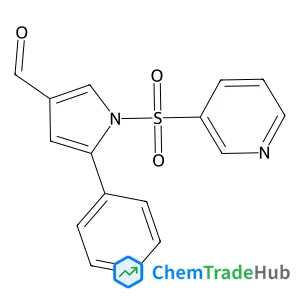
5-Phenyl-1-(pyridin-3-ylsulfonyl)-1H-pyrrole-3-carbaldehyde
CAS Number:
881676-90-0
Molecular Formula:
C16H12N2O3S

Recommended Suppliers



Disclaimer
This page provides academic journal information for reference and research purposes only. We are not affiliated with any journal publishers and do not handle publication submissions. For publication-related inquiries, please contact the respective journal publishers directly.
If you notice any inaccuracies in the information displayed, please contact us at support@chemtradehub.com. We will promptly review and address your concerns.