












Inside front cover
Literature Information
Publication Date
2021-03-11
DOI
10.1039/D1CP90047A
Impact Factor
3.676
Authors
View Original
Abstract
A graphical abstract is available for this content
Related Literature
Role of pore curvature on the thermal stability of gold nanoparticles in mesoporous silica
Mangesh T. Bore, Hien N. Pham, Timothy L. Ward, Abhaya K. Datye
2004-10-04
Communication
DOI: 10.1039/B407575G
Metal-chelating nanoparticles as selective fluorescent sensor for Cu2+
Rachel Méallet-Renault, Robert Pansu, Sonia Amigoni-Gerbier, Chantal Larpent
2004-09-07
Communication
DOI: 10.1039/B407766K
Novel Pt/CeO2/C catalysts for electrooxidation of alcohols in alkaline media
Changwei Xu, Pei Kang Shen
2004-08-25
Communication
DOI: 10.1039/B408589B
Unsaturated 1,2-amino alcohols and ethers from aziridines and organolithiums
David M. Hodgson, Bogdan Štefane, Timothy J. Miles, Jason Witherington
2004-08-24
Communication
DOI: 10.1039/B409486G
The anion sequence in the phase transformation of mesostructures templated by non-ionic block copolymers
Jiawei Tang, Chengzhong Yu, Xufeng Zhou, Xiaoxia Yan, Dongyuan Zhao
2004-08-25
Communication
DOI: 10.1039/B408100E
Molecular tectonics: design of luminescent H-bonded molecular networks
Sylvie Ferlay, Mir Wais Hosseini, Véronique Bulach, Jean-Marc Planeix
2004-09-07
Communication
DOI: 10.1039/B410459P
Estimates of internal energies of vaporisation of some room temperature ionic liquids
Konrad Swiderski, Andrew McLean, Charles M. Gordon, D. Huw Vaughan
2004-09-07
Communication
DOI: 10.1039/B408334B
Secondary coordination sphere controlled reversible geometry reorganisations in copper(ii) complexes
John Fielden, De-Liang Long, Leroy Cronin
2004-08-20
Communication
DOI: 10.1039/B407229D
Synthesis of Ag2S quantum dots in water-in-CO2 microemulsions
2004-09-30
Communication
DOI: 10.1039/B410700D
An active ferrocenyl triarylphosphine for palladium-catalyzed Suzuki–Miyaura cross-coupling of aryl halides
Fuk Yee Kwong, Kin Shing Chan, Chi Hung Yeung, Albert S. C. Chan
2004-09-21
Communication
DOI: 10.1039/B407661C
You might also like
Compound Q&A
What is the market or research trend for N-(4-Methoxybenzyl)-2-pyridinamine (CAS: 52818-63-0)?
N-(4-Methoxybenzyl)-2-pyridinamine (CAS: 52818-63-0) is increasingly being used ...
52818-63-0N-(4-Methoxybenzyl)-...
Compound Q&A
What precautions should be taken when handling Ethyl 4-(2-chlorophenyl)-1,3-thiazole-2-carboxylate (CAS: 1050507-06-6)?
When handling Ethyl 4-(2-chlorophenyl)-1,3-thiazole-2-carboxylate, appropriate p...
1050507-06-6Ethyl 4-(2-chlorophe...
Compound Q&A
What regulatory guidelines apply to diethyldiselane (CAS: 628-39-7)?
Diethyldiselane (CAS: 628-39-7) is classified under the Globally Harmonized Syst...
628-39-7Diethyldiselane
Compound Q&A
What is the market or research trend for oxocopper (CAS: 12053-18-8)?
The market for oxocopper (CAS: 12053-18-8) is primarily driven by its use in cat...
12053-18-8oxocopper; oxo-(oxoc...
Compound Q&A
What is the market or research trend for 5-{[(2-Methyl-2-propanyl)oxy]carbonyl}-5-azaspiro[2.4]heptane-7-carboxylic acid?
The market for 5-{[(2-Methyl-2-propanyl)oxy]carbonyl}-5-azaspiro[2.4]heptane-7-c...
1268519-54-55-{[(2-Methyl-2-prop...
Compound Q&A
What is 2-(1-Pyrrolidinyl)-4-pyridinamine (CAS: 35981-63-6)?
2-(1-Pyrrolidinyl)-4-pyridinamine is a chemical compound with the CAS number 359...
35981-63-62-(1-Pyrrolidinyl)-4...
Compound Q&A
What are the physical and chemical properties of 2-(3-Pyridinyl)-1-azabicyclo[2.2.2]octane (CAS: 91556-75-1)?
2-(3-Pyridinyl)-1-azabicyclo[2.2.2]octane (CAS: 91556-75-1) is a crystalline sol...
91556-75-12-(3-Pyridinyl)-1-az...
Compound Q&A
How is (S)-Alpha-allyl-proline hydrochloride (CAS: 129704-91-2) typically synthesized?
(S)-Alpha-allyl-proline hydrochloride is usually synthesized via a Wittig reacti...
129704-91-2(S)-Alpha-allyl-prol...
Compound Q&A
What is 3-Methyl-1,2-oxazole-5-carboxylic acid (CAS: 4857-42-5)?
3-Methyl-1,2-oxazole-5-carboxylic acid (CAS: 4857-42-5) is an organic compound w...
4857-42-53-Methyl-1,2-oxazole...
Compound Q&A
How is Lys-SMCC-DM1 (CAS: 1281816-04-3) typically synthesized?
Lys-SMCC-DM1 is synthesized via a multi-step process involving the coupling of S...
1281816-04-3Lys-SMCC-DM1
Source Journal
Physical Chemistry Chemical Physics

CiteScore:
5.5
Self-citation Rate:
10.3%
Articles per Year:
3036
Physical Chemistry Chemical Physics (PCCP) is an international journal co-owned by 19 physical chemistry and physics societies from around the world. This journal publishes original, cutting-edge research in physical chemistry, chemical physics and biophysical chemistry. To be suitable for publication in PCCP, articles must include significant innovation and/or insight into physical chemistry; this is the most important criterion that reviewers and Editors will judge against when evaluating submissions. The journal has a broad scope and welcomes contributions spanning experiment, theory, computation and data science. Topical coverage includes spectroscopy, dynamics, kinetics, statistical mechanics, thermodynamics, electrochemistry, catalysis, surface science, quantum mechanics, quantum computing and machine learning. Interdisciplinary research areas such as polymers and soft matter, materials, nanoscience, energy, surfaces/interfaces, and biophysical chemistry are welcomed if they demonstrate significant innovation and/or insight into physical chemistry. Joined experimental/theoretical studies are particularly appreciated when complementary and based on up-to-date approaches.
Recommended Compounds
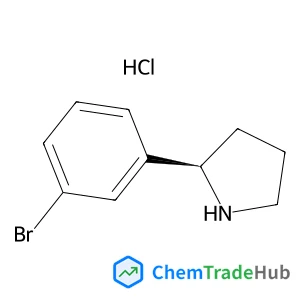
(2R)-2-(3-Bromophenyl)pyrrolidine hydrochloride (1:1)
CAS Number:
1391550-13-2
Molecular Formula:
C10H13BrClN
Recommended Suppliers







Disclaimer
This page provides academic journal information for reference and research purposes only. We are not affiliated with any journal publishers and do not handle publication submissions. For publication-related inquiries, please contact the respective journal publishers directly.
If you notice any inaccuracies in the information displayed, please contact us at support@chemtradehub.com. We will promptly review and address your concerns.