


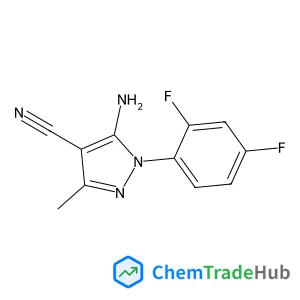
5-Amino-1-(2,4-difluorophenyl)-3-methyl-1H-pyrazole-4-carbonitrile
CAS Number:
1020057-92-4
Molecular Formula:
C11H8F2N4
Xiaoteng Li, Xi Zuo, Bin Cui, Wenkai Zhao, Yuqing Xu, Dongqing Zou, Chuanlu Yang
Two-dimensional (2D) Dirac materials have been a research hotspot due to their intriguing properties, such as high carrier mobility and ballistic charge transport. Here, we demonstrate that the B2S3 monolayer with a hexagonal structure, which has been reported as a photocatalyst, can be tuned to new 2D Dirac materials by doping atoms. The Young's modulus can reach 65.23 N m−1, indicating that the monolayer can be used as a buffer materials. The electronic structures of the pristine B2S3 monolayer show that some Dirac points appear but do not occur exactly on the Fermi level (EF). Fortunately, we find that the Dirac cone can be tuned to the EF by doping C, N, or Sn atoms. The C-doped B2S3 monolayer can be a half-metallic Dirac material, which has significant potential application in spintronics. For N- and Sn-doped B2S3 monolayers, the typical kagome bands are formed near the EF, which arise from three molecular orbitals hybridized by B, S, and N (Sn) atoms. These outstanding properties render the doped B2S3 monolayers promising 2D Dirac materials for future nanoelectronic devices.

Journal of Heterocyclic Chemistry

Journal of Organometallic Chemistry

Kinetics and Catalysis

Israel Journal of Chemistry

Organic Preparations and Procedures International

Pharmacological Reviews

European Journal of Wood and Wood Products

Russian Chemical Reviews

Fibre Chemistry

Proceedings of the National Academy of Sciences of the United States of America
Huiwen Wang, Haoquan Liu, Shangbo Ning, Chengwei Zeng, Yunjie Zhao
DOI: 10.1039/D1CP05558E
Seth Beck, Phillip Choi, Samir H. Mushrif
DOI: 10.1039/D2CP01683D
Wei Liu, Maxime Pouvreau, Andrew G. Stack, Xiaoning Yang, Aurora E. Clark
DOI: 10.1039/D2CP01997C
Sushil Kumar, R. K. Moudgil
DOI: 10.1039/D2CP01831D
Blake Trusty, Samuel Berens, Ahmad Yahya, Junchuan Fang, Sarah Barber, Anastasios P. Angelopoulos, Jonathan D. Nickels, Sergey Vasenkov
DOI: 10.1039/D2CP01125E
Leonardo Muñoz-Rugeles, Brayan Alberto Arenas-Blanco, Jorge M. del Campo, Enrique Mejía-Ospino
DOI: 10.1039/D2CP00292B
Li-Zhen Sun, Jun-Lin Qian, Pinggen Cai, Xiaojun Xu
DOI: 10.1039/D2CP02737B
Muhammad Shafiq Bin Mohd Yusof, Hongwei Song, Tushar Debnath, Bethany Lowe, Zhi-Heng Loh
DOI: 10.1039/D2CP00505K
Vikram Mahamiya, Alok Shukla
DOI: 10.1039/D2CP02705D
Xiang Zhang, Chunwen Sun
DOI: 10.1039/D2CP01655A
Ethyl 4-chlorothieno[2,3-b]pyridine-5-carboxylate (CAS: 59713-58-5) can be synth...
5-Methyl-1H-indole-3-carbaldehyde (CAS: 52562-50-2) is subject to various regula...
(1,3-Dimethyl-2,4-dioxo-1,2,3,4-tetrahydro-5-pyrimidinyl)boronic acid is a white...
Waste containing Sulfocostunolide A (CAS: 1016983-51-9) should be handled with c...
When handling Murraxocin (CAS: 88478-44-8), ensure proper personal protective eq...
Formvar (CAS: 63148-64-1) is an alkyd resin characterized by a high molecular we...
(S)-4-benzyl-2-((benzyloxy)methyl)morpholine is generally safe when handled with...
Methyl 1-(5-bromo-2-pyrimidinyl)cyclopropanecarboxylate (CAS: 1447607-69-3) is p...
2-Methyl-1-phenyl-1-propanamine hydrochloride (CAS: 24290-47-9) is generally con...
3-(4-Bromophenyl)-2-methylpropanoic acid is synthesized through a multi-step pro...

Physical Chemistry Chemical Physics (PCCP) is an international journal co-owned by 19 physical chemistry and physics societies from around the world. This journal publishes original, cutting-edge research in physical chemistry, chemical physics and biophysical chemistry. To be suitable for publication in PCCP, articles must include significant innovation and/or insight into physical chemistry; this is the most important criterion that reviewers and Editors will judge against when evaluating submissions. The journal has a broad scope and welcomes contributions spanning experiment, theory, computation and data science. Topical coverage includes spectroscopy, dynamics, kinetics, statistical mechanics, thermodynamics, electrochemistry, catalysis, surface science, quantum mechanics, quantum computing and machine learning. Interdisciplinary research areas such as polymers and soft matter, materials, nanoscience, energy, surfaces/interfaces, and biophysical chemistry are welcomed if they demonstrate significant innovation and/or insight into physical chemistry. Joined experimental/theoretical studies are particularly appreciated when complementary and based on up-to-date approaches.
![Sodium 6-amino-3-[(E)-{4-[(E)-(4-aminophenyl)diazenyl]-2-methoxy-5-methylphenyl}diazenyl]-4-hydroxy-2-naphthalenesulfonate structure](https://static.chemtradehub.com/structs/294/2945-96-2-092f.webp "Sodium 6-amino-3-[(E)-{4-[(E)-(4-aminophenyl)diazenyl]-2-methoxy-5-methylphenyl}diazenyl]-4-hydroxy-2-naphthalenesulfonate structure")
![9,9'-Spirobi[fluoren]-2-amine structure](https://static.chemtradehub.com/structs/118/118951-68-1-0d14.webp "9,9'-Spirobi[fluoren]-2-amine structure")



