


First principles study of thermoelectric performance in pristine and binary alloyed monolayers of noble metals
Literature Information
Publication Date
2022-08-17
DOI
10.1039/D2CP01831D
Impact Factor
3.676
Authors
Sushil Kumar, R. K. Moudgil
View Original
Abstract
In search of novel thermoelectric materials, we have investigated the thermoelectric performance of freestanding pristine and binary alloyed monolayers of noble metals (viz. Au, Ag, Cu, Pt) in honeycomb morphology using first principles methods based on density functional theory (DFT) and the non-equilibrium Green's function (NEGF) approach. The requisite electron transmission function is calculated using the TranSIESTA code – a module of the SIESTA package, while its phonon counterpart is obtained using the Phonons module of the python package along with the NEGF utility – PHtrans. Transport is explored along both the armchair (ac) and zigzag (zz) directions. Due to greater transverse length of the unit cell, electron and phonon transport is found to be more in the zz-direction. Among the pristine monolayers, Pt is found to exhibit ferromagnetism as well as the highest thermoelectric efficiency ZT ∼ 8 with an external bias of μ = 0.795 eV. However, alloying brings in a characteristic energy gap in the phononic transmission function, which diminishes the (room-temperature) relative phononic conductance to less than 5% in Pt-containing alloys. Also, monolayers of AuAg and AuCu turn semiconducting, with the former yielding a high Seebeck coefficient of 1264.96 μV K−1 at μ ∼ −0.055 eV. Moreover, they exhibit an enhanced ZT near the edges of the band gap, with ZTmax as high as 3.74 and 3.05, respectively. Interestingly, the Pt-containing alloyed monolayers also show a ferromagnetic character and hence, a spin-dependent Seebeck effect. In the CuPt monolayer, the bias μ can be tuned to attain an appreciable charge figure of merit ZcT = 4.80 at μ = 0.58 eV, while a decent spin figure of merit ZsT = 1.43 at μ = 0.56 eV. Instead, the pristine Pt monolayer shows a much better ZsT = 5.45 for a bias of μ = 0.785 eV. Nevertheless, the predicted ZT remains smaller than the corresponding alloyed atomic chains in double zigzag topology.
Recommended Journals

Helvetica Chimica Acta

Russian Chemical Reviews

Journal of Catalysis

Journal of Organometallic Chemistry

Nature

European Journal of Wood and Wood Products

Molecular Pharmacology

Science Progress

Proceedings of the National Academy of Sciences of the United States of America

Journal of Physics and Chemistry of Solids
Related Literature
Trapping Ca+ inside a molecular cavity: computational study of the potential energy surfaces for Ca+-[n]cycloparaphenylene, n = 5–12
Cole D. Allen, Susan L. B. Rempe, Timothy S. Zwier, Pengyu Ren
2022-04-07
Paper
DOI: 10.1039/D2CP00717G
Designing SnS/MoS2 van der Waals heterojunction for direct Z-scheme photocatalytic overall water-splitting by DFT investigation
Xiaofang Jia, Jinlong Wang, Yue Lu, Jiaming Sun, Yang Li, Yuyan Wang, Junying Zhang
2022-08-18
Paper
DOI: 10.1039/D2CP02692A
Optical absorption and shape transition in neutral SnN clusters with N ≤ 40: a photodissociation spectroscopy and electric beam deflection study
Andreas Lehr, Filip Rivic, Marc Jäger, Martin Gleditzsch, Rolf Schäfer
2022-05-04
Paper
DOI: 10.1039/D2CP01171A
Comparative study of Janus B2XY (X, Y = S, Se, Te) and F-BNBN-H monolayers for water splitting: revealing the positive and negative roles of the intrinsic dipole
Xing Zou, Li-Li Liu, Anrong Wang, Shi-Fa Wang, Yong Wei, Chun-Ming Yang, Lei Hu
2022-08-17
Paper
DOI: 10.1039/D2CP03069A
DLSSAffinity: protein–ligand binding affinity prediction via a deep learning model
Huiwen Wang, Haoquan Liu, Shangbo Ning, Chengwei Zeng, Yunjie Zhao
2022-04-04
Paper
DOI: 10.1039/D1CP05558E
Wettability of graphene oxide functionalized with N-alkylamines: a molecular dynamics study
Leonardo Muñoz-Rugeles, Brayan Alberto Arenas-Blanco, Jorge M. del Campo, Enrique Mejía-Ospino
2022-04-11
Paper
DOI: 10.1039/D2CP00292B
Electronic structure and magnetic coupling in selenium substituted pyridine-bridged bisdithiazolyl multifunctional molecular materials
2022-04-27
Paper
DOI: 10.1039/D2CP00415A
Reaction dynamics of Diels–Alder reactions from machine learned potentials
Tom A. Young, Tristan Johnston-Wood, Hanwen Zhang, Fernanda Duarte
2022-08-10
Paper
DOI: 10.1039/D2CP02978B
Glucose-induced self-assembly and phase separation in hydrophilic triblock copolymers and the governing mechanism
Divya Patel, Amit K. Bhojani, Debes Ray, Dheeraj K. Singh, Sanyukta Bhattacharjee, Debabrata Seth, Vinod K. Aswal, Ketan Kuperkar, Pratap Bahadur
2022-08-10
Paper
DOI: 10.1039/D2CP01909D
You might also like
Compound Q&A
How is Ethyl 4-chlorothieno[2,3-b]pyridine-5-carboxylate (CAS: 59713-58-5) typically synthesized?
Ethyl 4-chlorothieno[2,3-b]pyridine-5-carboxylate (CAS: 59713-58-5) can be synth...
59713-58-5Ethyl 4-chlorothieno...
Compound Q&A
What regulatory guidelines apply to 5-Methyl-1H-indole-3-carbaldehyde (CAS: 52562-50-2)?
5-Methyl-1H-indole-3-carbaldehyde (CAS: 52562-50-2) is subject to various regula...
52562-50-25-Methyl-1H-indole-3...
Compound Q&A
What are the physical and chemical properties of (1,3-Dimethyl-2,4-dioxo-1,2,3,4-tetrahydro-5-pyrimidinyl)boronic acid (CAS: 223418-73-3)?
(1,3-Dimethyl-2,4-dioxo-1,2,3,4-tetrahydro-5-pyrimidinyl)boronic acid is a white...
223418-73-3(1,3-Dimethyl-2,4-di...
Compound Q&A
How should waste containing Sulfocostunolide A (CAS: 1016983-51-9) be handled?
Waste containing Sulfocostunolide A (CAS: 1016983-51-9) should be handled with c...
1016983-51-9Sulfocostunolide A
Compound Q&A
What precautions should be taken when handling Murraxocin (CAS: 88478-44-8)?
When handling Murraxocin (CAS: 88478-44-8), ensure proper personal protective eq...
88478-44-8Murraxocin
Compound Q&A
What are the physical and chemical properties of Formvar (CAS: 63148-64-1)?
Formvar (CAS: 63148-64-1) is an alkyd resin characterized by a high molecular we...
63148-64-1Formvar(R)
Compound Q&A
Is (S)-4-benzyl-2-((benzyloxy)methyl)morpholine (CAS: 205242-66-6) safe?
(S)-4-benzyl-2-((benzyloxy)methyl)morpholine is generally safe when handled with...
205242-66-6(S)-4-benzyl-2-((ben...
Compound Q&A
What industries use Methyl 1-(5-bromo-2-pyrimidinyl)cyclopropanecarboxylate (CAS: 1447607-69-3)?
Methyl 1-(5-bromo-2-pyrimidinyl)cyclopropanecarboxylate (CAS: 1447607-69-3) is p...
1447607-69-3Methyl 1-(5-bromo-2-...
Compound Q&A
Is 2-Methyl-1-phenyl-1-propanamine hydrochloride (CAS: 24290-47-9) safe?
2-Methyl-1-phenyl-1-propanamine hydrochloride (CAS: 24290-47-9) is generally con...
24290-47-92-Methyl-1-phenyl-1-...
Compound Q&A
How is 3-(4-Bromophenyl)-2-methylpropanoic acid (CAS: 66735-01-1) typically synthesized?
3-(4-Bromophenyl)-2-methylpropanoic acid is synthesized through a multi-step pro...
66735-01-13-(4-Bromophenyl)-2-...
Source Journal
Physical Chemistry Chemical Physics

CiteScore:
5.5
Self-citation Rate:
10.3%
Articles per Year:
3036
Physical Chemistry Chemical Physics (PCCP) is an international journal co-owned by 19 physical chemistry and physics societies from around the world. This journal publishes original, cutting-edge research in physical chemistry, chemical physics and biophysical chemistry. To be suitable for publication in PCCP, articles must include significant innovation and/or insight into physical chemistry; this is the most important criterion that reviewers and Editors will judge against when evaluating submissions. The journal has a broad scope and welcomes contributions spanning experiment, theory, computation and data science. Topical coverage includes spectroscopy, dynamics, kinetics, statistical mechanics, thermodynamics, electrochemistry, catalysis, surface science, quantum mechanics, quantum computing and machine learning. Interdisciplinary research areas such as polymers and soft matter, materials, nanoscience, energy, surfaces/interfaces, and biophysical chemistry are welcomed if they demonstrate significant innovation and/or insight into physical chemistry. Joined experimental/theoretical studies are particularly appreciated when complementary and based on up-to-date approaches.
Recommended Compounds
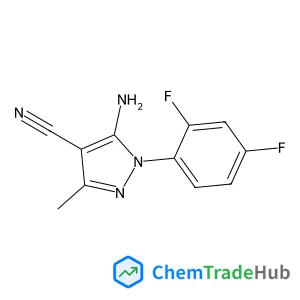
5-Amino-1-(2,4-difluorophenyl)-3-methyl-1H-pyrazole-4-carbonitrile
CAS Number:
1020057-92-4
Molecular Formula:
C11H8F2N4

Recommended Suppliers






Disclaimer
This page provides academic journal information for reference and research purposes only. We are not affiliated with any journal publishers and do not handle publication submissions. For publication-related inquiries, please contact the respective journal publishers directly.
If you notice any inaccuracies in the information displayed, please contact us at support@chemtradehub.com. We will promptly review and address your concerns.