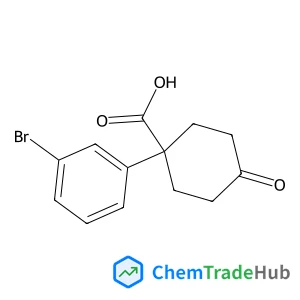
1-(3-Bromophenyl)-4-oxocyclohexanecarboxylic acid
CAS Number:
1385694-53-0
Molecular Formula:
C13H13BrO3
Sophia Klokishner, Oleg Reu, Marianna Roman
A crystal containing the heterometallic Cr-ligand-Co cluster with an unpaired electron on the ligand as a structural unit is examined. The developed model which describes the magnetic and polarizability characteristics of this crystal takes into account that the electron residing on the ligand can be transferred to the Co-ion, thus converting the diamagnetic ls-CoIII ion into the paramagnetic hs-CoII one. Since this transformation is accompanied by electron density redistribution and elongation of the Co–N bond lengths, the vibronic interaction of the Co-ion with totally symmetric displacements of the nearest surroundings and cooperative dipole–dipole and electron-deformational interactions are accounted for as well. The exchange interactions between the CrIII ion and the electron localized on the ligand as well as in the CrIII-hs-CoII pair are also included in consideration; the parameters of these interactions are estimated within the framework of the DFT method. Bistability in the magnetic and polarization characteristics is predicted for certain strengths of intra- and intercluster interactions in the crystal under study. Within the framework of the developed approach an explanation of the observed magnetic properties of the [Cr(SS-cth)(Co(RR-cth)(μ-dhbq))](PF6)2Cl crystal is given.
R. E. Ovcharenko, I. I. Tupitsyn, E. P. Savinov, E. N. Voloshina, B. Paulus, Yu. S. Dedkov, A. S. Shulakov
DOI: 10.1039/C3CP44304C
Alister E. Inglesby, Kamran Yunus, Adrian C. Fisher
DOI: 10.1039/C3CP51076J
Terry D. Humphries, Derek Birkmire, Bjørn C. Hauback, G. Sean McGrady, Craig M. Jensen
DOI: 10.1039/C3CP50777G
Xin Zeng, Stevin S. Pramana, Sudip K. Batabyal, Xiaodong Chen, K. B. Jinesh
DOI: 10.1039/C3CP43470B
Luis Gómez-Hortigüela, Furio Corà, C. Richard A. Catlow
DOI: 10.1039/C3CP51079D
Kai Welke, Hiroshi C. Watanabe, Tino Wolter, Marcus Elstner
DOI: 10.1039/C3CP44181D
Irina V. Chernyshova, Sathish Ponnurangam, Ponisseril Somasundaran
DOI: 10.1039/C3CP44264K
Dong Myung Jang, Hyung Soon Im, Yoon Myung, Yong Jae Cho, Han Sung Kim, Seung Hyuk Back, Jeunghee Park, Eun Hee Cha, Minyung Lee
DOI: 10.1039/C3CP50769F
Ruguang Ma, Mingjun Hu, Hua Cheng, Yang Yang Li
DOI: 10.1039/C3CP50588J
4-Benzyl-2,2-dimethylmorpholine is generally considered safe when handled under ...
(5,6-Dimethoxy-3-pyridinyl)boronic acid is a chemical compound with the molecula...
1,1,3,3-Tetramethyl-1,3-bis(2-methyl-2-propanyl)disiloxane is synthesized throug...
(2R,4S)-1-Boc-4-methylpyrrolidine-2-carboxylic acid is primarily used as a build...
When handling 2,3-Dichloroacrylonitrile, it is crucial to wear appropriate perso...
(S)-1-(o-Tolyl)ethanamine hydrochloride should be stored in a cool, dry place to...
Benzyl [1-(hydroxyamino)-1-imino-2-methyl-2-propanyl]carbamate (CAS: 518047-98-8...
2-Methyloxazole-5-carbaldehyde is used in the pharmaceutical industry for the sy...
The market for 2-Methyl-2-propanyl 4-[(1S)-1-hydroxyethyl]-1-piperidinecarboxyla...
1-Butyl-3-methylpyridinium bromide is generally considered safe for laboratory u...

Physical Chemistry Chemical Physics (PCCP) is an international journal co-owned by 19 physical chemistry and physics societies from around the world. This journal publishes original, cutting-edge research in physical chemistry, chemical physics and biophysical chemistry. To be suitable for publication in PCCP, articles must include significant innovation and/or insight into physical chemistry; this is the most important criterion that reviewers and Editors will judge against when evaluating submissions. The journal has a broad scope and welcomes contributions spanning experiment, theory, computation and data science. Topical coverage includes spectroscopy, dynamics, kinetics, statistical mechanics, thermodynamics, electrochemistry, catalysis, surface science, quantum mechanics, quantum computing and machine learning. Interdisciplinary research areas such as polymers and soft matter, materials, nanoscience, energy, surfaces/interfaces, and biophysical chemistry are welcomed if they demonstrate significant innovation and/or insight into physical chemistry. Joined experimental/theoretical studies are particularly appreciated when complementary and based on up-to-date approaches.
![2-[1-(4-Chlorobenzyl)-1H-indol-3-yl]-2-oxo-N-(6-quinolinyl)acetamide structure](https://static.chemtradehub.com/structs/501/501921-61-5-756a.webp "2-[1-(4-Chlorobenzyl)-1H-indol-3-yl]-2-oxo-N-(6-quinolinyl)acetamide structure")