












![1,1'-[(E)-1,2-Ethenediyl]bis(4-bromobenzene) structure](https://static.chemtradehub.com/structs/188/18869-30-2-c907.webp "1,1'-[(E)-1,2-Ethenediyl]bis(4-bromobenzene) structure")
31P nuclear spin singlet lifetimes in a system with switchable magnetic inequivalence: experiment and simulation
Literature Information
Publication Date
2021-08-17
DOI
10.1039/D1CP03085J
Impact Factor
3.676
Authors
David E. Korenchan, Jiaqi Lu, Malcolm H. Levitt, Alexej Jerschow
View Original
Abstract
31P NMR spectroscopy and the study of nuclear spin singlet relaxation phenomena are of interest in particular due to the importance of phosphorus-containing compounds in physiology. We report the generation and measurement of relaxation of 31P singlet order in a chemically equivalent but magnetically inequivalent case. Nuclear magnetic resonance singlet state lifetimes of 31P pairs have heretofore not been reported. Couplings between 1H and 31P nuclei lead to magnetic inequivalence and serve as a mechanism of singlet state population conversion within this molecule. We show that in this molecule singlet relaxation occurs at a rate significantly faster than spin–lattice relaxation, and that anticorrelated chemical shift anisotropy can account for this observation. Calculations of this mechanism, with the help of molecular dynamics simulations and ab initio calculations, provide excellent agreement with the experimental findings. This study could provide guidance for the study of 31P singlets within other compounds, including biomolecules.
Related Literature
Structural dynamics upon photoexcitation-induced charge transfer in a dicopper(i)–disulfide complex
Mateusz Rebarz, Martin Rohrmüller, Shirly Espinoza, Miroslav Kloz, Norman Kretzschmar, Adam Neuba, Jochen Ortmeyer, Roland Schoch, Matthias Bauer, Wolf Gero Schmidt, Gerald Henkel
2018-02-12
Paper
DOI: 10.1039/C7CP04880G
Electronic structure calculations and nonadiabatic dynamics simulations of excited-state relaxation of Pigment Yellow 101
Meng Che, Yuan-Jun Gao, Yan Zhang, Shu-Hua Xia, Ganglong Cui
2018-02-05
Paper
DOI: 10.1039/C7CP07692D
On the cononsolvency behaviour of hydrophobic clusters in water–methanol solutions
Andrea Pica, Giuseppe Graziano
2018-02-10
Paper
DOI: 10.1039/C7CP07943E
Effects of CNT size on the desalination performance of an outer-wall CNT slit membrane
Elisa Y. M. Ang, Teng Yong Ng, Rongming Lin, Zishun Liu, K. R. Geethalakshmi
2018-04-19
Paper
DOI: 10.1039/C8CP01191E
Adsorption of alcohols and hydrocarbons on nonstoichiometric cementite{010} surfaces
David Muñoz Ramo, Stephen J. Jenkins
2018-05-03
Paper
DOI: 10.1039/C8CP01028E
Lithium doping on 2D squaraine-bridged covalent organic polymers for enhancing adsorption properties: a theoretical study
Ling Huang, Xianfeng Yi, Anmin Zheng
2018-01-31
Paper
DOI: 10.1039/C7CP07686J
Imaging the ordering of a weakly adsorbed two-dimensional condensate: ambient-pressure microscopy and spectroscopy of CO2 molecules on rutile TiO2(110)
Mausumi Mahapatra, David C. Grinter, Fang Xu, Si Luo, Robert M. Palomino, Shyam Kattel, Iradwikanari Waluyo, Ping Liu, Dario J. Stacchiola, Sanjaya D. Senanayake
2018-05-01
Communication
DOI: 10.1039/C8CP01614C
Poly(vinylidene fluoride)/poly(3-methylthiophene) core–shell nanocomposites with improved structural and electronic properties of the conducting polymer component
Nikolay A. Ogurtsov, Valery N. Bliznyuk, Andrii V. Mamykin, Oleksandr L. Kukla, Yuri P. Piryatinski, Alexander A. Pud
2018-02-05
Paper
DOI: 10.1039/C7CP07604E
A first-principles study of hydrogen storage capacity based on Li–Na-decorated silicene
Zhe Sheng, Shujing Wu, Xianying Dai, Tianlong Zhao, Yue Hao
2018-04-25
Paper
DOI: 10.1039/C8CP00722E
Viable aromatic BenHn stars enclosing a planar hypercoordinate boron or late transition metal
Xue-Feng Zhao, Jia-Jia Li, Hai-Ru Li, Caixia Yuan, Xinxin Tian, Si-Dian Li, Yan-Bo Wu, Zhi-Xiang Wang
2018-02-19
Paper
DOI: 10.1039/C7CP06955C
You might also like
Compound Q&A
What is 3-Fluoro-2-methylbenzylamine (CAS: 771573-36-5)?
3-Fluoro-2-methylbenzylamine is an organic compound with the CAS number 771573-3...
771573-36-53-Fluoro-2-methylben...
Compound Q&A
Is Tert-butyl 2-(oxetan-3-ylidene)acetate (CAS: 1207175-03-8) safe?
Tert-butyl 2-(oxetan-3-ylidene)acetate is considered safe for its intended uses ...
1207175-03-8Tert-butyl 2-(oxetan...
Compound Q&A
What precautions should be taken when handling 4-Acetyl-2-fluorobenzonitrile (CAS: 214760-18-6)?
Proper personal protective equipment (PPE) such as gloves, goggles, and a lab co...
214760-18-64-Acetyl-2-fluoroben...
Compound Q&A
How is 2-Ethyl-4-methyl-1,3-thiazole (CAS: 15679-12-6) typically synthesized?
2-Ethyl-4-methyl-1,3-thiazole is commonly synthesized via the reaction of thiour...
15679-12-62-Ethyl-4-methyl-1,3...
Compound Q&A
How should 5',5''-([2,2'-Bithiophene]-5,5'-diyl)bis(([1,1':3',1''-terphenyl]-4,4''-dicarboxylic acid)) (CAS: 1227780-71-3) be stored?
This compound should be stored in a cool, dry place away from direct sunlight an...
1227780-71-35',5''''-([2,2'-Bith...
Compound Q&A
What regulatory guidelines apply to L-Lysine Acetate Salt (CAS: 52315-92-1)?
L-Lysine Acetate Salt (CAS: 52315-92-1) is subject to various regulatory guideli...
52315-92-1L-LYSINE ACETATE SAL...
Compound Q&A
Is 6-Fluoro-3-hydroxy-2-pyrazinecarboxamide (CAS: 259793-96-9) safe?
6-Fluoro-3-hydroxy-2-pyrazinecarboxamide (CAS: 259793-96-9) is generally conside...
259793-96-96-Fluoro-3-hydroxy-2...
Compound Q&A
What are the physical and chemical properties of 1,1'-Sulfonylbis(1H-imidazole) (CAS: 7189-69-7)?
1,1'-Sulfonylbis(1H-imidazole) is a crystalline solid with a molecular weight of...
7189-69-71,1'-Sulfonylbis(1H-...
Compound Q&A
What industries use 4-methyl-7-nitro-1H-indole-3-carbonitrile (CAS: 289483-82-5)?
4-Methyl-7-nitro-1H-indole-3-carbonitrile (CAS: 289483-82-5) is primarily used i...
289483-82-54-methyl-7-nitro-1H-...
Compound Q&A
How should waste containing 5-Bromo-3-indolyl-beta-galactoside (CAS: 97753-82-7) be handled?
Waste containing 5-Bromo-3-indolyl-beta-galactoside (CAS: 97753-82-7) should be ...
97753-82-75-Bromo-3-indolyl-be...
Source Journal
Physical Chemistry Chemical Physics

CiteScore:
5.5
Self-citation Rate:
10.3%
Articles per Year:
3036
Physical Chemistry Chemical Physics (PCCP) is an international journal co-owned by 19 physical chemistry and physics societies from around the world. This journal publishes original, cutting-edge research in physical chemistry, chemical physics and biophysical chemistry. To be suitable for publication in PCCP, articles must include significant innovation and/or insight into physical chemistry; this is the most important criterion that reviewers and Editors will judge against when evaluating submissions. The journal has a broad scope and welcomes contributions spanning experiment, theory, computation and data science. Topical coverage includes spectroscopy, dynamics, kinetics, statistical mechanics, thermodynamics, electrochemistry, catalysis, surface science, quantum mechanics, quantum computing and machine learning. Interdisciplinary research areas such as polymers and soft matter, materials, nanoscience, energy, surfaces/interfaces, and biophysical chemistry are welcomed if they demonstrate significant innovation and/or insight into physical chemistry. Joined experimental/theoretical studies are particularly appreciated when complementary and based on up-to-date approaches.
Recommended Compounds
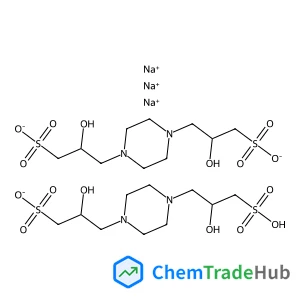
3,3'-(Piperazine-1,4-diyl)bis(2-hydroxypropane-1-sulfonic acid) Sodium Salt
CAS Number:
108321-08-0
Molecular Formula:
C20H41N4Na3O16S4
Recommended Suppliers





Disclaimer
This page provides academic journal information for reference and research purposes only. We are not affiliated with any journal publishers and do not handle publication submissions. For publication-related inquiries, please contact the respective journal publishers directly.
If you notice any inaccuracies in the information displayed, please contact us at support@chemtradehub.com. We will promptly review and address your concerns.