












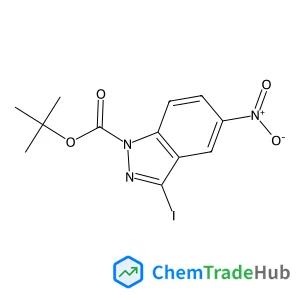
Tert-butyl 3-iodo-5-nitro-1H-indazole-1-carboxylate
CAS Number:
459133-69-8
Molecular Formula:
C12H12IN3O4
Ling Huang, Xianfeng Yi, Anmin Zheng
Lithium modification, especially quantitative and oriented doping, is an effective way to enhance the adsorption properties of covalent organic frameworks (e.g., CO2 and H2). Two-dimensional squaraine-bridged covalent organic polymers (SQ-COPs), with quantitative and oriented Li-doped open oxygen sites of the squaric-acid unit, are investigated for their CO2 capture properties by using first-principles calculation combined with grand canonical Monte Carlo (GCMC) simulation. It is found that owing to the strong affinity of Li atoms to the squaraine units of SQ-COPs, the gas adsorption capacity in SQ-COP-Li increased to 3 times more than those of the pristine SQ-COPs. In particular, since the Li–O bonds between squaraine units and Li atoms can enhance the electrostatic interaction between the framework and CO2, the adsorption amount of CO2 in SQ-COP-Li reaches an extremely high capacity of 83.4 and 202.0 mmol g−1 at 298 K and 100 bar for 1-Li (SQ-COP-1-Li) and 3-Li (SQ-COP-3-Li), respectively. Such a high CO2 uptake means that 3-Li outperforms the best 3D COF (COF-05) materials so far reported, and is even twice that of MOF-177 and IRMOF-10. Even at 30 bar and 298 K, the CO2 uptake values of 49.2 mmol g−1 of 1-Li and 61.5 mmol g−1 of 3-Li are far higher than 29.7 mmol g−1 of Li-doped COF-102 and 42.0 mmol g−1 of Li-doped COF-105. Moreover, the selectivity of CO2/H2 and CO2/CH4 in 1-Li reaches 19 and 5.4 at 273 K, and 10.3 and 3.6 at 298 K, respectively. Therefore, such Li-doped SQ-COPs might be an environmentally friendly candidate for high CO2 capture. Furthermore, the possible synthesis pathways of SQ-COP-Li are investigated, and it is indicated that the use of lithium di-isopropylamide and lithium naphthalene as dopants is energetically favorable. The findings in this work are expected to provide new ideas for metal doping and extended applications of functionalized materials.
Xieweiyi Ye, Yakun Xue, Kaijia Li, Wen Tang, Xiao Han, Xibo Zhang, Zhijia Song, Zhiping Zheng, Qin Kuang
DOI: 10.1039/D1MA00475A
DOI: 10.1039/C3TB20284D
Daniel J. Harrison, Ulrich Fekl
DOI: 10.1039/B915614C
Justyna Łuczak, Christian Jungnickel, Izabela Łącka, Stefan Stolte, Jan Hupka
DOI: 10.1039/B921805J
Xiaosong Xiong, Ruoyu Zhi, Qi Zhou, Wenqi Yan, Yusong Zhu, Yuhui Chen, Lijun Fu, Nengfei Yu, Yuping Wu
DOI: 10.1039/D1MA00121C
Ritu Malik, Nirav Joshi, Vijay K. Tomer
DOI: 10.1039/D1MA00374G
Srikanth Mandava, Ranita Basu, B. Khasimsaheb, Sai Muthukumar V., Ajay Singh, S. Neeleshwar
DOI: 10.1039/D1MA00155H
Jan Pschierer, Natalie Peschek, Herbert Plenio
DOI: 10.1039/B924772F
Gokul Venugopalan, Deepra Bhattacharya, Subarna Kole, Cameron Ysidron, Polyxeni P. Angelopoulou, Georgios Sakellariou, Christopher G. Arges
DOI: 10.1039/D1MA00208B
When handling 4-Methyl-6-(trifluoromethyl)quinoline (CAS: 40716-16-3), safety go...
4-(3,5-Difluorophenyl)aniline is an aromatic organic compound with the CAS numbe...
5-{[4-(Trifluoromethyl)phenyl]sulfanyl}-1,2,3-thiadiazole-4-carboxylic acid can ...
The market for 4-Benzylaniline hydrochloride (CAS: 6317-57-3) is steadily growin...
[3-(Diethylsulfamoyl)phenyl]boronic acid is generally considered safe when handl...
3-Bromo-2,5-dimethoxyaniline is mainly used in the pharmaceutical and chemical i...
N-Methyl-1-(5-methyl-1H-indol-3-yl)methanamine (CAS: 915922-67-7) is subject to ...
This compound is primarily used in the pharmaceutical industry for the synthesis...
2-Methyl-2-propanyl [(1S,3R)-3-aminocyclohexyl]carbamate (CAS: 1298101-47-9) sho...
Ethyl 2-bromo-4,4,4-trifluorobutanoate (CAS: 367-33-9) is utilized in the pharma...

Physical Chemistry Chemical Physics (PCCP) is an international journal co-owned by 19 physical chemistry and physics societies from around the world. This journal publishes original, cutting-edge research in physical chemistry, chemical physics and biophysical chemistry. To be suitable for publication in PCCP, articles must include significant innovation and/or insight into physical chemistry; this is the most important criterion that reviewers and Editors will judge against when evaluating submissions. The journal has a broad scope and welcomes contributions spanning experiment, theory, computation and data science. Topical coverage includes spectroscopy, dynamics, kinetics, statistical mechanics, thermodynamics, electrochemistry, catalysis, surface science, quantum mechanics, quantum computing and machine learning. Interdisciplinary research areas such as polymers and soft matter, materials, nanoscience, energy, surfaces/interfaces, and biophysical chemistry are welcomed if they demonstrate significant innovation and/or insight into physical chemistry. Joined experimental/theoretical studies are particularly appreciated when complementary and based on up-to-date approaches.
![N-{3-[Benzyl(methyl)amino]propyl}-9-chloro-5,6,7,8-tetrahydro-2-acridinecarboxamide structure](https://static.chemtradehub.com/structs/142/1426944-49-1-1e4c.webp "N-{3-[Benzyl(methyl)amino]propyl}-9-chloro-5,6,7,8-tetrahydro-2-acridinecarboxamide structure")
![2,4-Dichloro-6-isopropyl-5H-pyrrolo[3,4-d]pyrimidin-7(6H)-one structure](https://static.chemtradehub.com/structs/107/1079649-94-7-ad4a.webp "2,4-Dichloro-6-isopropyl-5H-pyrrolo[3,4-d]pyrimidin-7(6H)-one structure")
![6-Bromo-3-ethyl-3H-imidazo[4,5-b]pyridine structure](https://static.chemtradehub.com/structs/103/1033202-59-3-2a8f.webp "6-Bromo-3-ethyl-3H-imidazo[4,5-b]pyridine structure")



