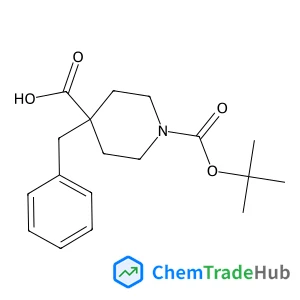
4-Benzyl-1-(tert-butoxycarbonyl)piperidine-4-carboxylic acid
CAS Number:
170838-87-6
Molecular Formula:
C18H25NO4
Barbara Marchetti, Vincent J. Esposito, Rachel E. Bush, Tolga N. V. Karsili
Criegee intermediates are of great significance to Earth's troposphere – implicated in altering the tropospheric oxidation cycle and in forming low volatility products that typically condense to form secondary organic aerosols (SOAs). As such, their chemistry has attracted vast attention in recent years. In particular, the unimolecular decay of thermal and vibrationally-excited Criegee intermediates has been the focus of several experimental and computational studies, and it is now recognized that Criegee intermediates undergo unimolecular decay to form OH radicals. In this contribution we reveal insight into the chemistry of Criegee intermediates by highlighting the hitherto neglected multi-state contribution to the ground state unimolecular decay dynamics of the Criegee intermediate products. The two key intermediates of present focus are dioxirane and vinylhydroperoxide – known to be active intermediates that mediate the unimolecular decay of CH2OO and CH3CHOO, respectively. In both cases the unimolecular decay path encounters conical intersections, which may play a pivotal role in the ensuing dynamics. This hitherto unrecognized phenomenon may be vital in the way in which the reactivity of Criegee intermediates are modelled and is likely to affect the ensuing dynamics associated with the unimolecular decay of a given Criegee intermediate.
Neeladri Sekhar Roy, Subrata Debnath, Abhijit Chakraborty, Prasenjit Chakraborty, Indrani Bera, Raka Ghosh, Nanda Ghoshal, Saikat Chakrabarti, Siddhartha Roy
DOI: 10.1039/C8CP01119B
Dessalegne A. Tsehay
DOI: 10.1039/C7CP08341F
Hui Li, Xizu Wang, FuKe Wang
DOI: 10.1039/C7CP07896J
Cloé Azarias, Simon Pascal, Olivier Siri, Denis Jacquemin
DOI: 10.1039/C8CP03789B
Petra Jarosova, Petr Paroulek, Michal Rajecky, Veronika Rajecka, Eva Taborska, Ramon Eritja, Anna Aviñó, Stefania Mazzini, Raimundo Gargallo, Petr Taborsky
DOI: 10.1039/C8CP02681E
Daoyi Dong
DOI: 10.1039/C8CP00512E
Pavel Adam, Alexander M. Smith, Gregor Trefalt, István Szilágyi, Plinio Maroni, Michal Borkovec
DOI: 10.1039/C8CP00679B
Marco Smerieri, Lara Ferrighi, Silvia Nappini, Luca Vaghi, Antonio Papagni, Cristiana Di Valentin, Federica Bondino, Letizia Savio
DOI: 10.1039/C8CP04791J
Junjun Wu, Liuhao Ma
DOI: 10.1039/C8CP04114H
This compound is mainly used as an intermediate in the synthesis of antipsychoti...
Waste containing 1-(D-Ribofuranosyl)-1,4-dihydro-3-pyridinecarboxamide (CAS: 191...
2-Methyl-2-propanyl 3-bromo-3-(hydroxymethyl)-1-azetidinecarboxylate (CAS: 20079...
N-(4-Chloro-2-pyridinyl)acetamide (CAS: 245056-66-0) is a chemical compound with...
5-Chloro-2-hydroxybenzoic acid, also known as 5-chlorosalicylic acid, is an arom...
When handling 1,1-Dichloro-1-fluoroethane (CAS: 1717-00-6), it is important to u...
Fmoc-(2S,3R)-3-phenylpyrrolidine-2-carboxylic acid is a white crystalline solid ...
4-Amino-5-bromo-2-pyridinecarboxylic acid is primarily used as a precursor in th...
Handling this compound should be done with personal protective equipment (PPE) i...
When handling 8-bromo-2,2-dimethyl-3,4-dihydro-2H-1,4-benzoxazin-3-one, use prop...

Physical Chemistry Chemical Physics (PCCP) is an international journal co-owned by 19 physical chemistry and physics societies from around the world. This journal publishes original, cutting-edge research in physical chemistry, chemical physics and biophysical chemistry. To be suitable for publication in PCCP, articles must include significant innovation and/or insight into physical chemistry; this is the most important criterion that reviewers and Editors will judge against when evaluating submissions. The journal has a broad scope and welcomes contributions spanning experiment, theory, computation and data science. Topical coverage includes spectroscopy, dynamics, kinetics, statistical mechanics, thermodynamics, electrochemistry, catalysis, surface science, quantum mechanics, quantum computing and machine learning. Interdisciplinary research areas such as polymers and soft matter, materials, nanoscience, energy, surfaces/interfaces, and biophysical chemistry are welcomed if they demonstrate significant innovation and/or insight into physical chemistry. Joined experimental/theoretical studies are particularly appreciated when complementary and based on up-to-date approaches.
![Pyrazolo[1,5-a]pyridine-3-carbothioamide structure](https://static.chemtradehub.com/structs/885/885275-44-5-aae0.webp "Pyrazolo[1,5-a]pyridine-3-carbothioamide structure")