













Investigation of crystallization kinetics and its relationship with molecular dynamics for chiral fluorinated glassforming smectogen 3F5HPhH6
Literature Information
Publication Date
2021-08-31
DOI
10.1039/D1CP02297K
Impact Factor
3.676
Authors
Aleksandra Deptuch, Małgorzata Jasiurkowska-Delaporte, Wojciech Zając, Ewa Juszyńska-Gałązka, Anna Drzewicz, Magdalena Urbańska
View Original
Abstract
The phase transitions, crystallization kinetics and molecular dynamics of (S)-4′-(1-methylheptylcarbonyl)biphenyl-4-yl 4-[5-(2,2,3,3,4,4,4-heptafluorobutoxy)pent-1-oxy] benzoate (3F5HPhH6) are investigated by differential scanning calorimetry, polarizing optical microscopy and broadband dielectric spectroscopy. The vitrification of the antiferroelectric hexatic phase is observed for cooling rates ≥5 K min−1 and the fragility index determined from dielectric data is mf ≈ 90. Two regimes of non-isothermal cold crystallization are distinguished using the Kissinger and Augis–Bennett methods in the heating rate ranges of 1–5 K min−1 (larger activation energy) and 8–20 K min−1 (lower activation energy). The correlation between the time of non-isothermal cold crystallization (using isothermal approximation) and relaxation time of the α-process is determined. The obtained coupling coefficient ξ ≈ 0.7 and temperature dependence of the crystallization rate Z from the Ozawa model imply a mainly diffusion-controlled cold crystallization below 275 K. The Avrami exponents n and Ozawa exponents nO determined for isothermal melt crystallization and non-isothermal cold crystallization, respectively, weigh in favour of two- rather than three-dimensional crystal growth. The transition between crystal phases is observed on heating, with a lower activation energy for 1–3 K min−1 than for 5–20 K min−1 rates.
Recommended Journals
Related Literature
Metal-free synthesis of 2,2-disubstituted indolin-3-ones
Xinpeng Jiang, Bingbin Zhu, Kai Lin, Guan Wang, Wei-Ke Su
2019-01-29
Paper
DOI: 10.1039/C8OB03057J
Synthesis of disaccharide nucleoside analogues as potential poly(ADP-ribose) polymerase-1 inhibitors
Meng Zheng, Martin Mex, Kathrin H. Götz, Andreas Marx
2018-08-30
Communication
DOI: 10.1039/C8OB01894D
Enantioselective synthesis of tunable chiral pyridine–aminophosphine ligands and their applications in asymmetric hydrogenation
Youran Liu, Fei Chen, Yan-Mei He, Chenghao Li
2019-05-01
Paper
DOI: 10.1039/C9OB00770A
Chemoselective synthesis of m-teraryls through ring transformation of 2H-pyran-2-ones by 2-(1-arylethylidene)-malononitriles
Rahul Panwar, Shally, Ranjay Shaw, Amr Elagamy, Ramendra Pratap
2018-10-31
Paper
DOI: 10.1039/C8OB02370K
Stereocontrolled synthesis of resolvin D1
Masao Morita, Shangze Wu, Yuichi Kobayashi
2019-01-30
Paper
DOI: 10.1039/C8OB03128B
Ring-closing metathesis of unprotected peptides in water
Shun Masuda, Shugo Tsuda, Taku Yoshiya
2018-11-27
Communication
DOI: 10.1039/C8OB02778A
Robust synthesis of C-terminal cysteine-containing peptide acids through a peptide hydrazide-based strategy
Bing-Jia Yan, Han-Ying Zhu, Wei-Wei Shi, Tong-Kuai Xi, Jing Shi, Ge-Min Fang
2019-05-17
Communication
DOI: 10.1039/C9OB01114E
A designed protein binding-pocket to control excited-state intramolecular proton transfer fluorescence
Bryan J. Lampkin, Cecilia Monteiro, Evan T. Powers, Paige M. Bouc, Jeffery W. Kelly, Brett VanVeller
2018-11-28
Paper
DOI: 10.1039/C8OB02673D
Modification of oligonucleotides with weak basic residues via the 2′-O-carbamoylethyl linker for improving nuclease resistance without loss of duplex stability and antisense activity
Yoshiaki Masaki, Keishi Yamamoto, Keita Yoshida, Atsuya Maruyama, Takahito Tomori, Yusuke Iriyama, Hiroyuki Nakajima, Tatsuro Kanaki, Kohji Seio
2019-04-29
Paper
DOI: 10.1039/C9OB00668K
Photo-sensitized oxy-thiocyanation of terminal alkynes/1,3-aryldienes and their one-pot conversion to 2-hydroxy 4-substituted aryl thiazoles‡
Swargam Vijaykumar
2019-01-26
Paper
DOI: 10.1039/C9OB00054B
You might also like
Compound Q&A
What is 3-Fluoro-2-methylbenzylamine (CAS: 771573-36-5)?
3-Fluoro-2-methylbenzylamine is an organic compound with the CAS number 771573-3...
771573-36-53-Fluoro-2-methylben...
Compound Q&A
Is Tert-butyl 2-(oxetan-3-ylidene)acetate (CAS: 1207175-03-8) safe?
Tert-butyl 2-(oxetan-3-ylidene)acetate is considered safe for its intended uses ...
1207175-03-8Tert-butyl 2-(oxetan...
Compound Q&A
What precautions should be taken when handling 4-Acetyl-2-fluorobenzonitrile (CAS: 214760-18-6)?
Proper personal protective equipment (PPE) such as gloves, goggles, and a lab co...
214760-18-64-Acetyl-2-fluoroben...
Compound Q&A
How is 2-Ethyl-4-methyl-1,3-thiazole (CAS: 15679-12-6) typically synthesized?
2-Ethyl-4-methyl-1,3-thiazole is commonly synthesized via the reaction of thiour...
15679-12-62-Ethyl-4-methyl-1,3...
Compound Q&A
How should 5',5''-([2,2'-Bithiophene]-5,5'-diyl)bis(([1,1':3',1''-terphenyl]-4,4''-dicarboxylic acid)) (CAS: 1227780-71-3) be stored?
This compound should be stored in a cool, dry place away from direct sunlight an...
1227780-71-35',5''''-([2,2'-Bith...
Compound Q&A
What regulatory guidelines apply to L-Lysine Acetate Salt (CAS: 52315-92-1)?
L-Lysine Acetate Salt (CAS: 52315-92-1) is subject to various regulatory guideli...
52315-92-1L-LYSINE ACETATE SAL...
Compound Q&A
Is 6-Fluoro-3-hydroxy-2-pyrazinecarboxamide (CAS: 259793-96-9) safe?
6-Fluoro-3-hydroxy-2-pyrazinecarboxamide (CAS: 259793-96-9) is generally conside...
259793-96-96-Fluoro-3-hydroxy-2...
Compound Q&A
What are the physical and chemical properties of 1,1'-Sulfonylbis(1H-imidazole) (CAS: 7189-69-7)?
1,1'-Sulfonylbis(1H-imidazole) is a crystalline solid with a molecular weight of...
7189-69-71,1'-Sulfonylbis(1H-...
Compound Q&A
What industries use 4-methyl-7-nitro-1H-indole-3-carbonitrile (CAS: 289483-82-5)?
4-Methyl-7-nitro-1H-indole-3-carbonitrile (CAS: 289483-82-5) is primarily used i...
289483-82-54-methyl-7-nitro-1H-...
Compound Q&A
How should waste containing 5-Bromo-3-indolyl-beta-galactoside (CAS: 97753-82-7) be handled?
Waste containing 5-Bromo-3-indolyl-beta-galactoside (CAS: 97753-82-7) should be ...
97753-82-75-Bromo-3-indolyl-be...
Source Journal
Physical Chemistry Chemical Physics

CiteScore:
5.5
Self-citation Rate:
10.3%
Articles per Year:
3036
Physical Chemistry Chemical Physics (PCCP) is an international journal co-owned by 19 physical chemistry and physics societies from around the world. This journal publishes original, cutting-edge research in physical chemistry, chemical physics and biophysical chemistry. To be suitable for publication in PCCP, articles must include significant innovation and/or insight into physical chemistry; this is the most important criterion that reviewers and Editors will judge against when evaluating submissions. The journal has a broad scope and welcomes contributions spanning experiment, theory, computation and data science. Topical coverage includes spectroscopy, dynamics, kinetics, statistical mechanics, thermodynamics, electrochemistry, catalysis, surface science, quantum mechanics, quantum computing and machine learning. Interdisciplinary research areas such as polymers and soft matter, materials, nanoscience, energy, surfaces/interfaces, and biophysical chemistry are welcomed if they demonstrate significant innovation and/or insight into physical chemistry. Joined experimental/theoretical studies are particularly appreciated when complementary and based on up-to-date approaches.
Recommended Compounds
![1,1'-[(E)-1,2-Ethenediyl]bis(4-bromobenzene) structure](https://static.chemtradehub.com/structs/188/18869-30-2-c907.webp "1,1'-[(E)-1,2-Ethenediyl]bis(4-bromobenzene) structure")
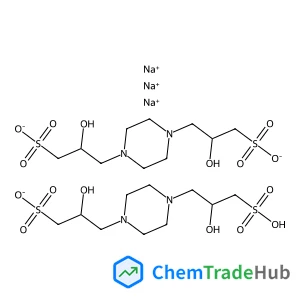
3,3'-(Piperazine-1,4-diyl)bis(2-hydroxypropane-1-sulfonic acid) Sodium Salt
CAS Number:
108321-08-0
Molecular Formula:
C20H41N4Na3O16S4
Recommended Suppliers




Disclaimer
This page provides academic journal information for reference and research purposes only. We are not affiliated with any journal publishers and do not handle publication submissions. For publication-related inquiries, please contact the respective journal publishers directly.
If you notice any inaccuracies in the information displayed, please contact us at support@chemtradehub.com. We will promptly review and address your concerns.