


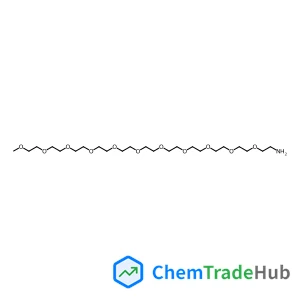
2,5,8,11,14,17,20,23,26,29,32-Undecaoxatetratriacontan-34-amine
CAS Number:
854601-60-8
Molecular Formula:
C23H49NO11
Yoshiaki Masaki, Keishi Yamamoto, Keita Yoshida, Atsuya Maruyama, Takahito Tomori, Yusuke Iriyama, Hiroyuki Nakajima, Tatsuro Kanaki, Kohji Seio
For the improvement of nuclease resistance, four kinds of new modifications through a carbamoylethyl linker were designed. Among them, the 2′-O-[2-N-{2-(benzimidazol-1-yl)ethyl}carbamoylethyl] modification showed 20-fold longer half-life when treated with a 3′ to 5′ exonuclease compared to the 2′-O-methoxyethyl (MOE) modification, which is used in approved drugs. In addition, this large modification did not disturb the binding affinity or RNase H-dependent antisense activity. From these findings, it could be concluded that an adequate linker, such as carbamoylethyl in this study, could extend the utility of 2′-O-modification without loss of the properties of nucleic acids. This strategy would be useful for the development of nucleic acid therapeutics.

Journal of the American Chemical Society

Cement and Concrete Research

Chemistry of Natural Compounds

Canadian Metallurgical Quarterly

Bulletin of the Chemical Society of Japan

Accounts of Chemical Research

Chemical Reviews

Australian Journal of Chemistry

Doklady Chemistry

Advances in Colloid and Interface Science
Vanessa Riffet, Vanessa Labet, Julia Contreras-García
DOI: 10.1039/C7CP04349J
Niels Boon, Peter Schurtenberger
DOI: 10.1039/C7CP02434G
Federico Bertasi, Guinevere A. Giffin, Keti Vezzù, Yaser Abu-Lebdeh, Michel Armand
DOI: 10.1039/C7CP02304A
Congdi Shang, Li Wang, Yanqin An, Ping Chen, Xingmao Chang, Yanyu Qi, Rui Kang, Yu Fang
DOI: 10.1039/C7CP04235C
Markus Doerr, Martha C. Daza
DOI: 10.1039/C7CP03930A
Andrea Gemma, Gema Ballano, Juan Torras, Ana I. Jiménez, Carlos Cativiela
DOI: 10.1039/C7CP03792A
Haoyue Guo, Yiman Zhang
DOI: 10.1039/C7CP04590E
Guofeng Yang, Rui Sun, Pengfei Yan, Yanan Lu, Junjun Xue, Guoqing Chen
DOI: 10.1039/C7CP05386J
Bei Deng, Xingqiang Shi
DOI: 10.1039/C7CP05109C
3-Fluoro-2-methylbenzylamine is an organic compound with the CAS number 771573-3...
Tert-butyl 2-(oxetan-3-ylidene)acetate is considered safe for its intended uses ...
Proper personal protective equipment (PPE) such as gloves, goggles, and a lab co...
2-Ethyl-4-methyl-1,3-thiazole is commonly synthesized via the reaction of thiour...
This compound should be stored in a cool, dry place away from direct sunlight an...
L-Lysine Acetate Salt (CAS: 52315-92-1) is subject to various regulatory guideli...
6-Fluoro-3-hydroxy-2-pyrazinecarboxamide (CAS: 259793-96-9) is generally conside...
1,1'-Sulfonylbis(1H-imidazole) is a crystalline solid with a molecular weight of...
4-Methyl-7-nitro-1H-indole-3-carbonitrile (CAS: 289483-82-5) is primarily used i...
Waste containing 5-Bromo-3-indolyl-beta-galactoside (CAS: 97753-82-7) should be ...

Organic & Biomolecular Chemistry (OBC) publishes original and high impact research and reviews in organic chemistry. We welcome research that shows new or significantly improved protocols or methodologies in total synthesis, synthetic methodology or physical and theoretical organic chemistry as well as research that shows a significant advance in the organic chemistry or molecular design aspects of chemical biology, catalysis, supramolecular and macromolecular chemistry, theoretical chemistry, mechanism-oriented physical organic chemistry, medicinal chemistry or natural products. Articles published in the journal should report new work which makes a highly-significant impact in the field. Routine and incremental work is generally not suitable for publication in the journal. More details about key areas of our scope are below. In all cases authors should include in their article clear rationale for why their research has been carried out.
![5-(2-Phenylpyrazolo[1,5-a]pyridin-3-yl)-2H-pyrazolo[3,4-c]pyridazin-3-amine structure](https://static.chemtradehub.com/structs/865/865362-74-9-0091.webp "5-(2-Phenylpyrazolo[1,5-a]pyridin-3-yl)-2H-pyrazolo[3,4-c]pyridazin-3-amine structure")





