


Surface amplification of tetraphenylporphyrin overtone and combination Raman bands in drop coating deposition Raman (DCDR) on electrically conductive surfaces
Literature Information
Publication Date
2021-08-09
DOI
10.1039/D1CP01911B
Impact Factor
3.676
Authors
Phutri Milana, Tika Pebriani, Fry V. Steky, Cynthia L. Radiman
View Original
Abstract
It is essential to realize a Raman measurement technique without artifact or fluorescence signals for high-quality and reliable data in a valid molecular-level analysis and interpretation. This requirement applies especially to a molecule with strong fluorescence like porphyrin. Here, the surface of a gold substrate performs better as a DCDR substrate for tetraphenylporphyrin than other surfaces, such as tantalum, indium tin oxide glass, or aluminium. Polarized Raman spectra of tetraphenylporphyrin demonstrated the oriented deposition of porphyrin crystallites on the Au substrate using the drop coating technique. The emission anisotropy suggests that the deposited crystallites are arranged outward radially with the porphyrin ring orientation. The orientation is signed by the NH⋯HN axis that is parallel to the radial vector along the X-axis. Moreover, it also demonstrates high chemical stability after preservation and repeated measurements. The Raman signal on a gold substrate is enhanced more than on other substrates beyond mere preconcentration of analytes or the coffee-ring effect only, which might be due to the contribution of the SERRS effect. This effect will be discussed based on the interactions among localized surface plasmons, vibronic transitions, and Raman active vibrational modes.
Recommended Journals

Biopolymers

Bulletin of the Chemical Society of Japan

Journal of the Chinese Chemical Society

Chemical Reviews

Journal of the American Chemical Society

Canadian Metallurgical Quarterly

Chemical & Pharmaceutical Bulletin

Chemistry of Natural Compounds

Chemistry of Heterocyclic Compounds

Australian Journal of Chemistry
Related Literature
Piperylene sulfone: a labile and recyclable DMSO substitute
P. G. Jessop
2007-01-30
Communication
DOI: 10.1039/B616806J
A photoswitchable molecular wire with the dithienylethene (DTE) linker, (dppe)(η5-C5Me5)Fe–CC–DTE–CC–Fe(η5-C5Me5)(dppe)
Yuya Tanaka, Akiko Inagaki, Munetaka Akita
2006-12-19
Communication
DOI: 10.1039/B614748H
Enhanced reactivity of hydrophobic vitamin B12 towards the dechlorination of DDT in ionic liquid
Md. Abdul Jabbar, Hisashi Shimakoshi, Yoshio Hisaeda
2007-03-23
Communication
DOI: 10.1039/B700725F
A reductase-mimicking thiourea organocatalyst incorporating a covalently bound NADH analogue: efficient 1,2-diketone reduction with in situ prosthetic group generation and recycling
Barbara Procuranti, Stephen J. Connon
2007-01-30
Communication
DOI: 10.1039/B618792G
Two-photon degradable supramolecular assemblies of linear-dendritic copolymers
Justin L. Mynar, Andrew P. Goodwin, Joel A. Cohen, Yingzhong Ma, Graham R. Fleming, Jean M. J. Fréchet
2007-03-15
Communication
DOI: 10.1039/B701681F
Quantitative detection of protein expression in single cells using droplet microfluidics
M. Srisa-Art, F. Hollfelder, A. J. deMello
2007-01-26
Communication
DOI: 10.1039/B618570C
Pore-expansion of monodisperse mesoporous silica spheres by a novel surfactant exchange method
Mamoru Mizutani, Yuri Yamada, Kazuhisa Yano
2006-12-19
Communication
DOI: 10.1039/B613163H
New insights into the mechanism of asymmetric hydrogenation catalysed by monophosphonite–rhodium complexes
Ilya D. Gridnev, Cheng Fan, Paul G. Pringle
2007-02-27
Communication
DOI: 10.1039/B617705K
You might also like
Compound Q&A
What precautions should be taken when handling 2-Chloro-1,2-bis(4-methylphenyl)ethanone (CAS: 71193-32-3)?
When handling 2-Chloro-1,2-bis(4-methylphenyl)ethanone (CAS: 71193-32-3), it is ...
71193-32-32-Chloro-1,2-bis(4-m...
Compound Q&A
What industries use 4-Ethoxy-3-(5-methyl-4-oxo-7-propyl-1,4-dihydroimidazo[5,1-f][1,2,4]triazin-2-yl)benzenesulfonyl chloride (CAS: 224789-26-8)?
4-Ethoxy-3-(5-methyl-4-oxo-7-propyl-1,4-dihydroimidazo[5,1-f][1,2,4]triazin-2-yl...
224789-26-84-Ethoxy-3-(5-methyl...
Compound Q&A
How should Methyl 3-Oxo-4-Androsten-17-Carboxylate (CAS: 2681-55-2) be stored?
Methyl 3-Oxo-4-Androsten-17-Carboxylate (CAS: 2681-55-2) should be stored in a c...
2681-55-2Methyl 3-Oxo-4-Andro...
Compound Q&A
What are the main uses of (R)-3-Amino-4-(3-hexylphenylamino)-4-oxobutylphosphonic acid (CAS: 909725-61-7)?
(R)-3-Amino-4-(3-hexylphenylamino)-4-oxobutylphosphonic acid is primarily used i...
909725-61-7(R)-3-Amino-4-(3-hex...
Compound Q&A
What regulatory guidelines apply to 2-Methyl-2-propanyl 3-amino-3-carbamoyl-1-azetidinecarboxylate (CAS: 1254120-14-3)?
2-Methyl-2-propanyl 3-amino-3-carbamoyl-1-azetidinecarboxylate (CAS: 1254120-14-...
1254120-14-32-Methyl-2-propanyl ...
Compound Q&A
Are there alternatives to (E)-4-(tert-Butoxy)-4-oxobut-2-enoic acid (CAS: 135355-96-3) in synthesis?
There are alternative reagents that can be used in synthesis instead of (E)-4-(t...
135355-96-3(E)-4-(tert-Butoxy)-...
Compound Q&A
What are the physical and chemical properties of [2-(3-Chlorophenyl)-1,3-thiazol-4-yl]methanol (CAS: 121202-20-8)?
[2-(3-Chlorophenyl)-1,3-thiazol-4-yl]methanol (CAS: 121202-20-8) is a crystallin...
121202-20-8[2-(3-Chlorophenyl)-...
Compound Q&A
What is the market or research trend for Methyl (2S)-[(4S)-2,2-dimethyl-1,3-dioxolan-4-yl]{[(4-methylphenyl)sulfonyl]oxy}acetate (CAS: 166249-17-8)?
The market and research trends for Methyl (2S)-[(4S)-2,2-dimethyl-1,3-dioxolan-4...
166249-17-8Methyl (2S)-[(4S)-2,...
Compound Q&A
What is the market or research trend for 1-Bromo-2-isocyanatoethane (CAS: 42865-19-0)?
The market for 1-Bromo-2-isocyanatoethane (CAS: 42865-19-0) is driven by its use...
42865-19-01-Bromo-2-isocyanato...
Compound Q&A
What are the main uses of 4-Nitro-D-phenylalanine hydrochloride (CAS: 147065-06-3)?
4-Nitro-D-phenylalanine hydrochloride (CAS: 147065-06-3) is primarily used in re...
147065-06-34-Nitro-D-phenylalan...
Source Journal
Physical Chemistry Chemical Physics

CiteScore:
5.5
Self-citation Rate:
10.3%
Articles per Year:
3036
Physical Chemistry Chemical Physics (PCCP) is an international journal co-owned by 19 physical chemistry and physics societies from around the world. This journal publishes original, cutting-edge research in physical chemistry, chemical physics and biophysical chemistry. To be suitable for publication in PCCP, articles must include significant innovation and/or insight into physical chemistry; this is the most important criterion that reviewers and Editors will judge against when evaluating submissions. The journal has a broad scope and welcomes contributions spanning experiment, theory, computation and data science. Topical coverage includes spectroscopy, dynamics, kinetics, statistical mechanics, thermodynamics, electrochemistry, catalysis, surface science, quantum mechanics, quantum computing and machine learning. Interdisciplinary research areas such as polymers and soft matter, materials, nanoscience, energy, surfaces/interfaces, and biophysical chemistry are welcomed if they demonstrate significant innovation and/or insight into physical chemistry. Joined experimental/theoretical studies are particularly appreciated when complementary and based on up-to-date approaches.
Recommended Compounds
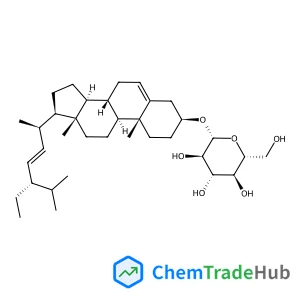
(3beta,22E)-Stigmasta-5,22-dien-3-yl beta-D-glucopyranoside
CAS Number:
19716-26-8
Molecular Formula:
C35H58O6


Recommended Suppliers




Disclaimer
This page provides academic journal information for reference and research purposes only. We are not affiliated with any journal publishers and do not handle publication submissions. For publication-related inquiries, please contact the respective journal publishers directly.
If you notice any inaccuracies in the information displayed, please contact us at support@chemtradehub.com. We will promptly review and address your concerns.