


A reductase-mimicking thiourea organocatalyst incorporating a covalently bound NADH analogue: efficient 1,2-diketone reduction with in situ prosthetic group generation and recycling
Literature Information
Publication Date
2007-01-30
DOI
10.1039/B618792G
Impact Factor
6.222
Authors
Barbara Procuranti, Stephen J. Connon
View Original
Abstract
A new class of bifunctional organocatalyst promotes the chemoselective reduction of diketone electrophiles at catalytic loadings in the presence of an inorganic co-reductant.
Recommended Journals

Biocatalysis and Biotransformation

Journal of Asian Natural Products Research

Critical Reviews in Solid State and Materials Sciences

Heteroatom Chemistry

Electroanalysis

Bioorganic & Medicinal Chemistry Letters

Acta Metallurgica Sinica-English Letters

Journal of the Indian Institute of Science

Topics in Catalysis

Herald of the Russian Academy of Sciences
Related Literature
Band gap engineering of ZnOvia doping with manganese: effect of Mn clustering
Hilkka Saal, Thomas Bredow, Michael Binnewies
2009-03-26
Paper
DOI: 10.1039/B901596E
Time-resolved gas-phase kinetic study of the germylene addition reaction, GeH2 + CH3CCCH3
Rosa Becerra, Robin Walsh
2009-03-05
Paper
DOI: 10.1039/B821330E
Thermodynamics of nano- and macrocrystalline anatase using cell voltage measurements
Palani Balaya, Joachim Maier
2009-11-09
Paper
DOI: 10.1039/B910820C
A detailed comparison of centrifugal sudden and J-shift estimates of the reactive properties of the N + N2 reaction
Antonio Laganà, Dimitris Skouteris
2009-10-27
Paper
DOI: 10.1039/B915409D
Electron spin relaxation at low field
Per-Olof Westlund, Håkan Wennerström
2009-11-06
Paper
DOI: 10.1039/B916999G
Pulsed electrodeposition of porous ZnO on Ag-coated polyamide filaments
Melanie Rudolph, Thomas Loewenstein, Elisa Arndt, Yvonne Zimmermann, Andreas Neudeck, Derck Schlettwein
2009-03-13
Paper
DOI: 10.1039/B822534F
An electrochemical study of lithium insertion into Cr5−yTiySe8 (y = 1, 2, 3, 4, 4.5) beyond the intercalation limit
Joseph Wontcheu, Wolfgang Bensch
2009-03-12
Paper
DOI: 10.1039/B822397A
Carbohydrate–aromatic π interactions: a test of density functionals and the DFT-D method
Rajesh K. Raju, Anitha Ramraj, Ian H. Hillier, Mark A. Vincent, Neil A. Burton
2009-03-02
Paper
DOI: 10.1039/B822877A
Adjustment of the bioresistivity by electron irradiation: self-assembled monolayers of oligo(ethyleneglycol)-terminated alkanethiols with embedded cleavable group
Simone Krakert, Nirmalya Ballav, Michael Zharnikov, Andreas Terfort
2009-11-16
Paper
DOI: 10.1039/B915036F
You might also like
Compound Q&A
What precautions should be taken when handling 2-Chloro-1,2-bis(4-methylphenyl)ethanone (CAS: 71193-32-3)?
When handling 2-Chloro-1,2-bis(4-methylphenyl)ethanone (CAS: 71193-32-3), it is ...
71193-32-32-Chloro-1,2-bis(4-m...
Compound Q&A
What industries use 4-Ethoxy-3-(5-methyl-4-oxo-7-propyl-1,4-dihydroimidazo[5,1-f][1,2,4]triazin-2-yl)benzenesulfonyl chloride (CAS: 224789-26-8)?
4-Ethoxy-3-(5-methyl-4-oxo-7-propyl-1,4-dihydroimidazo[5,1-f][1,2,4]triazin-2-yl...
224789-26-84-Ethoxy-3-(5-methyl...
Compound Q&A
How should Methyl 3-Oxo-4-Androsten-17-Carboxylate (CAS: 2681-55-2) be stored?
Methyl 3-Oxo-4-Androsten-17-Carboxylate (CAS: 2681-55-2) should be stored in a c...
2681-55-2Methyl 3-Oxo-4-Andro...
Compound Q&A
What are the main uses of (R)-3-Amino-4-(3-hexylphenylamino)-4-oxobutylphosphonic acid (CAS: 909725-61-7)?
(R)-3-Amino-4-(3-hexylphenylamino)-4-oxobutylphosphonic acid is primarily used i...
909725-61-7(R)-3-Amino-4-(3-hex...
Compound Q&A
What regulatory guidelines apply to 2-Methyl-2-propanyl 3-amino-3-carbamoyl-1-azetidinecarboxylate (CAS: 1254120-14-3)?
2-Methyl-2-propanyl 3-amino-3-carbamoyl-1-azetidinecarboxylate (CAS: 1254120-14-...
1254120-14-32-Methyl-2-propanyl ...
Compound Q&A
Are there alternatives to (E)-4-(tert-Butoxy)-4-oxobut-2-enoic acid (CAS: 135355-96-3) in synthesis?
There are alternative reagents that can be used in synthesis instead of (E)-4-(t...
135355-96-3(E)-4-(tert-Butoxy)-...
Compound Q&A
What are the physical and chemical properties of [2-(3-Chlorophenyl)-1,3-thiazol-4-yl]methanol (CAS: 121202-20-8)?
[2-(3-Chlorophenyl)-1,3-thiazol-4-yl]methanol (CAS: 121202-20-8) is a crystallin...
121202-20-8[2-(3-Chlorophenyl)-...
Compound Q&A
What is the market or research trend for Methyl (2S)-[(4S)-2,2-dimethyl-1,3-dioxolan-4-yl]{[(4-methylphenyl)sulfonyl]oxy}acetate (CAS: 166249-17-8)?
The market and research trends for Methyl (2S)-[(4S)-2,2-dimethyl-1,3-dioxolan-4...
166249-17-8Methyl (2S)-[(4S)-2,...
Compound Q&A
What is the market or research trend for 1-Bromo-2-isocyanatoethane (CAS: 42865-19-0)?
The market for 1-Bromo-2-isocyanatoethane (CAS: 42865-19-0) is driven by its use...
42865-19-01-Bromo-2-isocyanato...
Compound Q&A
What are the main uses of 4-Nitro-D-phenylalanine hydrochloride (CAS: 147065-06-3)?
4-Nitro-D-phenylalanine hydrochloride (CAS: 147065-06-3) is primarily used in re...
147065-06-34-Nitro-D-phenylalan...
Source Journal
Chemical Communications

CiteScore:
8.6
Self-citation Rate:
4.7%
Articles per Year:
2458
ChemComm publishes urgent research which is of outstanding significance and interest to experts in the field, while also appealing to the journal’s broad chemistry readership. Our communication format is ideally suited to short, urgent studies that are of such importance that they require accelerated publication. Our scope covers all topics in chemistry, and research at the interface of chemistry and other disciplines (such as materials science, nanoscience, physics, engineering and biology) where there is a significant novelty in the chemistry aspects. Major topic areas covered include: Analytical Chemistry Catalysis Chemical Biology and medicinal chemistry Computational Chemistry and Machine Learning Energy and sustainable chemistry Environmental Chemistry Green Chemistry Inorganic Chemistry Materials Chemistry Nanoscience Organic Chemistry Physical Chemistry Polymer Chemistry Supramolecular Chemistry
Recommended Compounds
![4-[2-(Trichlorosilyl)ethyl]benzenesulfonyl chloride structure](https://static.chemtradehub.com/structs/797/79793-00-3-de16.webp "4-[2-(Trichlorosilyl)ethyl]benzenesulfonyl chloride structure")
4-[2-(Trichlorosilyl)ethyl]benzenesulfonyl chloride
CAS Number:
79793-00-3
Molecular Formula:
C8H8Cl4O2SSi
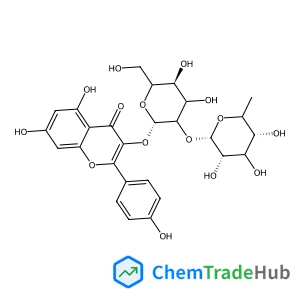
5,7-Dihydroxy-2-(4-hydroxyphenyl)-4-oxo-4H-chromen-3-yl 2-O-(6-deoxy-alpha-L-mannopyranosyl)-beta-D-glucopyranoside
CAS Number:
32602-81-6
Molecular Formula:
C27H30O15
Recommended Suppliers






Disclaimer
This page provides academic journal information for reference and research purposes only. We are not affiliated with any journal publishers and do not handle publication submissions. For publication-related inquiries, please contact the respective journal publishers directly.
If you notice any inaccuracies in the information displayed, please contact us at support@chemtradehub.com. We will promptly review and address your concerns.