


Residue-specific binding mechanisms of PD-L1 to its monoclonal antibodies by computational alanine scanning
Literature Information
Publication Date
2021-06-24
DOI
10.1039/D1CP01281A
Impact Factor
3.676
Authors
Wei Wen, Dading Huang, Jingxiao Bao
View Original
Abstract
Programmed cell death 1 receptor (PD-1) on the surface of T cells and its ligand 1 (PD-L1) are immune checkpoint proteins. Treating cancer patients with inhibitors blocking this checkpoint has significantly prolonged the survival rate of patients. In this study, we examined several monoclonal antibodies (mAbs) of PD-L1 and studied their detailed binding mechanism to PD-L1. An efficient computational alanine scanning method was used to perform quantitative analysis of hotspot residues that are important for PD-1/PD-L1 binding. A total of five PD-L1/mAb complexes were investigated and hotspots on both PD-L1 and mAbs were predicted. Our result shows that PD-L1M115 and PD-L1Y123 are two relatively important hotspots in all the five PD-L1/mAb binding complexes. It is also found that the important residues of mAbs binding to PD-L1M115 and PD-L1Y123 are similar to each other. The computational alanine scanning result is compared to the experimental measurements that are available for two of the mAbs (KN035 and atezolizumab). The calculated alanine scanning result is in good agreement with the experimental data with a correlation coefficient of 0.87 for PD-L1/KN035 and 0.6 for PD-L1/atezolizumab. Our computation found more hotspots on PD-L1 in the PD-L1/KN035 complex than those in the PD-L1/atezolizumab system, indicating stronger binding affinity in the former than the latter, which is in good agreement with the experimental finding. The present work provides important insights for the design of new mAbs targeting PD-L1.
Recommended Journals

Current Opinion in Colloid & Interface Science

Russian Journal of Bioorganic Chemistry

Acta Materialia

Chemical Communications

Journal of Natural Medicines

Crystallography Reports

Current Opinion in Solid State & Materials Science

Russian Journal of Coordination Chemistry

Saudi Pharmaceutical Journal

Drug Discovery Today
Related Literature
Characterization and control of the electronic properties of a NiO based dye sensitized photocathode
Idan Hod, Zion Tachan, Menny Shalom, Arie Zaban
2013-03-21
Paper
DOI: 10.1039/C3CP50242B
Photoelectrical properties and the electronic structure of Tl1−xIn1−xSnxSe2 (x = 0, 0.1, 0.2, 0.25) single crystalline alloys
G. E. Davydyuk, H. Kamarudin, G. L. Myronchuk, S. P. Danylchuk, A. O. Fedorchuk, L. V. Piskach, M. Yu. Mozolyuk, O. V. Parasyuk
2013-03-12
Paper
DOI: 10.1039/C3CP50836F
Ab initio simulations of scanning-tunneling-microscope images with embedding techniques and application to C58-dimers on Au(111)
Alexei Bagrets
2013-02-14
Paper
DOI: 10.1039/C3CP44286A
Interpretation of experimental hydrogen-bond enthalpies and entropies from COSMO polarisation charge densities
Jens Reinisch, Frank Eckert, Jérôme Graton, Jean-Yves Le Questel
2013-03-22
Paper
DOI: 10.1039/C3CP44611E
Effects of intramolecular hydrogen bonding on the excited state dynamics of phenol chromophores
Yi Lin Yang, Yu-Chieh Ho, Yuri A. Dyakov, Wen-Hsin Hsu, Yi-Lun Sun, Wan-Chen Tsai, Wei-Ping Hu
2013-03-15
Paper
DOI: 10.1039/C3CP44674C
Rotational spectroscopy meets theory
Cristina Puzzarini
2013-02-19
Perspective
DOI: 10.1039/C3CP44301A
Significant performance improvement in dye-sensitized solar cells employing cobalt(iii/ii) tris-bipyridyl redox mediators by co-grafting alkyl phosphonic acids with a ruthenium sensitizer
Yeru Liu, James Robert Jennings, Xingzhu Wang, Qing Wang
2013-03-08
Communication
DOI: 10.1039/C3CP50998B
Long-range Li+ dynamics in the lithium argyrodite Li7PSe6 as probed by rotating-frame spin–lattice relaxation NMR
V. Epp, Ö. Gün, H.-J. Deiseroth, M. Wilkening
2013-03-18
Paper
DOI: 10.1039/C3CP44379E
High permeability and salt rejection reverse osmosis by a zeolite nano-membrane
Yilun Liu
2013-02-12
Paper
DOI: 10.1039/C3CP43854F
Recovering degraded quasi-solid-state dye-sensitized solar cells by applying electrical pulses
Xi Zhang, Xuezhen Huang
2013-03-14
Paper
DOI: 10.1039/C3CP51071A
You might also like
Compound Q&A
Is 4-Benzyl-2,2-dimethylmorpholine (CAS: 84761-04-6) safe?
4-Benzyl-2,2-dimethylmorpholine is generally considered safe when handled under ...
84761-04-64-Benzyl-2,2-dimethy...
Compound Q&A
What is (5,6-Dimethoxy-3-pyridinyl)boronic acid (CAS: 1346526-61-1)?
(5,6-Dimethoxy-3-pyridinyl)boronic acid is a chemical compound with the molecula...
1346526-61-1(5,6-Dimethoxy-3-pyr...
Compound Q&A
How is 1,1,3,3-Tetramethyl-1,3-bis(2-methyl-2-propanyl)disiloxane (CAS: 67875-55-2) typically synthesized?
1,1,3,3-Tetramethyl-1,3-bis(2-methyl-2-propanyl)disiloxane is synthesized throug...
67875-55-21,1,3,3-Tetramethyl-...
Compound Q&A
What are the main uses of (2R,4S)-1-Boc-4-methylpyrrolidine-2-carboxylic acid (CAS: 1018818-04-6)?
(2R,4S)-1-Boc-4-methylpyrrolidine-2-carboxylic acid is primarily used as a build...
1018818-04-6(2R,4S)-1-Boc-4-meth...
Compound Q&A
What precautions should be taken when handling 2,3-Dichloroacrylonitrile (CAS: 22410-58-8)?
When handling 2,3-Dichloroacrylonitrile, it is crucial to wear appropriate perso...
22410-58-82,3-Dichloroacryloni...
Compound Q&A
How should (S)-1-(o-Tolyl)ethanamine hydrochloride (CAS: 1332832-16-2) be stored?
(S)-1-(o-Tolyl)ethanamine hydrochloride should be stored in a cool, dry place to...
1332832-16-2(S)-1-(o-Tolyl)ethan...
Compound Q&A
What are the physical and chemical properties of Benzyl [1-(hydroxyamino)-1-imino-2-methyl-2-propanyl]carbamate (CAS: 518047-98-8)?
Benzyl [1-(hydroxyamino)-1-imino-2-methyl-2-propanyl]carbamate (CAS: 518047-98-8...
518047-98-8Benzyl [1-(hydroxyam...
Compound Q&A
What industries use 2-Methyloxazole-5-carbaldehyde (CAS: 885273-42-7)?
2-Methyloxazole-5-carbaldehyde is used in the pharmaceutical industry for the sy...
885273-42-72-Methyloxazole-5-ca...
Compound Q&A
What is the market or research trend for 2-Methyl-2-propanyl 4-[(1S)-1-hydroxyethyl]-1-piperidinecarboxylate (CAS: 389889-82-1)?
The market for 2-Methyl-2-propanyl 4-[(1S)-1-hydroxyethyl]-1-piperidinecarboxyla...
389889-82-12-Methyl-2-propanyl ...
Compound Q&A
Is 1-Butyl-3-methylpyridinium bromide (CAS: 26576-85-2) safe?
1-Butyl-3-methylpyridinium bromide is generally considered safe for laboratory u...
26576-85-21-Butyl-3-methylpyri...
Source Journal
Physical Chemistry Chemical Physics

CiteScore:
5.5
Self-citation Rate:
10.3%
Articles per Year:
3036
Physical Chemistry Chemical Physics (PCCP) is an international journal co-owned by 19 physical chemistry and physics societies from around the world. This journal publishes original, cutting-edge research in physical chemistry, chemical physics and biophysical chemistry. To be suitable for publication in PCCP, articles must include significant innovation and/or insight into physical chemistry; this is the most important criterion that reviewers and Editors will judge against when evaluating submissions. The journal has a broad scope and welcomes contributions spanning experiment, theory, computation and data science. Topical coverage includes spectroscopy, dynamics, kinetics, statistical mechanics, thermodynamics, electrochemistry, catalysis, surface science, quantum mechanics, quantum computing and machine learning. Interdisciplinary research areas such as polymers and soft matter, materials, nanoscience, energy, surfaces/interfaces, and biophysical chemistry are welcomed if they demonstrate significant innovation and/or insight into physical chemistry. Joined experimental/theoretical studies are particularly appreciated when complementary and based on up-to-date approaches.
Recommended Compounds
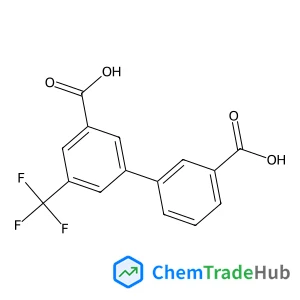
3-(3-Carboxyphenyl)-5-(trifluoromethyl)benzoic acid
CAS Number:
1261930-96-4
Molecular Formula:
C15H9F3O4
Recommended Suppliers




Disclaimer
This page provides academic journal information for reference and research purposes only. We are not affiliated with any journal publishers and do not handle publication submissions. For publication-related inquiries, please contact the respective journal publishers directly.
If you notice any inaccuracies in the information displayed, please contact us at support@chemtradehub.com. We will promptly review and address your concerns.