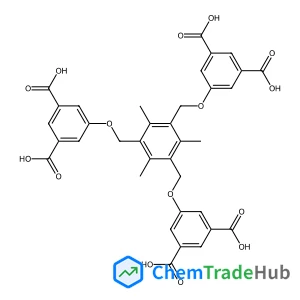
5,5',5''-(((2,4,6-Trimethylbenzene-1,3,5-triyl)tris(methylene))tris(oxy))triisophthalic acid
CAS Number:
1159974-70-5
Molecular Formula:
C36H30O15
C. P. E. Varsamis, N. Makris, C. Valvi, E. I. Kamitsos
Bismuth-containing borate glasses, xBi2O3–(1 − x)B2O3, were synthesized in the broad composition range 0.20 ≤ x ≤ 0.80 by melting in Pt crucibles and splat-quenching between two metal blocks. Infrared reflectance spectra, measured in the range 30–5000 cm−1, were transformed into absorption coefficient spectra and then deconvoluted into component bands to probe the glass structure as a function of composition. Integrated intensities of bands above 800 cm−1 were used in combination with mass and charge balance equations to quantify the short-range borate structure in terms of the molar fractions X4m, X4o, X3, X2, X1 and X0 for borate units BØ4−, BØ2O23−, BØ3, BØ2O−, BØO22− and BO33−, where Ø and O− denote bridging and non-bridging oxygen atoms. Borate tetrahedral units were found to be present in both the meta-borate, BØ4−, and ortho-borate, BØ2O23−, forms with BØ4− constituting the dominating tetrahedral species for 0.20 ≤ x ≤ 0.70. The BØ2O23− units prevail at higher Bi2O3 levels (x > 0.7), and coexist with their isomeric triangular borate species BO33− (BØ2O23− ⇌ BO33−). The present IR results for the total molar fraction of borate tetrahedral units, X4 = X4m + X4o, are in very good agreement with reported NMR results for the fraction of boron atoms in four-fold coordination, N4. Besides evaluating X4m and X4o, the present work reports also for the first time the fractions of all types of triangular borate species X3−n with n = 0, 1, 2 and 3. The IR region below 550 cm−1 was found to be dominated by the Bi–O vibrational activity in coexisting ionic (160–230 cm−1) and distorted BiO6 sites (330–365 cm−1 and 475–510 cm−1), a result reflecting the dual role of Bi2O3 as glass-modifier and glass-former oxide. The latter role dominates in glasses exceeding 60 mol% Bi2O3, and is consistent with the extended glass formation in the bismuth-borate system. The structural results were used to calculate the average number of bridging B–Ø bonds per boron center, the average Bi–O and B–O single bond energy, and the atomic packing density of the studied glasses. These properties vary approximately linearly with Bi2O3 content in the three regimes 0.2 ≤ x ≤ 0.4, 0.4 < x ≤ 0.6 and 0.6 < x ≤ 0.83, and contribute collectively to the composition dependence of glass transition temperature.
Victorio Cadierno, Sergio E. García-Garrido, José Gimeno, Noel Nebra
DOI: 10.1039/B506788J
Yanfei Shen, Yuanjian Zhang, Qixian Zhang, Tianyan You, Ari Ivaska
DOI: 10.1039/B507688A
Jyongsik Jang, Byungkwon Lim, Moonjung Choi
DOI: 10.1039/B506265A
Hiroyuki Katayama, Hiroshi Yari, Masaki Tanaka, Fumiyuki Ozawa
DOI: 10.1039/B504436G
Seigo Ito, Paul Liska, Pascal Comte, Raphaël Charvet, Peter Péchy, Udo Bach, Lukas Schmidt-Mende, Shaik Mohammed Zakeeruddin, Andreas Kay, Mohammad K. Nazeeruddin, Michael Grätzel
DOI: 10.1039/B505718C
Yvonne Chiang, A. Jerry Kresge, Ikenna Onyido, John P. Richard, Peter Wan, Musheng Xu
DOI: 10.1039/B506706E
Frank Hauke, Andrew J. Myles, Julius Rebek Jr.
DOI: 10.1039/B506048F
Daniel L. Reger, J. Derek Elgin, Radu F. Semeniuc, Perry J. Pellechia, Mark D. Smith
DOI: 10.1039/B504998A
Jeane Bordini, Peter C. Ford, Elia Tfouni
DOI: 10.1039/B507407J
Waste containing N-Methoxy-N-methyl-1,3-thiazole-5-carboxamide (CAS: 898825-89-3...
N-(4-Biphenylyl)dibenzo[b,d]furan-4-amine should be stored in a tightly sealed c...
The market for 3-Acetamido-5-amino-2,4,6-triiodobenzoic acid (CAS: 1713-07-1) is...
Benzyl 2-O-acetyl-3,4,6-tri-O-benzyl-beta-D-galactopyranoside (CAS: 61820-03-9) ...
2-Ethylpiperazine dihydrochloride (CAS: 438050-52-3) is regulated under the Glob...
1,1'-[1,3-Phenylenebis(methylene)]bis(3-methyl-1H-pyrrole-2,5-dione) (CAS: 11946...
Several alternatives can be used in the synthesis of 5-Fluoro-2-(1-pyrrolidinyl)...
Proper personal protective equipment (PPE) must be worn when handling this compo...
When handling 6-Bromoimidazo[1,2-a]pyridin-8-amine, it is important to wear appr...
Alternatives to (2S,4R)-4-(4-Nitrobenzyl)pyrrolidine-2-carboxylic acid hydrochlo...

Physical Chemistry Chemical Physics (PCCP) is an international journal co-owned by 19 physical chemistry and physics societies from around the world. This journal publishes original, cutting-edge research in physical chemistry, chemical physics and biophysical chemistry. To be suitable for publication in PCCP, articles must include significant innovation and/or insight into physical chemistry; this is the most important criterion that reviewers and Editors will judge against when evaluating submissions. The journal has a broad scope and welcomes contributions spanning experiment, theory, computation and data science. Topical coverage includes spectroscopy, dynamics, kinetics, statistical mechanics, thermodynamics, electrochemistry, catalysis, surface science, quantum mechanics, quantum computing and machine learning. Interdisciplinary research areas such as polymers and soft matter, materials, nanoscience, energy, surfaces/interfaces, and biophysical chemistry are welcomed if they demonstrate significant innovation and/or insight into physical chemistry. Joined experimental/theoretical studies are particularly appreciated when complementary and based on up-to-date approaches.