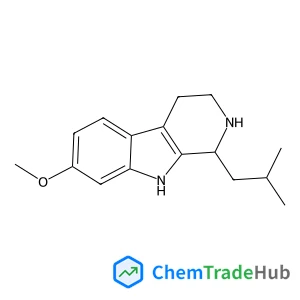
1-Isobutyl-7-methoxy-2,3,4,9-tetrahydro-1H-beta-carboline
CAS Number:
175975-76-5
Molecular Formula:
C16H22N2O
Wenfan Chen
We use transient extreme ultraviolet (XUV) reflection absorption spectroscopy to study polaron formation on hematite and akaganeite surfaces. We observed a reduction in the offset of the imaginary refractive index (κoffset) that was attributed to the photoemission cross-section. The difference in the κoffset reduction indicated that deeper-trapped polarons were formed in hematite than in akaganeite.
S. Bordiga, C. Lamberti, G. Ricchiardi, L. Regli, F. Bonino, A. Damin, K.-P. Lillerud, M. Bjorgen, A. Zecchina
DOI: 10.1039/B407246D
David R. Kelly, Eva Caroff, Robert W. Flood, William Heal, Stanley M. Roberts
DOI: 10.1039/B404389H
DOI: 10.1039/B410700D
Anthony R. Chianese, Brian M. Zeglis, Robert H. Crabtree
DOI: 10.1039/B409672J
Shosuke Kojo, Hiromi Uchino, Mayu Yoshimura, Kyoko Tanaka
DOI: 10.1039/B409941A
Patrick Gunning, Andrew C. Benniston, Robert D. Peacock
DOI: 10.1039/B409132A
Sergey A. Piletsky, Elena V. Piletska, Kal Karim, Frank Davis, Seamus P. J. Higson, Anthony P. F. Turner
DOI: 10.1039/B408387C
Chuanbao Cao, Xu Xiang, Hesun Zhu
DOI: 10.1039/B409087J
Yu Liu, Hao Wang, Heng-Yi Zhang, Peng Liang
DOI: 10.1039/B409356A
Xiao-Ti Zhou, Rich G. Carter
DOI: 10.1039/B410092A
N-(4-Methoxybenzyl)-2-pyridinamine (CAS: 52818-63-0) is increasingly being used ...
When handling Ethyl 4-(2-chlorophenyl)-1,3-thiazole-2-carboxylate, appropriate p...
Diethyldiselane (CAS: 628-39-7) is classified under the Globally Harmonized Syst...
The market for oxocopper (CAS: 12053-18-8) is primarily driven by its use in cat...
The market for 5-{[(2-Methyl-2-propanyl)oxy]carbonyl}-5-azaspiro[2.4]heptane-7-c...
2-(1-Pyrrolidinyl)-4-pyridinamine is a chemical compound with the CAS number 359...
2-(3-Pyridinyl)-1-azabicyclo[2.2.2]octane (CAS: 91556-75-1) is a crystalline sol...
(S)-Alpha-allyl-proline hydrochloride is usually synthesized via a Wittig reacti...
3-Methyl-1,2-oxazole-5-carboxylic acid (CAS: 4857-42-5) is an organic compound w...
Lys-SMCC-DM1 is synthesized via a multi-step process involving the coupling of S...

Physical Chemistry Chemical Physics (PCCP) is an international journal co-owned by 19 physical chemistry and physics societies from around the world. This journal publishes original, cutting-edge research in physical chemistry, chemical physics and biophysical chemistry. To be suitable for publication in PCCP, articles must include significant innovation and/or insight into physical chemistry; this is the most important criterion that reviewers and Editors will judge against when evaluating submissions. The journal has a broad scope and welcomes contributions spanning experiment, theory, computation and data science. Topical coverage includes spectroscopy, dynamics, kinetics, statistical mechanics, thermodynamics, electrochemistry, catalysis, surface science, quantum mechanics, quantum computing and machine learning. Interdisciplinary research areas such as polymers and soft matter, materials, nanoscience, energy, surfaces/interfaces, and biophysical chemistry are welcomed if they demonstrate significant innovation and/or insight into physical chemistry. Joined experimental/theoretical studies are particularly appreciated when complementary and based on up-to-date approaches.
![1-oxaspiro[4.4]nonan-6-one structure](https://static.chemtradehub.com/structs/134/134179-01-4-e051.webp "1-oxaspiro[4.4]nonan-6-one structure")