












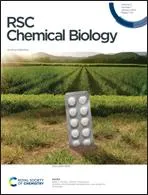

Cyclic peptide drugs approved in the last two decades (2001–2021)
Literature Information
Publication Date
2021-11-05
DOI
10.1039/D1CB00154J
Impact Factor
0
Authors
Huiya Zhang, Shiyu Chen
View Original
Abstract
In contrast to the major families of small molecules and antibodies, cyclic peptides, as a family of synthesizable macromolecules, have distinct biochemical and therapeutic properties for pharmaceutical applications. Cyclic peptide-based drugs have increasingly been developed in the past two decades, confirming the common perception that cyclic peptides have high binding affinities and low metabolic toxicity as antibodies, good stability and ease of manufacture as small molecules. Natural peptides were the major source of cyclic peptide drugs in the last century, and cyclic peptides derived from novel screening and cyclization strategies are the new source. In this review, we will discuss and summarize 18 cyclic peptides approved for clinical use in the past two decades to provide a better understanding of cyclic peptide development and to inspire new perspectives. The purpose of the present review is to promote efforts to resolve the challenges in the development of cyclic peptide drugs that are more effective.
Related Literature
Local rotational symmetry in the packing of uniform spheres
Z. A. Tian, K. J. Dong, A. B. Yu
2017-05-10
Paper
DOI: 10.1039/C7CP01152K
Visualization of structural evolution and phase distribution of a lithium vanadium oxide (Li1.1V3O8) electrode via an operando and in situ energy dispersive X-ray diffraction technique
Qing Zhang, Andrea M. Bruck, David C. Bock, Jing Li, Varun Sarbada, Eric A. Stach
2017-05-03
Paper
DOI: 10.1039/C7CP02239E
Electron stimulated desorption from condensed pyrimidine and pyridazine
L. Ellis-Gibbings, A. D. Bass, P. Cloutier, G. García, L. Sanche
2017-04-28
Paper
DOI: 10.1039/C7CP00715A
Back-exchange: a novel approach to quantifying oxygen diffusion and surface exchange in ambient atmospheres
Samuel J. Cooper, Mathew Niania, Franca Hoffmann, John A. Kilner
2017-04-27
Paper
DOI: 10.1039/C7CP01317E
Modulation of the electronic and mechanical properties of phagraphene via hydrogenation and fluorination
Houyang Chen
2017-02-28
Paper
DOI: 10.1039/C6CP08621G
Structural control of side-chain chromophores to achieve highly efficient electro-optic activity
Zhuo Chen, Jialei Liu, Hongyan Xiao, Zhen Zhen, Xinhou Liu
2017-03-31
Paper
DOI: 10.1039/C7CP01582H
A thermodynamic model to predict electron mobility in superfluid helium
Frédéric Aitken, Ferdinand Volino, Luis Guillermo Mendoza-Luna, Klaus von Haeften, Jussi Eloranta
2017-05-23
Paper
DOI: 10.1039/C7CP03067C
Acceptor doping in the proton conductor SrZrO3
Leigh Weston, A. Janotti, X. Y. Cui, C. Stampfl, C. G. Van de Walle
2017-04-12
Paper
DOI: 10.1039/C7CP01471F
Modeling DNA oxidation in water
Amedeo Capobianco, Alessandro Landi, Andrea Peluso
2017-05-03
Paper
DOI: 10.1039/C7CP02029E
You might also like
Compound Q&A
How should waste containing N-Methoxy-N-methyl-1,3-thiazole-5-carboxamide (CAS: 898825-89-3) be handled?
Waste containing N-Methoxy-N-methyl-1,3-thiazole-5-carboxamide (CAS: 898825-89-3...
898825-89-3N-Methoxy-N-methyl-1...
Compound Q&A
How should N-(4-Biphenylyl)dibenzo[b,d]furan-4-amine (CAS: 1318338-47-4) be stored?
N-(4-Biphenylyl)dibenzo[b,d]furan-4-amine should be stored in a tightly sealed c...
1318338-47-4N-(4-Biphenylyl)dibe...
Compound Q&A
What is the market or research trend for 3-Acetamido-5-amino-2,4,6-triiodobenzoic acid (CAS: 1713-07-1)?
The market for 3-Acetamido-5-amino-2,4,6-triiodobenzoic acid (CAS: 1713-07-1) is...
1713-07-13-Acetamido-5-amino-...
Compound Q&A
How should Benzyl 2-O-acetyl-3,4,6-tri-O-benzyl-beta-D-galactopyranoside (CAS: 61820-03-9) be stored?
Benzyl 2-O-acetyl-3,4,6-tri-O-benzyl-beta-D-galactopyranoside (CAS: 61820-03-9) ...
61820-03-9Benzyl 2-O-acetyl-3,...
Compound Q&A
What regulatory guidelines apply to 2-Ethylpiperazine dihydrochloride (CAS: 438050-52-3)?
2-Ethylpiperazine dihydrochloride (CAS: 438050-52-3) is regulated under the Glob...
438050-52-32-Ethylpiperazine di...
Compound Q&A
What regulatory guidelines apply to 1,1'-[1,3-Phenylenebis(methylene)]bis(3-methyl-1H-pyrrole-2,5-dione) (CAS: 119462-56-5)?
1,1'-[1,3-Phenylenebis(methylene)]bis(3-methyl-1H-pyrrole-2,5-dione) (CAS: 11946...
119462-56-51,1'-[1,3-Phenyleneb...
Compound Q&A
Are there alternatives to 5-Fluoro-2-(1-pyrrolidinyl)pyridine (CAS: 1287217-79-1) in synthesis?
Several alternatives can be used in the synthesis of 5-Fluoro-2-(1-pyrrolidinyl)...
1287217-79-15-Fluoro-2-(1-pyrrol...
Compound Q&A
What precautions should be taken when handling 1-((2R,3R,4R,5R)-5-((bis(4-methoxyphenyl)(phenyl)methoxy)methyl)-4-hydroxy-3-methoxytetrahydrofuran-2-yl)-5-methylpyrimidine-2,4(1H,3H)-dione (CAS: 153631-19-7)?
Proper personal protective equipment (PPE) must be worn when handling this compo...
153631-19-71-((2R,3R,4R,5R)-5-(...
Compound Q&A
What precautions should be taken when handling 6-Bromoimidazo[1,2-a]pyridin-8-amine (CAS: 676371-00-9)?
When handling 6-Bromoimidazo[1,2-a]pyridin-8-amine, it is important to wear appr...
676371-00-96-Bromoimidazo[1,2-a...
Compound Q&A
Are there alternatives to (2S,4R)-4-(4-Nitrobenzyl)pyrrolidine-2-carboxylic acid hydrochloride (CAS: 1049740-22-8) in synthesis?
Alternatives to (2S,4R)-4-(4-Nitrobenzyl)pyrrolidine-2-carboxylic acid hydrochlo...
1049740-22-8(2S,4R)-4-(4-Nitrobe...
Source Journal
Recommended Compounds




Recommended Suppliers



Disclaimer
This page provides academic journal information for reference and research purposes only. We are not affiliated with any journal publishers and do not handle publication submissions. For publication-related inquiries, please contact the respective journal publishers directly.
If you notice any inaccuracies in the information displayed, please contact us at support@chemtradehub.com. We will promptly review and address your concerns.